

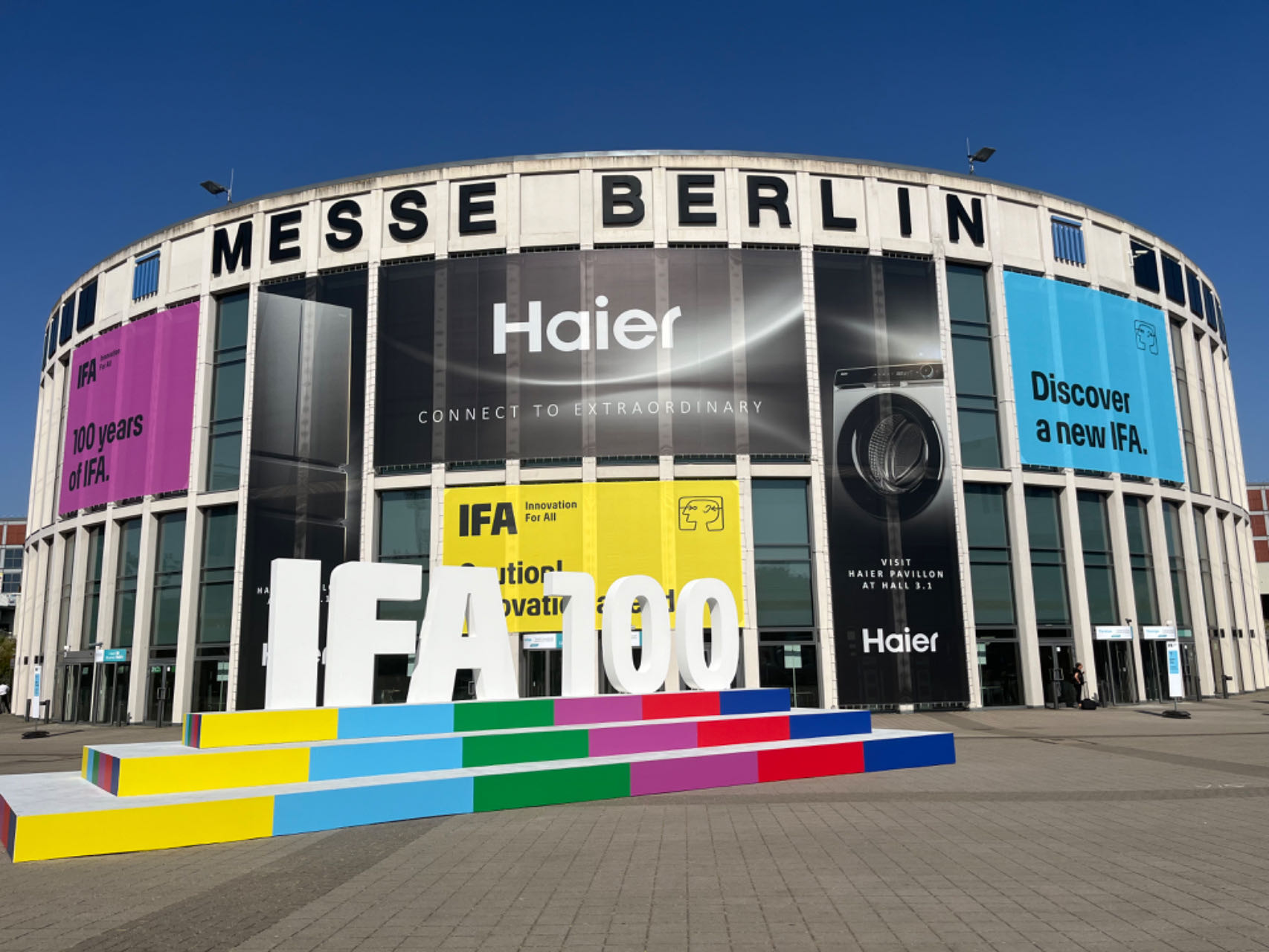
The recently concluded Berlin IFA has become a grand stage for Chinese tech brands.
Official data shows that the 2024 IFA had 2,200 exhibitors from 139 countries/regions, with Chinese companies accounting for 67%. Almost every exhibition hall featured Chinese exhibitors.
"I was surrounded by Chinese people, and I hardly spoke any English throughout the event," a representative from a Chinese company attending the IFA told TMTPost Outbound Reference.
The 2024 IFA marks its centennial anniversary. Initially, IFA was a "radio exhibition" focused on radio technology, but it has since evolved into an international exhibition influencing the home appliance and smart home sectors.
As one of the world's three major consumer electronics exhibitions, IFA primarily showcases cutting-edge products in the home appliance industry. In recent years, its scope has gradually expanded to become a "tech grand stage" for various home-related scenarios. In addition to home appliance brands, smart home, tech health, and new energy brands are also active at IFA. IFA is also the most important gateway for global home consumer electronics brands to enter the European market.
In this century-spanning "grand stage," IFA has witnessed the rise of Chinese home appliance brands and the "development status" of brands at different stages.
In the current era where AI large models are reshaping the tech industry, leading Chinese brands can compete with established international home appliance brands like Bosch, Siemens, LG, and Samsung. Emerging brands are becoming the most promising "seed players" for the next generation of global brands, while also facing the greatest uncertainties. OEM (original equipment manufacturer) companies, while providing stable high-quality products, aspire to create their own brands.
Competing with Traditional International Brands in AI
As an excellent showcase platform for global home appliance brands, the major exhibition spaces at this year's IFA remained largely unchanged.
Samsung continues its 2023 style, investing heavily to exclusively occupy one pavilion; Haier Smart Home once again secured a luxurious booth of 3,300 square meters at the forefront of the venue; German home appliance representatives Siemens and Bosch still compete in the "golden pavilion" 1.1.
Overall, German brands lacked impressive innovative products. In contrast, large home appliance companies from Korea, such as Samsung, and from China, such as TCL, Hisense, Changhong, Haier, and Midea, attracted a lot of attention with their smart and green products.
Samsung's AI refrigerator is equipped with cameras and CV to provide personalized insurance for food; Changhong launched the Canghai Intelligence AI TV and the "Zhihui Home" vertical large model for white goods, proposing AI home appliance concepts like "thousands of foods, thousands of faces" and "thousands of people, thousands of faces"; Hisense TV features a built-in large model, combined with self-developed chip, screen, and light full-chain technology, for deep picture quality optimization in gaming, sports, and movie-watching scenarios. The display of Hisense TV in collaboration with the official "Black Myth: Wukong" attracted a continuous stream of visitors.
In recent years, the European market has grown slowly, but the entire European market has a large consumption volume and a high consumption structure, offering greater value-added and differentiation opportunities in brands, products, and services.
Driven by high profits, seeking new growth in European and American markets is the goal of many Chinese companies. In the past, to enter the European market, many large home appliance companies opened the market by acquiring local home appliance brands.
At this exhibition, these companies showcased their strength by collaborating with their multinational acquisition brands. For example, Midea brought the American vacuum cleaner company EUREKA; Shark and Ninjia are backed by investments from Joyoung's major shareholders; Skyworth Group brought the German high-end TV brand Metz, which even attracted German Chancellor Scholz to the booth...
More importantly, Chinese home appliance brands are no longer going overseas with "good quality and low price" but have achieved high-end positioning.
For instance, at the IFA exhibition, Haier showcased several high-end home appliance products with innovative technologies: the X11 series washing machine with a fresh air function and the CUBE 90 series9 refrigerator with Fresher Techs energy-saving technology.
In Germany, Haier's high-end refrigerators can sell for up to 2,999 euros (about 24,000 RMB); in the UK, Haier's high-end washing machines sell for 849 pounds (about 7,914 RMB).
At the IFA exhibition, Chinese brands attracted a large number of visitors with their innovative products, not only representing the recognition of Chinese home appliance companies in Europe but also indicating that the R&D and manufacturing levels of Chinese home appliance companies are now capable of competing with traditional Japanese and Korean brands like Samsung, LG, Sony, and Toshiba.
China's Emerging Global Brands' "Three Horse Carriages"
At the exhibition, a sweeping robot capable of easily crossing 4cm obstacles attracted a crowd. This is the latest bionic dual mechanical foot high obstacle-crossing technology from Dreame, which can cross thresholds and steps, greatly enhancing cleaning coverage and efficiency.
From integrated sweeping and mopping, high-speed motors (solving the problem of incomplete cleaning), bionic mechanical arms to bionic dual mechanical arms (addressing issues of corners and high obstacles), Dreame has consistently held the top sales spot in the German market for 11 consecutive months since October last year.
In the niche market of cleaning appliances, a group of Chinese brands such as Ecovacs, Dreame, Laifen, EcoFlow, and Narwal have carved out a path in the European and American markets.
Take Narwal as an example, its shipment volume in the second quarter of 2024 increased by 121.7% year-on-year, and its overseas market sales in the first half of 2024 increased by 750% year-on-year, making it the fifth in the German high-end smart sweeping robot market and among the top three in the Italian market.
"Rolling" technology, "competing" in manufacturing, and "understanding" marketing are the three horse carriages driving their rapid rise in overseas markets.
Laifen, which sells hair dryers and electric toothbrushes globally, and Dreame, which holds the top spot in the German market with its sweeping robots, are brands driven by "strong technological iteration." These brands originate from precise insights into unmet needs.
Looking at Dreame's product development history, from the first S10 fully automatic vacuum cleaner meeting the need for automatic cloth cleaning to addressing corner cleaning with bionic mechanical arm technology, each product iteration has accurately grasped user pain points.
Laifen, on the other hand, broke through the bottleneck of electric toothbrushes with a servo motor, achieving precise large amplitude sweeping vibrations that simulate the Bass brushing method, solving the problem of sonic toothbrushes not cleaning thoroughly.
"Whether you can mass-produce one generation, develop one generation, and predict one generation is the standard for measuring the technological leadership of tech products," said Jiang Junqian, R&D Director of Laifen. Laifen's significant investment in R&D is the premise for ensuring leadership.
However, cutting-edge R&D technology alone is not enough; it needs to be validated through mass production. To achieve product excellence, Laifen abandoned the original OEM production model, built its own manufacturing plant, introduced automated equipment, adopted more efficient system software, and recruited a large number of top talents, achieving global market supply with a domestic supply chain.
ChaseDream adopts differentiated environmental testing, focusing on testing products in high-temperature and high-humidity environments in the Southeast Asian market, extreme low-temperature environments in the Russian market, and targeted testing for carpet cleaning in the U.S. market to meet the diverse needs of different markets.
After overcoming manufacturing obstacles, marketing presents another challenge. The differences in marketing between domestic and overseas markets are significant. In China, content is primarily distributed through KOLs or large social media accounts, while traditional media still dominate overseas markets.
Differentiated marketing in local markets is the last mile in forming a product market closed loop. To this end, like many emerging brands, ChaseDream has chosen sports marketing, partnering with Borussia Dortmund Football Club and Inter Milan Club to increase brand awareness.
By the end of this year, ChaseDream plans to open offline flagship stores to quickly establish a local user mindset. Laifen, which is also moving towards globalization through the "big single product explosion" strategy, is deeply cultivating mainstream offline channels in the European and American markets.
"Even with traditional brands leading the way, entering offline for the first time is still very challenging. The key point in entering this market is not the product and price, but more about the channel buyers being unfamiliar with you and not understanding quality control. Moreover, many mature products have already entered, so breaking in requires more differentiated products. Finally, they will also observe e-commerce performance, such as whether reviews are positive, whether quality is stable, and whether consumers like it," said Jennifer, head of Laifen's overseas market.
In a red ocean market of low-price competition, the new generation of Chinese cleaning appliance brands is carving a path to globalization through technological innovation. Their focus is always on how to explore and meet user needs.
The New Ecosystem of "Soft and Hard Coordination" Going Overseas
Just as Apple's prosperity is inseparable from the prosperity of the iOS content ecosystem, the rapid overseas development of Chinese smart home appliances is also propelling TV system and content ecosystem companies forward.
"After hardware reaches a certain extreme, the demand for large screens shifts to the pursuit of high-end intelligence and the richness of the content ecosystem, as well as the enjoyment and satisfaction of consuming content," said Li Jing, Vice President of Coocaa Technology, at the IFA exhibition in an interview with TMTPost Focus. This is precisely the demand base for the rapid global development of the Coolita global large-screen smart system.
According to market research reports and related statistics, the global smart TV shipment volume in 2023 decreased by 5.5% year-on-year, but it is expected to slowly recover starting in 2024. In the first half of this year, global TV shipments (including smart TVs) reached 90.717 million units. It is estimated that from 2023 to 2027, the compound annual growth rate (CAGR) of global smart TV shipments will be 3.3%.
With the popularization and application of ultra-high-definition TVs, projectors, laser TVs, and the development of 5G technology and artificial intelligence, the global audiovisual industry market continues to maintain a growth trend. For example, the global subscription video on demand (SVoD) market revenue is continuously increasing, expected to reach $108.5 billion in 2024 and $137.7 billion by 2027, with a compound annual growth rate of 8.27%. The global audiovisual production solutions market size is expected to reach $36,520 million by 2030, with a compound annual growth rate of 5.3% over the next six years.
OTT (Over-The-Top) industry is one of the main forms of the audiovisual industry, and global OTT is at different stages of development.
In recent years, mainstream consumers in the European and American markets have quickly chosen CTV (Connected TV) to watch content. According to eMarketer data, by 2025, American adults will spend more than an hour more watching digital video content than traditional TV. The Southeast Asian market is still in the early stages, experiencing what China went through ten years ago.
"We can take the experience of domestic development to expand overseas markets." Li Jing said.
Coolita AIOS, exhibited by Coocaa Technology at IFA, is launched based on the problems verified domestically, such as difficulty in finding content and the diversification and fragmentation of entertainment forms. It provides personalized viewing and home entertainment experiences through AI technology, such as generating high-quality picture books and immersive music through AIGC capabilities, expanding more home entertainment scenarios.
Currently, Coocaa has served more than 80 countries and regions worldwide and has supported the content ecosystem construction of many Chinese brands going overseas, such as Transsion. In this process, it has built the capability of content ecosystem construction across regions, brands, and terminals, providing technical support to overseas operators in countries like India and Indonesia.
However, Coocaa Technology has also encountered difficulties. Different regions have different standards for content and information security requirements, requiring different services for different countries. To this end, Coocaa Technology has established its own localized ecosystem and AI operation platform.
Besides bringing a global upgrade to the audiovisual industry, Coolita is also a new touchpoint for assisting Chinese brands in entering the global market. According to Coocaa, besides set-top boxes and TVs, Coolita will also enter industries related to display screens, such as new energy vehicles, connecting more hardware ecosystems to go overseas.
At the same time, as the most important device end of OTT, CTV, due to its "completely independent of cookies" and "no need for users to log in repeatedly" authentication environment, has become one of the best identity verification solutions in the post-cookie era for the advertising industry and an important brand display channel for many brands entering the European and American markets.
According to The Trade Desk's "2024 Annual Connected TV (CTV) Report," approximately 65% of respondents consider CTV advertising a "must-buy" option, making it more popular than all other forms of video advertising, including social video. The rapid expansion of CTV media resources and the swift development of programmatic technology are making it a crucial battleground for brand marketing. eMarketer predicts that by 2027, CTV will account for 47% of total TV ad spending.
With the overseas expansion of smart hardware, Chinese content ecosystem companies will encounter new development opportunities abroad.
Brands, Trends, and Challenges in the New Era of Foreign Trade
"Brand building is something most Chinese manufacturers lack. They usually bring market-leading products but lack brand stories and recognition to reach consumers," said Li Jing, Vice President of Coocaa Technology, to TMTPost Focus.
Li Jing's statement aptly describes the current awkward situation of Chinese manufacturing going global.
In addition to exploring new technological tracks, "nearly half of OEM companies are actively seeking brand upgrades," said Angel Liu, Senior Vice President of Customer Service, Marketing, and Business Analysis at Global Sources, to TMTPost Focus.
As the official operator of the IFA global market, Angel Liu observed that the proportion of Chinese companies among IFA exhibitors is increasing yearly, and the structure of these exhibitors is also changing. In the transition from foreign trade to brand globalization, OEM suppliers show a strong willingness to transform: half of the OEM suppliers are considering starting from scratch to study brand globalization, and 30% of OEM suppliers have already begun building brand systems.
Many OEM companies once relied on the advantages of the Chinese supply chain to achieve breakthroughs in the European market. However, as market competition intensifies, companies must comprehensively enhance their capabilities, focusing on technological innovation, product compliance, and reaching consumers both online and offline for sustainable long-term development.
For instance, OEM manufacturers often enter the European market through offline distribution channels, lacking direct contact with end consumers, making it difficult to obtain first-hand user feedback. This poses significant obstacles to essential brand activities such as market demand insights, matching demand pain points, and conducting marketing communications. This situation is vastly different from traditional foreign trade methods.
In the new era of foreign trade, helping companies build offline channels while guiding them to use data to gain real demand insights and leveraging online influence to drive offline channel penetration is one of the key business areas that Global Sources is actively promoting.
Liu Anqi stated, "Transforming from OEM (Original Equipment Manufacturer) to ODM (Original Design Manufacturer) or OBM (Original Brand Manufacturer) involves a lot of work that needs to be completed urgently, including technical management experience training, product upgrades, market research, and brand promotion."
In her view, the most critical aspect is to fully and deeply understand the needs, culture, and competitive environment of the target market. For example, procurement needs vary from country to country. In Europe, environmental protection and carbon reduction compliance are top priorities, while in the Middle East, procurement focuses more on quality and new technology. Additionally, careful consideration is needed on how to shape the brand image and reach users.
Technology-driven new-generation Chinese brands are rushing to the world stage. This is not a breakthrough of a single technology but a comprehensive result of the combined effects of core technology, manufacturing supply chain upgrades, and marketing upgrades.
In the new era of trade, Chinese brands going global are forming their own ways to communicate with the world.
(This article was first published on TMTPost App, Author|Yang Xiujuan, Editor|Luo Wenqin, Wang Lu)