

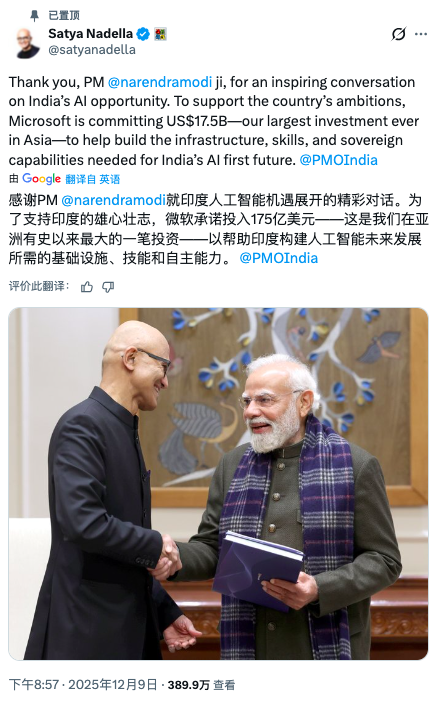
Microsoft CEO Satya Nadella announced on Tuesday via X that the company is committed to investing $17.5 billion to help India build the infrastructure, develop skills, and foster independent capabilities needed for the future of artificial intelligence.
Nadella made this announcement after meeting with Indian Prime Minister Modi on the same day. The Indian-origin leader of the world's fourth most valuable company stated that this marks Microsoft's largest-ever investment in Asia.
This investment will be rolled out gradually between 2026 and 2029. According to Microsoft, the focus of the investment is on constructing AI infrastructure, with hyperscale data centers at its core. Notably, Microsoft’s data center in Hyderabad, the capital of Telangana, is expected to become operational in mid-2026, and will be the company’s largest data center in India once completed.
Global investments drive Microsoft’s renewed AI strategy
According to the official Microsoft press release, Nadella’s meeting with Modi was described as “the beginning of Microsoft’s India AI journey.” However, in reality, Nadella had already announced a $3 billion investment plan during his visit to India in January this year.
In less than a year, the investment amount has soared to $17.5 billion—surpassing Microsoft’s AI investments announced in sovereign countries like Portugal, the UAE, and Canada over the past year.
With this latest investment pledge, Microsoft has stated its intention to equip 20 million people in India with essential AI skills by 2030 and to create job opportunities locally. At the same time, Microsoft will support the development of digital government platforms in India through AI technology, launch Sovereign public and private cloud services for Indian customers, and open up Copilot local data processing services, helping India build digital sovereignty solutions.
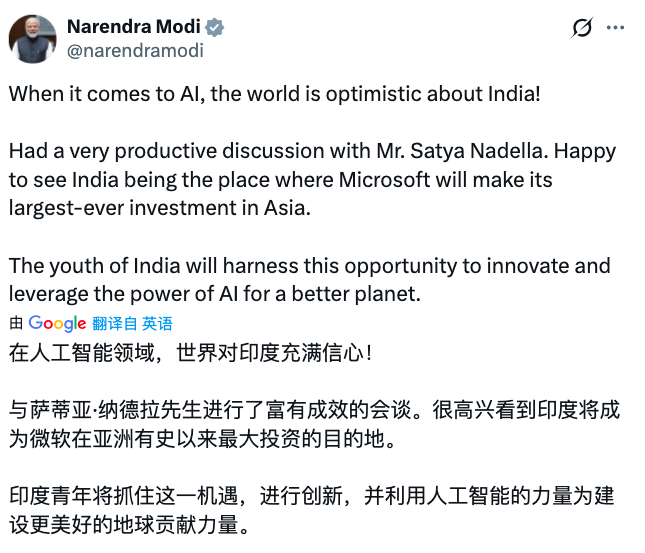
After Nadella’s post, Modi responded on social platforms, stating, “The world has great confidence in India when it comes to artificial intelligence.” He added, “India’s youth will seize this opportunity to innovate, and use the power of AI to help build a better planet.”
It's no surprise that Microsoft is doubling down on its AI business in India.
The company has been in the Indian market for over thirty years, with an extensive business presence and a local workforce of more than 22,000 employees. From cloud computing to artificial intelligence, Microsoft values India for its favorable policies, labor cost advantages, established IT and internet industries, as well as its strategic geographic position.
Since last year, Microsoft has carried out several rounds of global layoffs, affecting nearly 20,000 employees. However, its Indian subsidiary has repeatedly received exemptions from these cuts. As Microsoft’s overseas AI investments soar and its capital expenditure targets $100 billion by 2026, India has once again become Microsoft’s top choice in Asia.
It’s worth noting that this major investment comes as Microsoft is re-evaluating its strategic transformation.
According to a report from Business Insider, an internal Microsoft memo reveals that Satya Nadella is driving the company to rethink its business model in the era of AI. To support this effort, he has appointed Rolf Harms, who was instrumental in developing Microsoft's cloud business, as AI Economics Advisor.
The report indicates that this move aims to completely overhaul the company’s AI strategy, much like the transformation that took place during the cloud era.
Although specific reform measures have yet to be disclosed, based on Nadella’s recent speeches and conversations—especially those with OpenAI CEO Sam Altman, and Stripe co-founder John Collison—key focus areas include infrastructure, scaling, a “factory” software ecosystem for agents, overseas business expansion, and empowering enterprises (even entire countries) to establish “digital sovereignty” via private clouds.
Nadella has also repeatedly emphasized that Microsoft’s global investments are about “bringing the best of American technology to the world, enabling countries and businesses to innovate based on trust”—and he stresses that this approach benefits both the long-term development of the U.S. and Microsoft itself.
Earlier, a report from KeyBanc analyzed that Microsoft remains the most strategically significant AI software service provider at present, with a Copilot AI platform usage rate as high as 76%. It is expected that continuous increases in capital expenditure will bring even greater returns for the company.
By making major investments in India—a market with a vast internet and IT infrastructure base and considered to have enormous growth potential—Microsoft may be able to further solidify its position within the AI industry ecosystem.
Google and Nvidia Also Eye the Indian AI Market
On the same day as his meeting with Satya Nadella, Modi also met with Intel CEO Pat Gelsinger and Cognizant CEO Ravi Kumar S.
According to The Times of India, Modi emphasized during the discussions the government’s strong commitment to attracting foreign investment into strategic sectors such as artificial intelligence, semiconductors, and digital infrastructure.
Meanwhile, Intel signed a memorandum of understanding with India’s Tata Group to collaborate in the semiconductor sector. In a statement, Intel said it is further exploring rapid expansion of AI PC solutions in the fast-growing Indian market, aiming to reinforce its plan to position India as a major hub for the company’s future technology strategy.
So far, the list of tech giants interested in the Indian market does not end there.
According to Bloomberg, Nvidia CEO Jensen Huang and Google DeepMind CEO, 2024 Nobel Chemistry Laureate Demis Hassabis, are both planning to visit India next year.
Google, in particular, is noteworthy. Its CEO Sundar Pichai, like Satya Nadella, is of Indian descent. In October this year, Pichai announced Google would invest $15 billion in India over the next five years, including building its largest data center outside the United States.
Recently, Google, through Indian telecom giant Reliance Jio, offered 500 million users 18 months of free access to Gemini 2.5 Pro, aiming to quickly expand its market share and boost user adoption rates.
Additionally, Google has also invested in numerous Indian AI startups, with intentions to integrate them into its own AI ecosystem.
Similarly, this year Amazon announced a $12.7 billion investment over five years in India for local cloud and AI infrastructure development. OpenAI, which has close ties to Microsoft, launched a year-long free ChatGPT Go subscription service in India this November and plans to build a data center in the country.
For tech giants, India’s massive population not only represents a new market opportunity but also a potential training ground for artificial intelligence. The country boasts an abundant reserve of tech professionals and comparatively low average labor costs, making it an appealing investment destination.
For the Indian government, AI has already been recognized as a crucial strategic frontier for future development. However, initiatives promoted by Prime Minister Modi, such as the "India AI mission," have yet to deliver significant results, making the attraction of US technology and capital a clear path to breaking through current limitations.
According to projections from consulting firm Colliers, India’s data center capacity is expected to more than triple within the next five years. The National Association of Software and Service Companies (NASSCOM) also mentioned in a recent forecast that the scale of India’s AI market could grow to $1.7 billion by 2027, nearly three times its current size.