

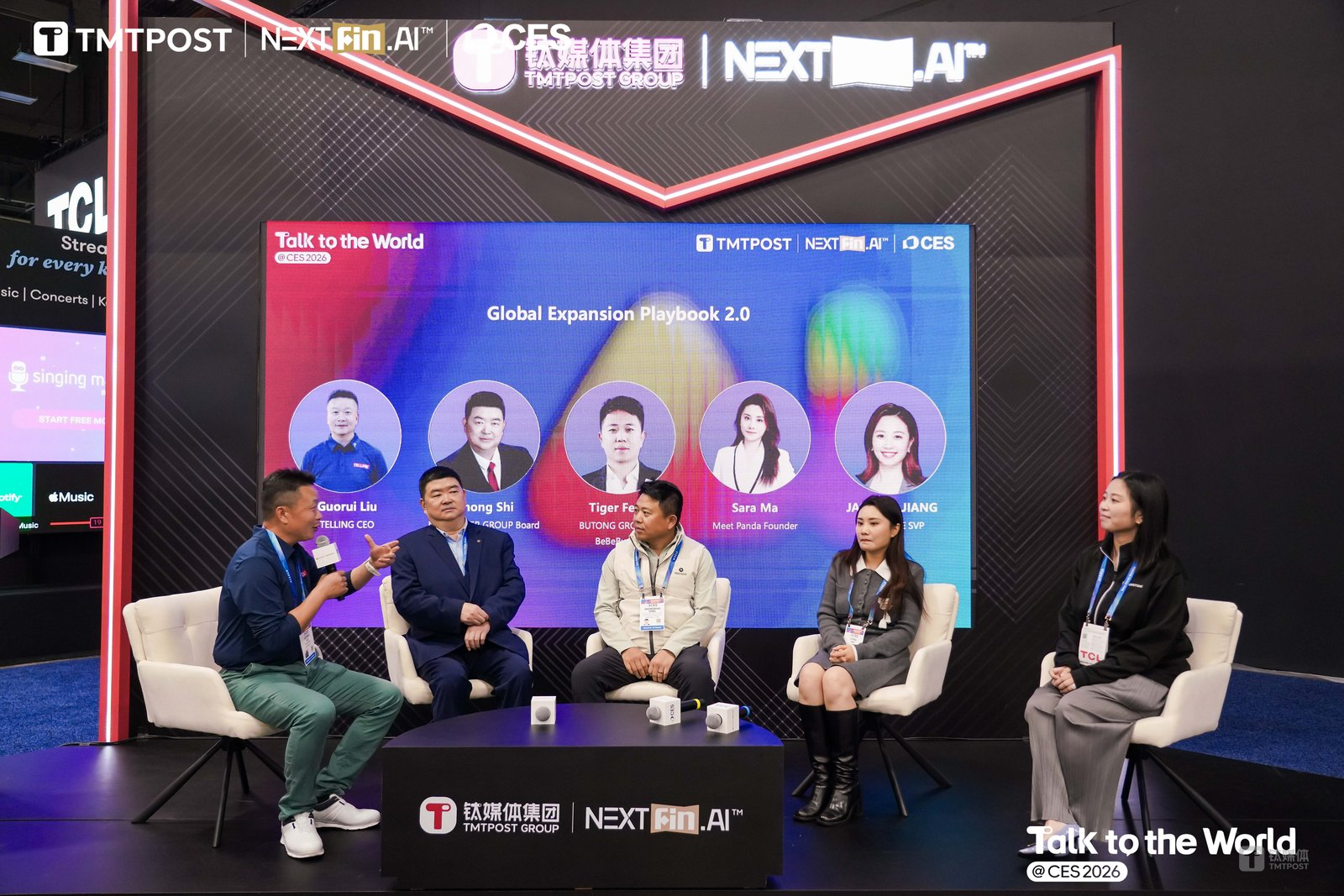
As Chinese companies push deeper into overseas markets amid shifting geopolitics, trade barriers and slowing global growth, executives and investors say the country’s international expansion drive has entered a more pragmatic and complex second phase.
Since 2022, when “going global” became a defining phrase for corporate growth in China, companies across manufacturing, consumer goods and services have accelerated their overseas ambitions. Nearly four years on, many say the initial phase — marked by rapid market entry, aggressive pricing and platform-led exports — is giving way to a more localized, partnership-driven and brand-focused strategy known among executives as “Going Global 2.0.”
Speaking at a roundtable discussion hosted by TMTPost at the CES 2026 technology show in Las Vegas, industry leaders said Chinese firms are increasingly reassessing where and how they expand, as tariffs, regulatory hurdles and rising competition reshape global markets.
“Going global today is no longer about speed alone,” said Shi Jihong, chairman of Newcom Group, a Zhejiang-based luggage manufacturer with three decades of export experience. “It’s about finding the right markets, the right partners, and the right positioning.”
Shi, whose company has long supplied global luggage brands as an original equipment manufacturer (OEM), said trade frictions and tariffs in recent years have prompted many Chinese exporters to rethink their heavy reliance on developed markets.
“In the past, Europe and North America were the obvious first choices,” Shi said. “But after tariffs were imposed, many companies began to seriously explore emerging markets.”
Shi believes that countries across the Middle East, Africa and parts of Asia now present growing opportunities for Chinese brands, particularly in the consumer goods segment. He described the strategy as “encircling the cities from the countryside” — a reference to entering less-saturated markets before challenging established players in major economies.
“In many of these markets, the middle class used to prefer European and American brands,” Shi said. “But now Chinese brands, with reliable quality and competitive pricing, are becoming viable alternatives.”
Newcom Group, which began as an OEM supplier to brands such as Samsonite, has taken steps to move up the value chain. In 2018, it acquired German luggage brand AIRLINE, and has since worked to expand its own brand portfolio overseas.
Shi said the company has also leveraged Dubai as a regional hub, using trade exhibitions, overseas warehouses and cross-border e-commerce platforms to help Chinese brands reach markets along China’s Belt and Road corridors.
“Dubai allows us to connect Chinese manufacturers directly with buyers from Asia, Africa and Europe,” he said. “It’s a gateway.”
While emerging markets offer growth potential, executives said success increasingly depends on deep localization and partnerships with local players — a shift from earlier approaches that relied heavily on exporting China-made products with minimal adaptation.
Tiger Feng, vice president of Butong Group, a Chinese consumer technology company that listed in Hong Kong in 2025, said his company’s overseas expansion strategy evolved significantly after extensive travel across Southeast Asia, the Middle East, Europe and North America.
“At first, we thought about setting up offices and teams on our own,” Feng said. “But we soon realized that without deep local understanding, efficiency suffers.”
Instead, Butong Group opted for partnerships with established local firms. In South Korea, Feng said the company formed a joint venture with a local partner that handles market research, regulatory compliance and front-end operations, while Butong focuses on supply chain management, industrial design and branding.
“They understand consumer preferences, laws and channels,” Feng said. “We bring manufacturing strength and product innovation. This division of labor works much better.”
Butong’s flagship brand, BeBeBus, focuses on premium mother-and-baby products, including strollers, cribs and car seats. Feng said localization extends beyond language and marketing to product design itself.
“Products that sell well in China don’t always work in the U.S. or Europe,” he said. “You have to adapt.”
For service-oriented businesses, digital platforms — particularly social media — are playing an increasingly central role in overseas growth.
Sara Ma, founder of MeetPanda, a Las Vegas-based platform catering to foreign travelers visiting China, said her company relies heavily on content-driven customer acquisition.
“Social media is one of the most powerful tools for reaching global audiences today,” Ma said.
MeetPanda operates more than 50 social media accounts across platforms such as TikTok, producing content on Chinese food, culture, cities and travel experiences. The goal, Ma said, is to present a different image of China — one seen through the lens of younger generations.
“We’re not just selling travel services,” she said. “We’re telling stories.”
Ma said MeetPanda spent two years researching overseas travelers’ preferences, spending power and decision-making patterns before refining its product strategy. The platform centers on connecting travelers with local Chinese guides, a model designed to differentiate it from traditional tour operators.
“You find the guide first, and then solve everything else,” she said.
For investors backing Chinese companies expanding abroad, branding and product-market fit have become key criteria.
Jasmine Jiang, senior vice president at Akashi Management Fund, a Los Angeles-based investment firm, said many Chinese products perform well on short-video platforms but lack long-term brand strategy.
“Some products can sell millions of units on TikTok,” Jiang said. “But that doesn’t necessarily mean they’ve built a brand.”
Akashi focuses on supporting small and medium-sized businesses entering the U.S. market, providing not only capital but also local resources and guidance. Jiang said sustainable overseas growth depends on whether consumers are genuinely willing to pay for a product over time.
“That’s what product-market fit really means,” she said. “When people find your product useful and are willing to spend money on it.”
Jiang added that companies must integrate into local ecosystems — including distribution channels, regulatory frameworks and consumer culture — rather than relying solely on low-cost advantages.
The CES technology show provided a backdrop for the discussion, with participants noting that innovation themes have shifted from futuristic concepts to practical applications.
“A few years ago, AI and robotics were mostly conceptual,” said Liu Guorui, founder and CEO of Tianyin Go Global, who moderated the roundtable. “Now it’s about real-world impact.”
Executives said CES remains valuable not only as a showcase for technology but also as a networking hub for partnerships, investment and collaboration.
Jiang said face-to-face meetings at CES often yield more value than the exhibition floor itself. Ma described the event as a mix of “awareness, networking and reflection,” noting that exposure to competing products helps companies reassess their own offerings.
Feng said CES reinforced two priorities for his company: brand and artificial intelligence.
“Brand is not just a label,” he said. “It’s the value you deliver to users. And AI should ultimately make products simpler and more convenient.”
Shi said he attended CES with three perspectives — buyer, service provider and supplier — reflecting how Chinese manufacturers are repositioning themselves in global value chains.
Newcom Group, he said, is exploring partnerships with startups and specialized firms developing smart technologies that could be applied to luggage products, such as smart weighing systems.
“Even if their products don’t directly match ours, the underlying technologies can,” Shi said.
He added that Chinese manufacturers’ broad and complex supply chains give them an advantage in supporting innovation.
“Our supply chain involves more material categories than even the automotive industry,” he said. “That creates opportunities for collaboration.”
Despite differing business models, participants agreed that Going Global 2.0 requires patience, adaptability and long-term commitment.
“Brand influence isn’t built overnight,” Shi said. “If consumers just say, ‘It’s not bad,’ that doesn’t mean they’ll buy it.”
As Chinese companies navigate geopolitical uncertainty and rising competition, executives said overseas expansion is becoming less about rapid conquest and more about sustainable presence.
“The question now,” Jiang said, “is not whether you can go global — but whether you can stay global.”