

While humanoid robots continue to capture headlines with choreographed dances and viral demonstrations, a quieter shift is taking place away from the spotlight. A growing number of industry executives and investors say the real inflection point for embodied artificial intelligence will not come from showmanship, but from robots that can work — reliably, repeatedly and at scale.
That shift, participants agreed at a CES roundtable this month, sets the stage for 2026 to become the first year in which “operational robots” are commercially deployed across factories, hotels and other real-world environments.

Chen Liang, Founder of Mars Booster

Jin Ge, Founder and CEO of Dexteleop Intelligence
“Most robots today are still performing on stage,” said Jin Ge, founder and chief executive of Dexteleop Intelligence. “But 2026 will be the inaugural year for work robots — machines that generate real economic value in practical scenarios.”
Yang Zhangxin, Founder of TourMind

Jase Qiang, Founding Member of HTC VIVE Robotics

Shi Chenxing, Lenovo Capital
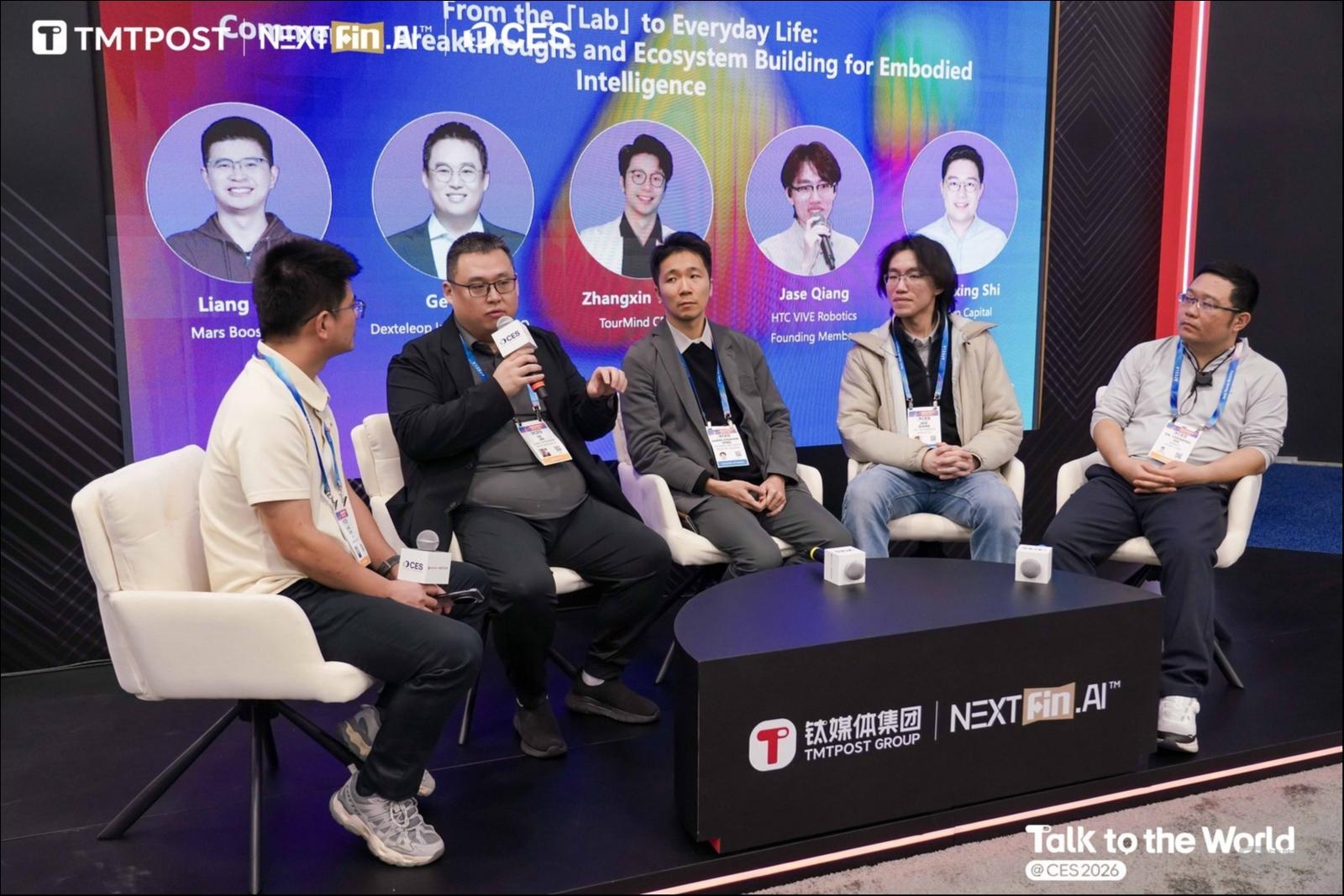
The discussion, moderated by Chen Liang, founder of robotics community Mars Booster, brought together founders, corporate executives and investors from across China’s embodied intelligence ecosystem, including Yang Zhangxin of TourMind, Jase Qiang of HTC VIVE Robotics, and Shi Chenxing of Lenovo Capital.
Their consensus reflects a broader recalibration underway in robotics, as hype around general-purpose humanoids gives way to more pragmatic approaches focused on narrow tasks, data accumulation and near-term returns.
Embodied intelligence — the fusion of AI with physical machines capable of perception, manipulation and movement — has surged to the forefront of China’s technology agenda over the past two years. Early 2025 was marked by basic walking demonstrations; by year-end, robots were appearing at concerts and exhibitions, fuelling public fascination and investor interest.
Yet speakers at the roundtable drew a sharp distinction between spectacle and substance.
“There is a fundamental divide emerging,” said Chen Liang, who over eight years has built one of China’s largest communities of robotics founders, comprising more than 500 entrepreneurs. “On one side are robots designed to be seen. On the other are ‘silent workers’ that people may barely notice, but which quietly integrate into operations.”
Those silent workers, participants said, are most likely to appear first in semi-structured environments such as hotels, warehouses and light industrial settings, where tasks are repetitive but still too complex for traditional automation.
A central theme of the discussion was skepticism toward near-term promises of fully autonomous, general-purpose robots. Instead, several executives argued that the fastest path to commercialisation lies in hybrid systems that combine AI with human oversight.
Dexteleop Intelligence exemplifies that approach. Its core product is a wheeled, dual-arm robot operated through teleoperation — remote human control — with AI gradually taking over as data accumulates.
“Purely AI-driven robots today are still clumsy and slow,” Jin said. “The bottleneck is data. We simply don’t yet have enough high-quality, real-world data to support highly generalised and reliable autonomy.”
By keeping humans “in the loop,” teleoperation allows robots to function in complex or hazardous environments while continuously generating training data. Over time, this data can be fed back into models to reduce human intervention.
The trajectory mirrors that of autonomous driving, Jin said, where advanced systems still rely on remote safety operators. “This is not a step backward,” he said. “It’s the most efficient way forward.”
Teleoperation also reshapes labour economics, speakers argued. Much as call centres were offshored after the rise of the internet, robot operations could be centralised and relocated across borders.
“Operations no longer need to be physically local,” Jin said. “A single operator can support robots across multiple sites, and across countries.”
Initially, robots may require one human operator each, but ratios could quickly improve to one-to-five or one-to-ten, dramatically reducing labour costs. Beyond that, however, diminishing returns set in.
“Going from one-to-one to one-to-ten already cuts 90% of labour costs,” Jin said. “Trying to reach one-to-100 may cost far more than it saves.”
That calculus, he argued, makes scaled hybrid intelligence commercially viable within three to five years, even without breakthroughs in full autonomy.
Among the most promising early markets, several panelists singled out hotels — particularly overseas properties facing rising labour costs and chronic staff shortages.
Yang Zhangxin, founder of TourMind, which provides AI-driven software and hardware to hotels in 15 countries, said hospitality environments closely resemble homes, making them a natural bridge toward future domestic robots.
“Factories already handle rigid objects well,” Yang said. “Hotels deal with flexible items — towels, clothes, bed sheets — which are much harder. That’s exactly where embodied intelligence is needed.”
Labour pressures in the United States and Europe, exacerbated by immigration policy shifts, are accelerating demand. Cleaning alone can account for more than half of a hotel’s operating costs, Yang said, dwarfing the value of delivery robots that bring items to guest rooms.
“Guests don’t complain if a robot doesn’t deliver toothpaste,” he said. “They complain if the room isn’t clean.”
Current technology can already automate tasks such as folding towels, sorting laundry and collecting trash. More complex jobs — bed-making or bathroom cleaning — remain challenging, but could be handled through teleoperation or incremental improvements in dexterous hands within one to two years.
China has already seen several waves of service robots, including delivery machines deployed in hotels and hospitals. Yet scaling has proven difficult.
Yang pointed to Yunji Technology, a Chinese pioneer in hotel delivery robots that reported revenue of about 200 million yuan after its listing last year, but has yet to see mass global adoption.
The constraints, he said, were structural rather than technological: low overseas exposure, relatively cheap domestic labour, and a focus on services that replace only marginal labour costs.
“The key question for hotel owners is simple,” Yang said. “How much labour cost can you replace?”
Shi Chenxing of Lenovo Capital agreed that cleaning represents the highest-value use case — and also the hardest. Lenovo Capital has invested in more than 40 companies related to embodied intelligence, spanning robotics, autonomous driving and AI hardware.
“Many companies have tried and failed at cleaning,” Shi said. “If you cannot do the task well, it has no value, no matter how impressive the demo.”
Across the discussion, data emerged as the industry’s most widely acknowledged constraint.
Unlike large language models, which can be trained on vast quantities of internet text, robots require physical interaction data — how humans grasp, move, adjust and recover from errors in real environments.
“Everyone is starting from zero,” said Jase Qiang, founding member of VIVE Robotics, a subsidiary of HTC. “There is no equivalent of the open internet for robotics data.”
VIVE Robotics focuses on high-precision, multimodal data collection using motion capture, XR trackers and dexterous gloves. Such data, Qiang said, captures human actions at sub-millimetre precision, enabling transfer across different robot embodiments.
This approach is costly and less scalable than simulation or synthetic data, but remains indispensable. “Synthetic data can only augment reality,” Qiang said. “It cannot replace it.”
Recent releases such as GEN-0, an embodied intelligence model reportedly trained on hundreds of thousands of hours of data, have fuelled optimism about a coming “scaling law” for robotics. But panelists cautioned that the field remains too young for consensus.
“This is the first year when real scaling becomes possible,” Qiang said. “Not the end point, but the beginning.”
While enthusiasm for embodied intelligence is global, panelists noted stark differences between China and the United States.
“In Silicon Valley, interest is high, but the ecosystem is fragmented,” Qiang said. U.S. firms often excel in software or specific components, such as dexterous hands, but face supply-chain constraints when building complete robots.
Chinese companies, by contrast, benefit from dense manufacturing networks and faster iteration, though they face geopolitical headwinds abroad.
“The buzz in China is stronger,” Qiang said. “Not because of hype, but because the industrial base is here.”
For investors like Shi, proof of real-world adoption requires more than pilot projects.
“A scenario is only established when dozens or hundreds of units are deployed at a single site,” he said. “Not one robot in a showroom.”
By that measure, the industry has yet to cross the threshold. But Shi expects several industrial and commercial scenarios to reach that scale by 2026, with revenues climbing into the tens or hundreds of millions.
Investment, he said, is now flowing into three areas: upstream components such as motors and reducers; diverse robot forms, from quadrupeds to wheeled bipeds; and narrowly defined scenarios that can be deeply penetrated.
As the session closed, Chen Liang asked each guest to sum up their outlook in a single sentence.
Jin predicted the large-scale deployment of “work robots.” Yang imagined hotel guests being greeted by embodied machines rather than front-desk staff. Qiang said the public would finally see robots doing real work, not just watching curated videos. Shi envisioned fleets of hundreds or thousands of units generating meaningful revenue.
Together, their remarks underscored a shared view: the next phase of embodied intelligence will be less visible, less glamorous — and far more consequential.
“The robots that matter most,” Chen said, “may be the ones no one notices at all.”