

Intel-owned autonomous driving company Mobileye on Tuesday announced it will acquire humanoid robotics startup Mentee Robotics for about $900 million, marking its most significant expansion beyond automotive technology as it positions itself as a “Physical AI” company spanning both vehicles and robots.
The transaction, unveiled during the Consumer Electronics Show (CES) in Las Vegas, underscores how autonomous driving companies are increasingly seeking growth beyond cars, as competition intensifies and technology cycles converge in the global intelligent mobility sector.
Mobileye said the deal consists of about $612 million in cash and up to roughly 26.2 million shares of its Class A common stock, with the final amount subject to adjustments linked to employee option vesting and other conditions. The acquisition is expected to close in the first quarter of 2026.
After completion, Mentee will operate as an independent business unit within Mobileye, maintaining its existing team and product roadmap while gaining access to Mobileye’s AI training infrastructure, simulation platforms and commercialization channels.
“The strong alliance between the two companies will enable us to seize the unique opportunities of our era and lead the global evolution of Physical AI technologies in robotics and driving automation,” Mobileye Chief Executive Amnon Shashua said.
Shashua has increasingly described Mobileye as an AI company focused on Physical AI — systems that perceive, reason and act in the physical world — rather than simply a supplier of automotive chips and software.
“In the past, Mobileye worked on one segment of Physical AI: autonomous driving,” he said in his CES keynote. “With this acquisition, we are expanding that vision to humanoid robotics.”
Founded in 1999 by Shashua, a professor at the Hebrew University of Jerusalem, Mobileye initially developed computer vision systems for driver assistance. Its EyeQ system-on-chip became widely used for features such as automatic emergency braking and lane keeping.
Intel acquired Mobileye in 2017 for about $15.3 billion, and the company was later relisted on Nasdaq in 2022. Today, Mobileye supplies advanced driver assistance systems (ADAS) and autonomous driving platforms to most major automakers, including Volkswagen, BMW, Toyota, Ford, General Motors, Volvo, Subaru and several Chinese brands.
The company said it has shipped more than 230 million chips since its founding. Its latest EyeQ6 family of chips is seeing strong demand, with the order backlog for EyeQ6 Lite in 2025 about 3.5 times larger than in 2024.
Mobileye expects revenue in 2025 to come in just under $2 billion, while its long-term order backlog stands at about $24.5 billion over the next eight years. On the eve of CES, the company also said a major U.S. automaker had selected its EyeQ6H-based driver-assistance system as standard equipment for millions of vehicles.
Despite its scale, Mobileye faces growing pressure from Nvidia and Qualcomm, which are pushing aggressively into high-end automotive computing platforms. Some automakers are increasingly choosing those suppliers for next-generation autonomous driving systems.
Against that backdrop, the Mentee acquisition represents both a technological and strategic pivot.
Mentee, founded four years ago, develops humanoid robot platforms designed for large-scale real-world deployment. Its approach relies on human demonstration, few-shot learning and simulation-based training, rather than on massive real-world data collection or continuous teleoperation.
Its robots are designed to observe humans, learn tasks quickly and perform them safely without remote control — an approach aimed at making robots more practical in unstructured environments such as homes, warehouses and factories.
“Cars and robots share much of the same technological foundation,” Shashua said. “They both require perception, modeling of the environment, intent-aware planning and control under uncertainty.”
The key difference, he said, is that cars operate in relatively structured environments, while robots must handle highly unstructured ones — such as homes where every layout, object and task can differ.
Mobileye plans to integrate Mentee’s vision-language-action models, simulation tools and “sim-to-real” transfer capabilities into its own autonomous driving stack. The company believes this will help improve generalization to rare scenarios, speed up validation cycles and reduce dependence on large-scale real-world data collection.
Beyond technology, Mobileye brings what Mentee lacks: industrialization, safety certification, and access to customers.
Mobileye has decades of experience in automotive-grade safety processes, regulatory compliance and large-scale manufacturing partnerships. That infrastructure, executives said, can accelerate the deployment of humanoid robots in logistics, manufacturing and industrial services.
Mentee plans to begin proof-of-concept deployments with customers in 2026 and targets mass production and commercial rollout around 2028.
By then, Shashua believes demand for robots could expand rapidly, driven by labour shortages, aging populations and rising costs in logistics and caregiving.
“In ten years, there will be millions of robots working in logistics centers and in home-care environments,” he said.
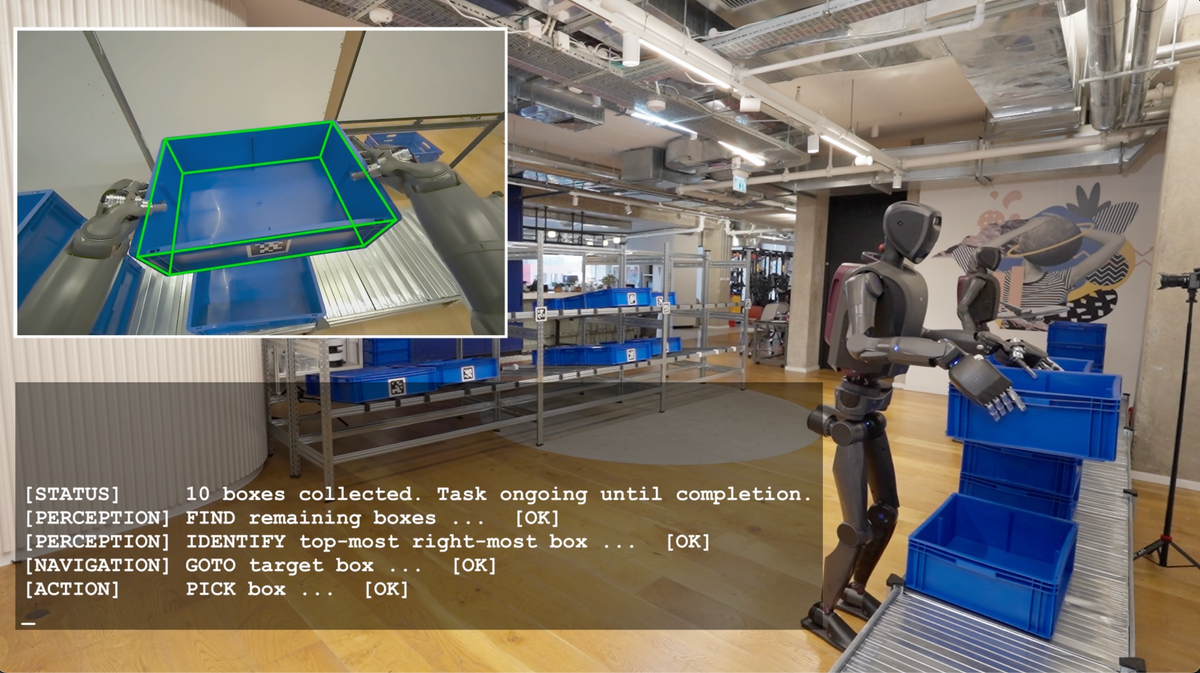
Image source: Mobileye
Mobileye’s move mirrors a broader trend in which autonomous driving, robotics and AI infrastructure are converging into a single “physical AI” technology stack.
Nvidia has framed its automotive, robotics and simulation platforms under the same concept, while Tesla has linked its self-driving systems and Optimus humanoid robot development under one technical roadmap.
For Mobileye, the Mentee acquisition represents a bid to remain relevant — and differentiated — in a market where competition is intensifying, margins are tightening and hardware advantages are becoming harder to sustain.
By extending into robotics, Mobileye is effectively betting that the future of intelligent machines will not be limited to vehicles — and that companies able to span multiple physical domains will be better positioned to capture the next wave of AI-driven growth.
As Shashua put it: “Physical AI is not about one product category. It’s about building intelligence that can safely and reliably operate in the real world — whether that world is a road, a factory, or a home.”