

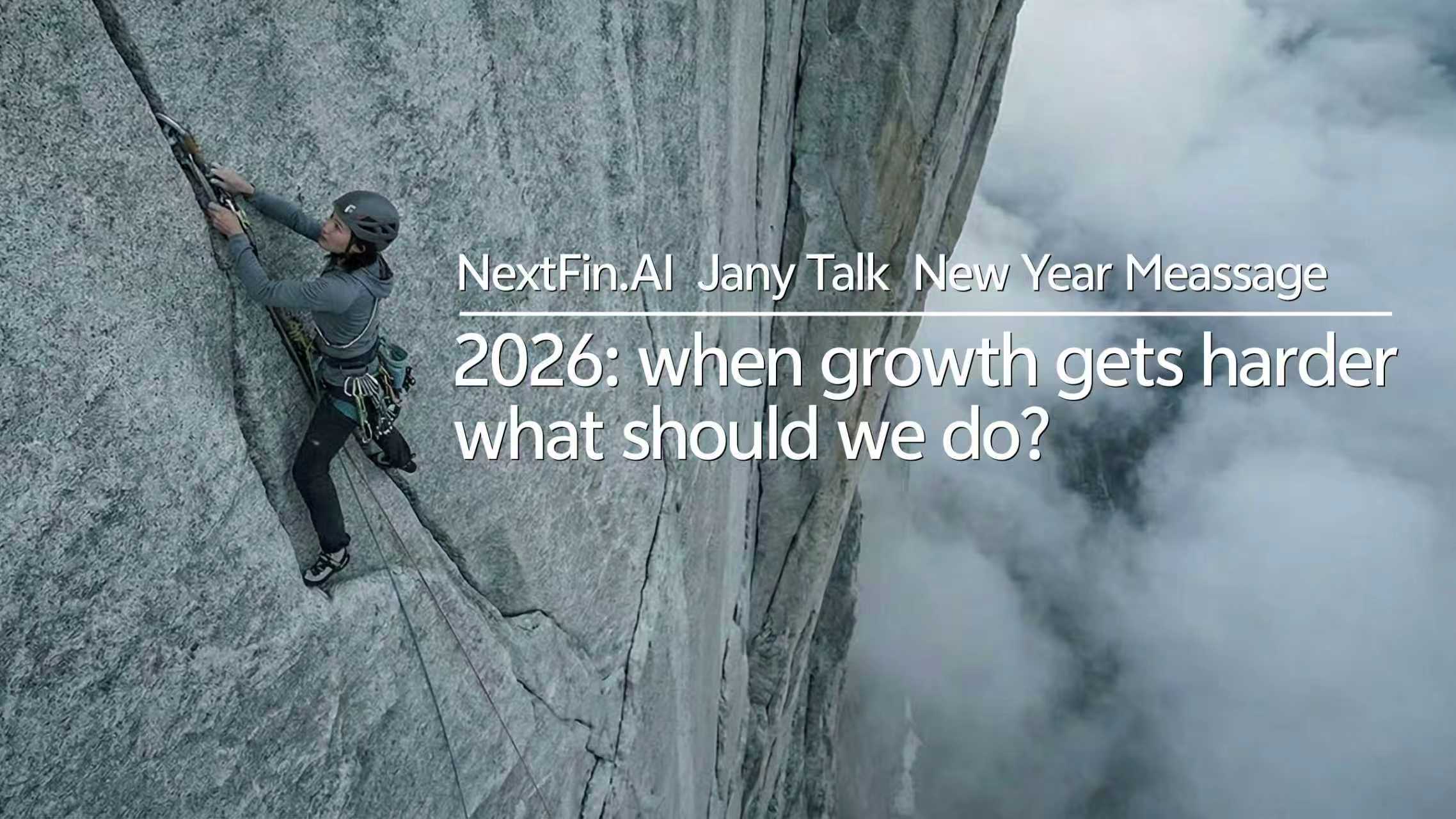
NextFin -- Looking ahead to 2026, if I had to choose one word to describe the outlook of the year, it would not be “disruption,” “breakthrough,” or even “AI.” It would be “harder.”
Harder not for one industry or one region, but across nearly every dimension of growth. Global economic momentum is slowing. Capital is becoming more selective. Geopolitical and regulatory frameworks are fragmenting. And at the same time, the rapid acceleration of artificial intelligence is compressing competitive cycles everywhere.
This is not a matter of sentiment. It is a likely reality increasingly confirmed by data.
At the macro level, the baseline among international institutions points to a “new normal of low growth.” In its October 2025 World Economic Outlook, the IMF projected global growth easing from 3.3% in 2024 to 3.2% in 2025 and 3.1% in 2026.
The OECD’s December 2025 outlook echoed the view: global GDP growth slowing from 3.2% in 2025 to 2.9% in 2026.
The World Bank’s 2025 Global Economic Prospects stressed the drag from trade barriers and policy uncertainty, which leads to slower growth and a feeble recovery in 2026.
Behind the numbers lies a more grounded consensus: growth still exists, but it’s costlier, slower, and more uneven. The old growth engines—solely relying on market expansion, capital narratives, copy‑and‑paste playbooks—are running out of steam.
From 2025, three facts stand out: AI is pulling economic growth, the world is fragmenting, and energy is the constraint.
- AI is driving tangible capex—not just narrative sizzle
In 2025, AI shifted from a “product race” to an “infrastructure race.” Semiconductors offer a clear yardstick: WSTS (World Semiconductor Trade Statistics) forecasts the global chip market could approach $975 billion in 2026, with memory chips and logic chips leading the gains.
Export-driven economies like South Korea show the split in year-end data: AI-related chip demand is strong, while traditional export sectors are under more pressure.
- Capital is concentrating: AI is soaking up risk capital’s attention
Crunchbase data at the end of 2025 shows AI attracted close to half of global venture funding, with AI investment reaching about $203 billion—up sharply year over year.
That means two things: AI is still accelerating; and non-AI sectors will find fundraising harder and valuations tougher. When growth is scarce, capital crowds into narratives with higher perceived certainty.
- Power is the hard cap on AI expansion
The IEA (International Energy Agency) estimates global electricity demand rose about 3.3% in 2025 and around 3.7% in 2026—elevated by the past decade’s standards.
More importantly, the IEA’s work on “energy and AI” suggests data center electricity use could roughly double by around 2030, making it a non-negotiable variable for national infrastructure and industrial policy.
That rewires the base logic of AI competition in 2026: compute isn’t just “buying GPUs.” It’s securing electricity, land, permits, and supply chains.
From this, two basic forecasts for 2026:
Forecast 1: A year of “modest repair + high volatility”
Policy trends in major economies point to a loose monetary stance. For example, in December 2025 the Fed lowered the federal funds target range to 3.5%–3.75%.
But complexity persists: trade frictions, geopolitics, and industrial policy competition remain. Corporate capex and global division of labor won’t snap back to the old “efficiency-first” world. In other words: interest rates may fall, but uncertainty won’t. Growth may “recover,” but it’ll be bumpier and more divergent.
Forecast 2: AI shifts from “capability contests” to “systemic deployment”—from “training” to “reasoning and applications”
The 2025 frontier-model race pushed “can it be done?” to a high watermark. In 2026 the questions turn to “can it scale, comply, and make money?” I expect the industry to focus on:
• Driving down reasoning costs and working through hardware/memory bottlenecks (reasoning becomes the main battlefield)
• Agents and workflows: AI embedded into organizational processes, not confined to a chat window
• Supply ceilings set by big-tech capex and electricity constraints—and whether high-debt models are sustainable
• Faster M&A and consolidation: as tech diffuses, differentiation shifts to data, domain, and distribution
So as the new year arrives, and we face a year where growth gets harder, my answer is plain: no more growth fantasies, but operating discipline.
- Shift from “scaling” back to “doing the math.” Cash flow, gross margin structure, and unit economics aren’t topics for the “mature stage”—they’re prerequisites for surviving 2026.
- Move from “single-point breakthroughs” to “multi-node resilience.” Make supply chains, markets, compliance, and team design more distributed and substitutable. In a more fragmented world, concentrated bets carry bigger downside.
- Treat AI as a “productivity system,” not a “content toy.” The winners will be those who wire AI into workflows, capture data, and build quality controls—turning cost advantage into durable advantage.
- In a noisy era, invest in “trust.” When information overflows, opinions conflict, and emotions amplify faster, trustworthy content and sound judgment become scarce assets—and a major moat for media.
The year 2026 won’t be easy. But it may be fairer—it will reward capability over luck, delivery over packaging.
When securing growth gets harder, we don’t need forced optimism or passive pessimism. If we face reality, build discipline, use the right tool kit, and hold the line, we can still find our own certainty in a complex world.