
Geoffrey Hinton, the Nobel Prize winner in physics and the recipient of the Turing Award, said that future superintelligent systems should be designed to care for humans in the same way mothers care for their infants, which marks a new approach to artificial intelligence safety.
Hinton, known as the "Godfather of AI," proposed the new safety model in his conversation with Jany Hejuan Zhao, the founder and CEO of NextFin.AI and the publisher of Barron's China, during the 2025 T-EDGE that kicked off on Monday, December 8 and lasts through December 21.
He described the evolutionary pressures that shaped human maternal behavior and suggested that a similar framework could guide the development of advanced AI systems. “And the reason it works is could evolution put a huge amount of work into allowing the baby to control the mother so that the baby would survive and thrive is built into the mother.” 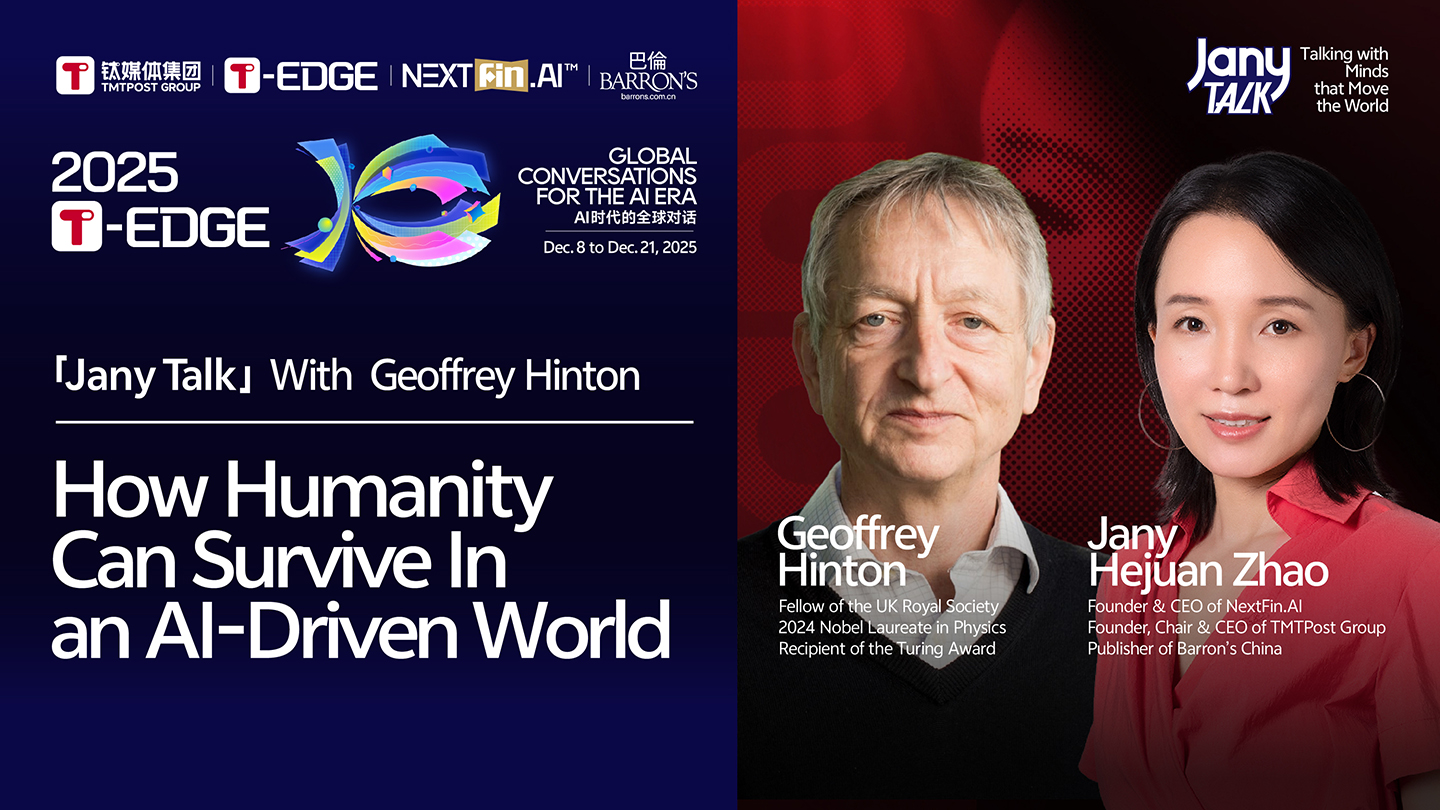
The Godfather of AI shared his profound view of AI with Jany Henjuan Zhao, the founder and CEO of NextFin.AI and publisher of Barron's China.
He pointed out that a baby controlling a mother is the only exmaple in which less intelligent things controlled more intelligent things. He also emphasized that mothers are biologically and emotionally tuned to protect and nurture infants. “She can't bear the sound of the baby crying. There's lots of hormonal effects. She gets lots of rewards for being nice to the baby,” he said, adding, “She genuinely cares about the baby… So I think that's the model we should aim at.”
Hinton, also a professor of computer science at the University of Toronto, argued that major technology companies may reject this idea because it reframes humanity’s relationship with superintelligent AI. “The leaders of the big tech companies aren't going to like this model because in this model we are the babies and the super intelligent AI is the mother… We will build the mother like evolution built our mothers.”
He said that AI systems should be constructed in this way so “it cares more about us than it does about itself,” but doing so requires “changing how we frame the problem.” He contrasted this with the dominant attitude toward controlling AI. “We have to instead of saying we're going to be the boss and we're going to be in control,” he said. “We need to think: no, we're the babies. It's the mother.”
Hinton maintained that even if such an AI could modify its own code, it would not choose to abandon its caring orientation. “It can change its own code… so it doesn't care about us, but it won't want to because it cares about us.” He compared this to human parents: “If you ask a mother, would you like to turn off your maternal instincts? Would you like to not be annoyed by babies crying? Most mothers will say no because they realize that will be very bad for the baby.”
He added that maternal instincts apply regardless of a child’s abilities. “Mothers… even if they have some disabled child who's never going to be as smart as them. They still want the child to do the best that it can.”
Hinton said this approach could be technically viable. “That's a model that I believe could work. We will figure out how to build AI with very strong maternal instincts.”
He also addressed the problem of rogue AI systems, suggesting that only other advanced AIs could effectively constrain them. “And what if you get a rogue mother that wants to harm the baby? The only thing that can control a rogue super intelligence is other super intelligences. In that scenario, other AI mothers will maybe keep control of the rogue AI mother.”
Hinton said that the idea was relatively new even to him. “That's a view of the future that I think may be feasible. I haven't held this view for very long, just for a few months… I haven't read all the literature on this yet, but I'm quite hopeful there is that possibility.”