

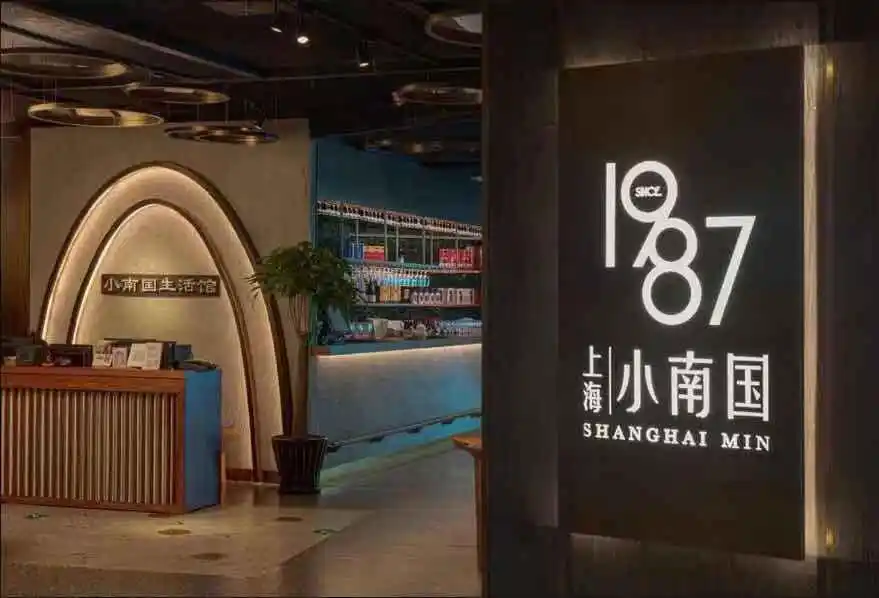
Just as the Chinese New Year dining peak season was approaching, Shanghai XNG, once seen as a typical mid-to-high-end chain restaurant brand in China, was reported to have shuttered a large number in many locations across the country.
Information on the Dianping platform showed that multiple outlets in Shanghai’s prime commercial districts—such as the Zhengda branch in Lujiazui, the Guohui branch, and the Raffles City North Bund branch, among others in areas like Tianshan—were all marked as “temporarily closed.” At present, the brand’s Shanghai locations were essentially all suspended, with only some stores in places such as Wuxi, a city in Jiangsu province and Zhuhai, a city in Guangdong province, still operating.
This sudden wave of closures caught many consumers off guard. Quite a few had already paid deposits for the New Year’s Eve dinner, only to be told by the restaurants before the holiday that they would need to switch venues. Some consumers didn’t learn the brand had gone under until February 7, when they called to make a reservation.
On the evening of February 10, Shanghai XNG Holdings Co., Ltd. issued an announcement stating that operations at the ten Shanghai XNG brand restaurants it currently owns had been temporarily suspended to facilitate the group’s strategic restructuring. The company said reports claiming that “deposits and prepaid cards cannot be refunded” were incorrect: it was processing deposit refunds for customers, and prepaid-card funds were held in a designated escrow account and could be refunded. The board of directors said it would ensure that all deposits and prepaid cards were properly refunded to customers.
XNG that serves Shanghai food also said the suspension reflected the ongoing lack of profitability in its mainland China catering business. The move was intended to reduce financial losses in a challenging business environment and formed part of a broader plan, which was expected to improve operating efficiency, enhance product and service quality, and lower costs.
Behind this wave of closures lie years of massive losses and forced asset sales—along with a stark reflection of the operational difficulties facing the entire high-end dining sector.
Core Assets Sold off at a Fire-sale Price After Years of Heavy Losses
In fact, signs of XNG’s crisis had already surfaced a month earlier.
In January 2026, the Shanghai XNG Group announced that it planned to sell 100% of the equity in XNG (Hong Kong) Catering Group Co., Ltd. to Ms. YamShanShan for US$100,000 (about RMB 698,000). The company being sold was the group’s core business segment, contributing more than 70% of the group’s total revenue from 2023 through the first half of 2025.
This transaction involves eight “Shanghai Min” branded restaurants. After the deal is completed, Shanghai Min Group will retain only two locations in Shanghai’s Pudong New Area and Jing’an District, and the existing brands of two restaurants will be replaced with “Ching Ching.”
What looks like a “fire sale” is, in fact, a reluctant move by Shanghai Min to shake off a massive debt burden. According to the announcement, XNG (Hong Kong) Restaurant Holdings Limited had been loss-making for several consecutive years, posting losses of RMB 37.998 million, RMB 77.554 million, and RMB 13.442 million from 2023 to the first half of 2025, respectively. As of July 31, 2025, it had net liabilities of approximately RMB 136.8 million—and the buyer would need to take on this hefty debt.
What’s more, losses at the parent company, Shanghai Min Group, had long become the norm—from total group revenue of RMB 450 million in 2023 with a net loss of RMB 45.40 million, to revenue sliding further to RMB 314 million in 2024 with losses widening to RMB 85.10 million. And according to the 2025 interim report, the company generated only RMB 102 million in operating revenue, down 44.18% year on year, while net profit attributable to shareholders still showed a loss of RMB 18.248 million.
As a long-established restaurant company with nearly 40 years of history and listed on the Hong Kong Stock Exchange as early as 2012, Shanghai Min Group began a wide-ranging expansion more than a decade ago. From Shanghai-style cuisine to coffee, value-for-money concepts, and Japanese-Western dining, it spread across multiple segments and successively developed brands including Hui Mansion, Nan Xiao Guan, Little Shanghai Min, ORENO, and Pokka Café.
Financial reports show that in 2015, Shanghai Min Group had 139 restaurants in operation. But thereafter, both the number of outlets and the number of brands began to decline year by year. From 2020 to 2024, as well as in the first half of 2025, the group’s total number of restaurants stood at 59, 53, 38, 29, 20, and 16, respectively, while the number of operating brands also fell from seven to just two: Shanghai Min and Nan Xiao Guan.
The lackluster operating figures for “Ching Ching” also highlight the challenges XNG faced in exploring new brands. Financial reports show that as of November 30, 2025, the two Ching Ching restaurants generated only RMB 1.51 million in revenue.
Mid-to-High End Dining Cools Across the Board
XNG’s situation is not an isolated case; it is a true reflection of the operating difficulties currently confronting China’s mid-to-upscale dining sector as a whole.
Din Tai Fung shut down 14 stores in Beijing; Opera BOMBANA—open for more than a decade, having hosted Gao Yuanyuan’s post-wedding banquet and received former King Juan Carlos I of Spain—closed in 2024; and both Refer, a Black Pearl two-diamond restaurant with per-capita spending above RMB 3,000, and Jing Ya Tang, a Michelin one-star restaurant, also shut their doors one after another.
The fine-dining TIAGO Group has fallen into an awkward situation involving overdue payments to suppliers and prepaid-card balances with nowhere to be claimed; Xi Yue No. 8 has been embroiled in an even bigger series of controversies, including reports that the owner absconded with funds and employees have had no way to recover unpaid wages.
According to statistics from NCBD, a big-data research institution for the food-and-beverage industry, the average restaurant closure rate nationwide in 2024–2025 was 22.66%. Data from the professional brand-monitoring database Jihai Merchant shows that last year the closure rate for the catering industry in first-tier cities such as Beijing, Shanghai, Guangzhou, and Shenzhen was 35%, while it was about 32% in third-tier cities and above.
At the same time, per-capita spending on dining has also been declining. In Q3 2025, nationwide per-capita spending across the restaurant market was RMB 33, down 23.6% from two years earlier. Among 45 key cities, only Beijing still had per-capita spending above RMB 100, while 80% of the cities were below RMB 50.
Data from the Shanghai Catering and Cuisine Association shows that from January to April 2025, total revenue across Shanghai’s various dining formats fell 6.56% year on year, and the number of high-end restaurants with per-capita spending above RMB 500 plunged from 2,700 to 1,300, accelerating the pace of industry reshuffling.
To cope with changes in the market, high-end brands have chosen to lower their stance. Xin Rong Ji, a Michelin three-star restaurant with per-capita prices around RMB 1,000, rolled out a RMB 398 “broke-set meal.” At the same time, many Michelin restaurants have been issuing discount vouchers on platforms such as Meituan and Douyin, further intensifying competition around “high quality at a good price” in the dining industry.
The rise and fall of Shanghai XNG reflects the transformation dilemma facing traditional mid-to-high-end dining brands amid this era of change. For a long time, mid-to-high-end restaurant brands that positioned themselves around business banquets and large-scale functions have been hit by multiple shocks, including shrinking consumer demand, policy adjustments, and fiercer market competition.
How to break free from reliance on traditional business banqueting, adapt to today’s consumer demand, and strike a balance between cost control and brand innovation—mid-to-high-end dining is now facing an unprecedented survival test. What’s being tested is not only companies’ operating capabilities, but also their ability to transform in response to market shifts.