

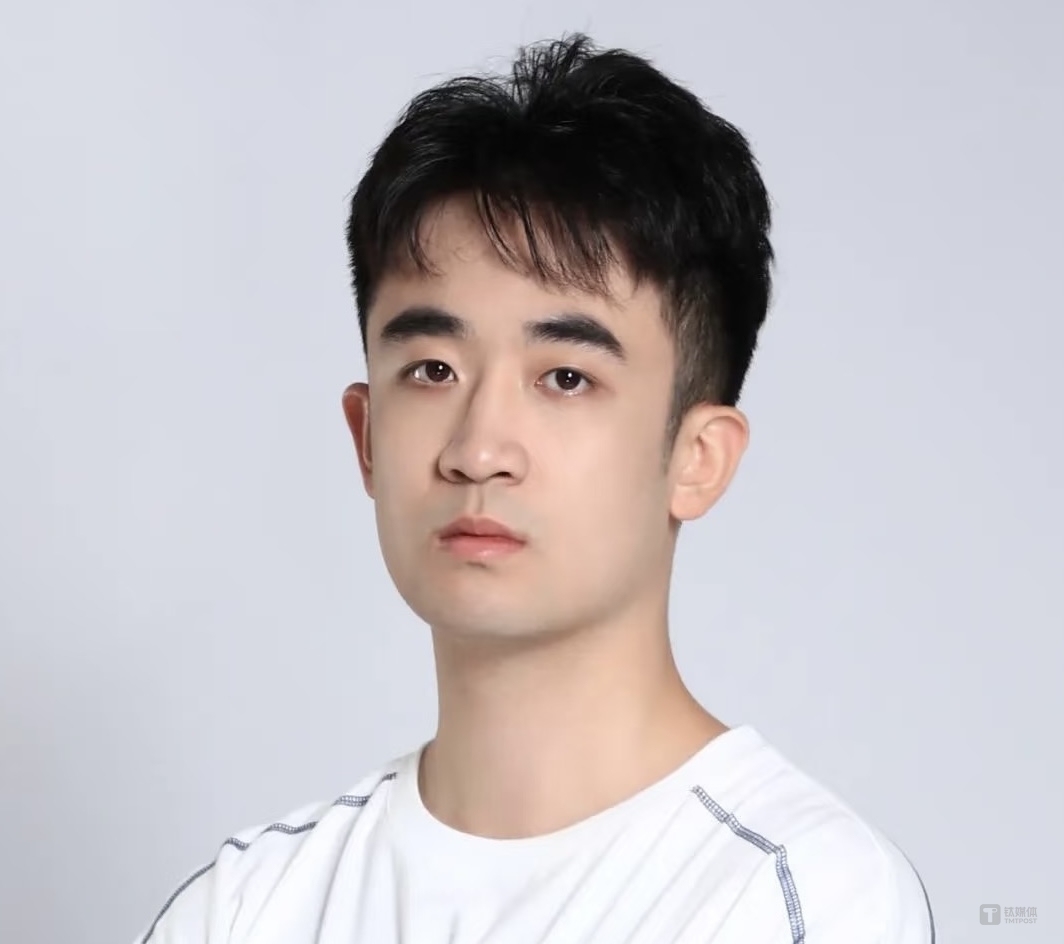
Pang Tianyu
After making headlines by bringing in former OpenAI researcher Yao Shunyu, Tencent has recruited another young scientist in the field of AI talent.
On January 29, former Senior Research Scientist at Singapore's Sea AI Lab, Pang Tianyu, posted a job announcement on his social media Xiaohongshu account and announced that he had recently joined the Hunyuan team.
Pang will soon join Tencent, becoming part of the Tencent Hunyuan Multimodal Department’s Exploration Center, where he will be responsible for cutting-edge research in reinforcement learning algorithms.
Although there has not yet been an official announcement regarding Pang’s position, his Xiaohongshu account displays the tags “Tencent Hunyuan principal scientist” and “Tech Lead@Multimodal RL Team.”
Based on the IP address in the job posting, Pang is currently based in Singapore.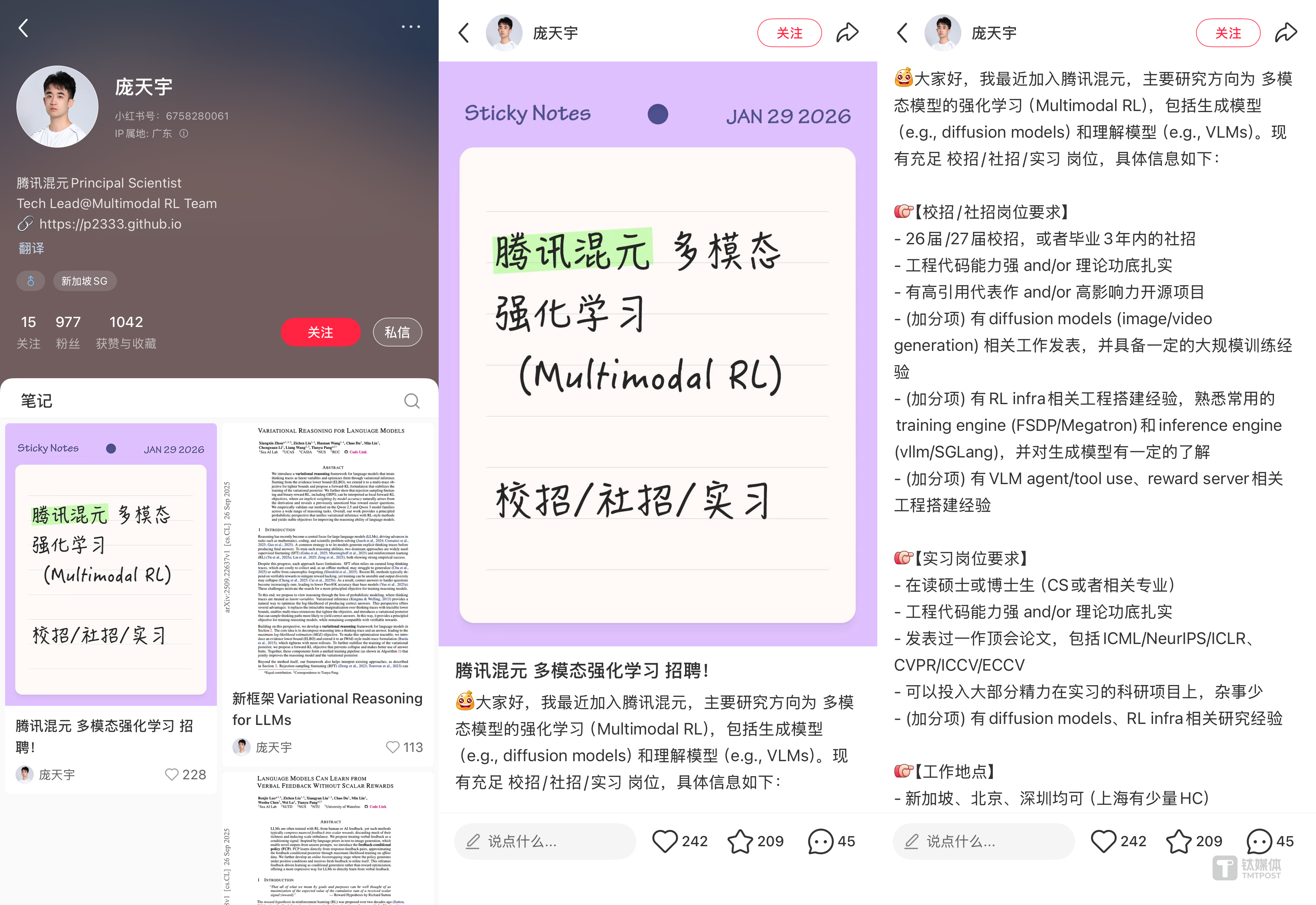
Screenshot from Xiaohongshu account @庞天宇
Pang is a graduate from a PhD program (starting in 2017) in the Department of Computer Science at Tsinghua University, under the supervision of Zhu Jun. His primary research areas are machine learning, especially deep learning and its robustness, and he has achieved a series of notable research results.
As first author (including co-first author), he has published several papers at top machine learning conferences such as ICML, NeurIPS, and ICLR, with multiple works selected for Oral or Spotlight presentations.
The teams he participated in have taken first place in multiple adversarial attack and defense competitions, including NIPS 2017 and GeekPwn 2018. In addition, Pang has served as a reviewer for top international conferences and journals such as ICML, NeurIPS, ICLR, CVPR, ICCV, ECCV, and TPAMI on numerous occasions. He has been awarded the Microsoft Research Asia Fellowship and the NVIDIA Pioneer Award. Since his graduation from Tsinghua University, Pang worked as a Senior Research Scientist at Sea AI Lab in Singapore.
Multimodality is a field that Tencent's foundational model team places great emphasis on. The Tencent Hunyuan team has developed language models of various sizes, as well as comprehensive multimodal generative models and toolset plugins for images, videos, and 3D content.
The Hunyuan series of large models have already been integrated into numerous internal businesses at Tencent as well as various external industries and open-source communities. As of now, the total number of image and video derivative models from Tencent Hunyuan has reached 3,000, with video model community downloads exceeding 5 million and Hunyuan 3D model community downloads surpassing 3 million.
On January 28, the Tencent Hunyuan team announced the open-sourcing of Hunyuan Image 3.0-Instruct, the image-to-image version, and simultaneously integrated it into Yuanbao. In the latest global authoritative large model arena, LMArena, Hunyuan Image 3.0-Instruct ranked among the top tier in the Image Edit leaderboard.
However, Tencent's position in the AI sector has been lagging behind that of Alibaba and ByteDance.
In the ongoing talent war, just yesterday, ByteDance CEO Liang Rubo reiterated the need to increase talent density and boost incentives, so that top talent is motivated to join ByteDance and reach new heights, and so that employees are willing to stay and build their careers at ByteDance. He emphasized ensuring that employee compensation and incentive rewards remain ahead of the industry leaders in every global market.
In response to external anxieties about AI, at the recently concluded Tencent 2026 all-hands meeting, Chairman of the Board and CEO Pony Ma opened by reassuring all employees, stressing the importance of staying focused and maintaining their own pace.
Over the past year, the Tencent Hunyuan large model has undergone a deep restructuring. After Yao Shunyu joined as Tencent's Chief AI Scientist, the company accelerated its talent acquisition efforts, restructured its R&D team, sped up internal co-design processes, and strengthened the synergy between the Hunyuan large model and Yuanbao.
Ma revealed that last year, Tencent Hunyuan made significant changes in talent acquisition and organizational structure, attracting more native AI talent.
At the same time, Tencent is leveraging its social ecosystem to make strides in the AI sector.
Ma revealed that Yuanbao is about to launch a new AI social feature called "Yuanbao Party," exploring the deep integration of AI technology in multi-user social scenarios. Yuanbao Party originated from AI experiments and innovations within Tencent Meeting, and is positioned as a "social space" where AI and groups of users can enjoy entertainment and collaborate together.
Tencent stated that it will open up massive content resources such as QQ Music and Tencent Video to Yuanbao users. Users can create their own "Party" spaces in Yuanbao, enabling them to watch and listen together with friends, interact with Yuanbao in real time, and experience a brand-new AI-powered social experience.
Notably, Ma hopes that Yuanbao can recreate the surprise impact of WeChat’s red envelope campaign during the 2015 Spring Festival Gala this year. To this end, Yuanbao is launching a 1 billion yuan cash red envelope incentive campaign for the Spring Festival. This move is already being seen as the opening salvo in this year’s battle among major internet companies over AI applications. (Author | Li Chengcheng, Editor | Li Yupeng)