

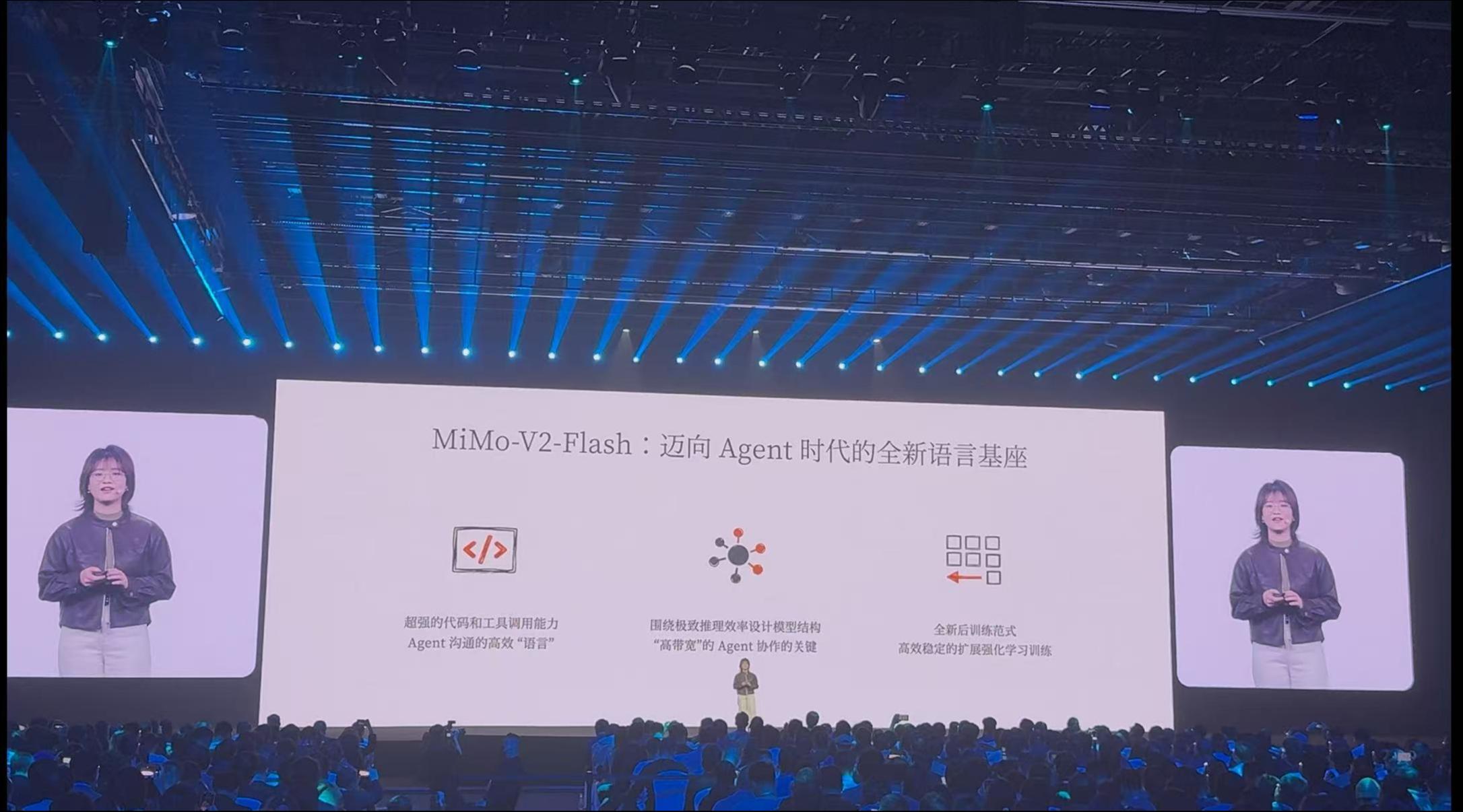
Xiaomi on Tuesday showcased a new generation of large language models and outlined an ambitious vision for intelligent agents that can interact with the physical world, as the Chinese smartphone and electric vehicle maker deepens its push into artificial intelligence and "hardcore" technologies.
At the 2025 Xiaomi All-Ecosystem Partner Conference, Luo Fuli, a young AI researcher nicknamed the "genius girl," made her first public appearance since joining Xiaomi, detailing progress on the company's MiMo large model project.
Luo, who now heads Xiaomi's MiMo foundation model initiative, said the company had built a new agent-oriented model, MiMo-V2-Flash, designed to deliver high performance at significantly lower cost.
"Large models have achieved an explosion in language capabilities by scaling up computing power and data, allowing them to better grasp human thought processes and our understanding of the world," Luo said at the conference.
Xiaomi's move comes as Chinese technology companies race to develop competitive large language models amid tightening U.S. export controls on advanced chips and intensifying competition with U.S. rivals such as OpenAI, Google and Anthropic. Domestic players including Alibaba, Baidu and Tencent have poured billions of yuan into AI research, while startups such as DeepSeek have gained attention for high-performing open-source models.
Luo, born after 1995, rose to prominence in China's AI community after publishing multiple papers at the top-tier ACL conference during her master's studies. She later joined Alibaba's DAMO Academy, where she led development of the multilingual pretrained model VECO, before moving to DeepSeek as a core contributor to its Mixture-of-Experts (MoE) model DeepSeek-V2.
Media reports late last year said Xiaomi founder Lei Jun had recruited Luo with a package worth tens of millions of yuan annually to strengthen the company's AI capabilities.
According to Luo, MiMo-V2-Flash has a total parameter count of 309 billion, but activates only 15 billion parameters during inference, a design aimed at sharply reducing computing costs. She said the model's coding and agent capabilities ranked among the top one to two open-source models globally on widely recognised evaluation leaderboards.
"For most benchmarks, MiMo-V2-Flash has already surpassed or matched models such as DeepSeek-V3, Kimi and Qwen, even though those models typically have two to three times as many parameters," Luo said.
She added that MiMo-V2-Flash's inference cost is slightly lower than that of DeepSeek-V3.2, while its inference speed is about three times faster. By contrast, she said, Google's Gemini 2.5 Pro delivers comparable overall performance and similar speed, but at roughly 20 times the inference cost.
Xiaomi said it has open-sourced all of MiMo-V2-Flash's model weights and released detailed technical documentation, while also providing application programming interfaces (APIs) to allow developers to integrate the model into web-based coding environments.
Despite rapid advances, Luo cautioned that most users remain reluctant to entrust large models with truly complex tasks. "The next generation of intelligent agent systems should not just be language simulators," she said. "They need to coexist with the real world."
She argued that future agents must evolve from answering questions to completing tasks, requiring not only memory, reasoning and planning abilities, but also omni-modal perception. Such capabilities, she said, would allow AI systems to be embedded into everyday devices such as smart glasses and home appliances.
A second, more fundamental challenge is building what Luo described as a "physical model" of the world. While today's large models excel at language and reinforcement learning, she said, they often lack an understanding of physical laws, leading to so-called embodied hallucinations.
"That is why large models can solve math Olympiad problems or imitate Shakespeare, but fail to grasp basic concepts like gravity," Luo said. Overcoming this gap will require AI systems that can perceive, simulate and interact with real environments, representing what she described as a major leap in artificial intelligence.
Xiaomi executives used the conference to underscore the company's long-term commitment to research and development. Luo said Xiaomi plans to invest 200 billion yuan ($28 billion) in R&D over the next five years, with the goal of becoming a global leader in advanced technologies.
Lu Weibing, president of Xiaomi Group, said the company's R&D spending is expected to reach 32 billion to 33 billion yuan this year and rise to around 40 billion yuan by 2026.
Since April, Xiaomi has released a series of open-source foundation models covering language, multimodal and voice capabilities. In November, it also unveiled Xiaomi Miloco, a smart home exploration initiative, and MiMo-Embodied, an embodied large model, both of which have been made available to developers worldwide.
Xiaomi has also pushed to open up its broader software and hardware ecosystem. Its lightweight operating system for the Internet of Things, Xiaomi Vela, has been open-sourced under the name openvela, attracting more than 100 partners and supporting over 1,500 product types. Devices running the Vela system now exceed 160 million units, the company said.
Globally, Xiaomi reported 742 million monthly active users, while its AIoT platform connects more than 1.04 billion devices through partnerships with over 15,000 hardware makers. On the software side, Xiaomi said it works with 1.2 million developers worldwide, with monthly app distribution in its domestic ecosystem exceeding 1.1 billion.
The company also said its CarIoT platform has been fully opened to the automotive industry, offering unified hardware interfaces and in-car ecosystem components. It has established collaborations with four automakers, including BYD and GAC Toyota, as Xiaomi seeks to extend its AI ambitions beyond consumer electronics and into vehicles.
($1 = 7.14 yuan)