

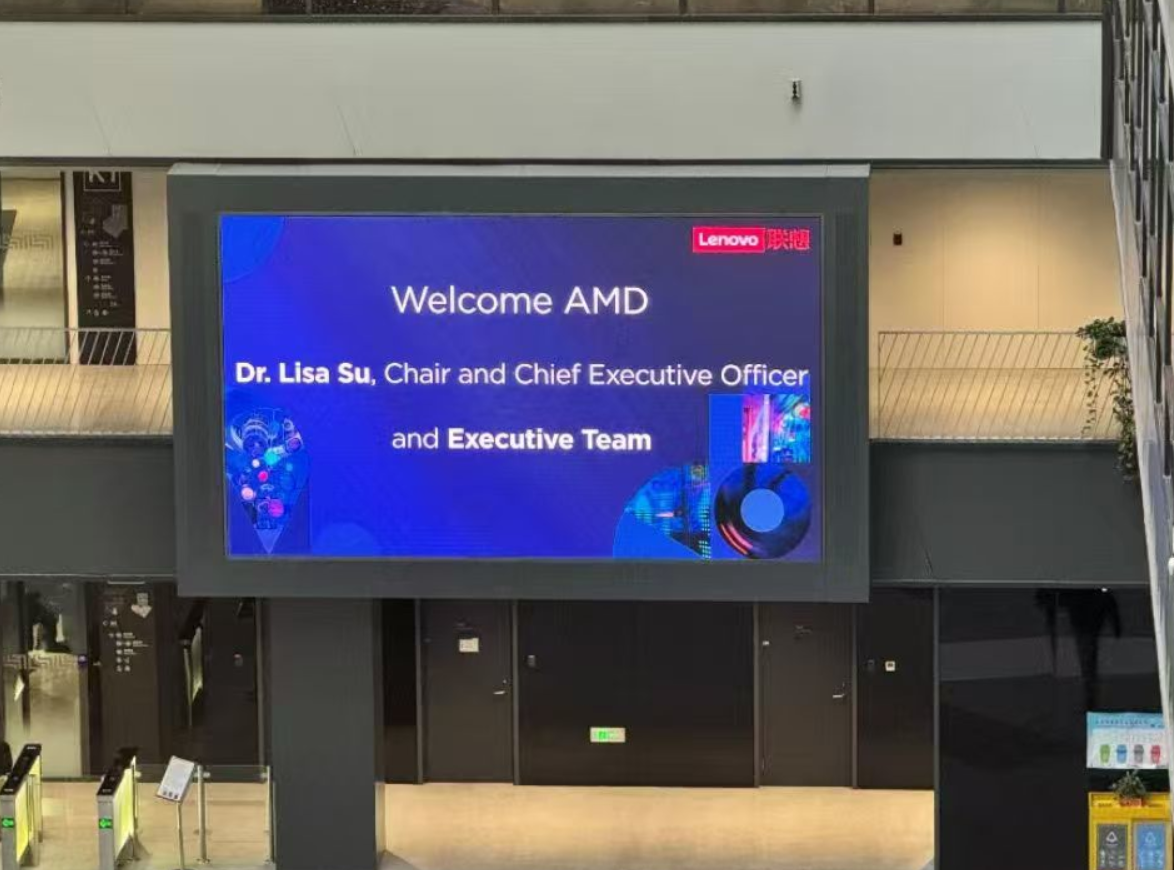
Lisa Su leading the AMD executive team on a low-profile visit to Lenovo headquarters; photo provided by a source familiar with the matter.
Advanced Micro Devices Chair and Chief Executive Lisa Su has arrived in China for a new round of strategic engagement, according to multiple media reports, as signs emerge of a softening in the U.S. government’s stance on restrictions governing the export of advanced chips to the country.
Su arrived in Beijing on Dec. 16, with her first stop being the headquarters of Lenovo Group, one of AMD’s most important partners in China, the reports said. She was accompanied by a group of senior AMD executives. AMD declined to comment on the visit or disclose details of Su’s itinerary.
Chinese media outlet Sina Technology reported that Lenovo Executive Vice President and China President Liu Jun, along with Executive Vice President and Intelligent Devices Group President Luca Rossi, were among the executives who hosted the AMD delegation. Yicai Global said Su and her team viewed Lenovo’s latest products and technological achievements, including humanoid robots.
Photographs circulating on Chinese social media showed a large welcome message displayed on a screen at Lenovo’s headquarters, with senior executives from both companies posing for group photos alongside robots. The visit drew widespread attention among Lenovo employees, with updates shared online even by staff not directly involved in the reception.
The Beijing trip followed a meeting between Su and China’s ambassador to the United States, Xie Feng, on Dec. 11, according to media reports. The two discussed AMD’s operations in China and broader China-U.S. economic and trade cooperation.
Compared with Su’s high-profile visit to China in March this year, the latest trip has been markedly lower key. During her week-long visit earlier in the year, Su also made Lenovo her first stop, with the two companies announcing multiple collaborations focused on so-called AI PCs. AMD later held two large-scale product launch events in China, putting AI-capable personal computers at the centre of its strategy.
At the time, AMD said its China AI Application Innovation Alliance had signed up more than 100 independent software vendors, including Tencent-backed Yuanbao and Alibaba’s DingTalk, and forecast the number would reach 170 by the end of 2025. Su described the China AI Excellence Center as central to AMD’s global artificial intelligence strategy, saying it would help “drive and empower the new generation of AI PCs.” Executives from leading Chinese PC makers, internet companies and AI firms attended those events.
Su also repeatedly highlighted AMD’s early support for Chinese AI startup DeepSeek and spoke of cooperation with major domestic technology groups such as Alibaba and Lenovo.
The timing of Su’s latest visit coincided with Nvidia’s annual GTC conference, underscoring the rivalry between the two U.S. chipmakers in the fast-growing AI market. While Nvidia Chief Executive Jensen Huang has repeatedly stressed the importance of China, his recent public comments have focused more on reshoring chip manufacturing and consolidating U.S. leadership in artificial intelligence, particularly after Donald Trump returned to the White House and strengthened ties with major technology executives.
In April, the Trump administration imposed fresh export controls on advanced chips from Nvidia, AMD and other companies destined for China, requiring exporters to obtain licenses before shipping. As a result, China-specific products such as Nvidia’s H20 and AMD’s MI308 struggled to enter the market.
In August, after lobbying by chipmakers and by Trump’s White House adviser on AI and cryptocurrencies, David Sacks, the administration temporarily eased the restrictions. U.S. officials proposed that chipmakers pay a levy equivalent to 15% of their China-related sales revenue in exchange for export licenses.
However, renewed controversy, including claims of potential “security backdoors” in Nvidia chips used in China, meant shipments did not resume at scale, weighing on the companies’ revenues. By 2024, AMD’s China region accounted for about 24% of its total revenue, but large-scale shipments effectively stalled after the second quarter of this year. Nvidia’s share of China’s AI chip market has been cited by industry analysts as having collapsed from about 95% to near zero.
Both companies excluded revenue from Chinese data centres in their guidance for the third and fourth quarters.
After AMD reported quarterly results in November, Su said on an earnings call that the MI308 had obtained an export license but that shipments to China had not yet begun. She added that AMD was prepared to pay U.S. taxes associated with exporting the chip to China.
U.S. policy has continued to shift. On Dec. 8, Trump said on social media that Nvidia would be allowed to deliver its H200 chips to qualified customers in China and other countries, provided a 25% tax on sales revenue was paid to the U.S. government. He said the same terms would apply to other chipmakers, including AMD and Intel.
The H200 significantly outperforms the earlier H20 designed for China, though it still lags Nvidia’s latest Blackwell architecture. Huang has said it remains unclear whether Chinese customers will accept the H200.
For AMD, questions also remain over the commercial prospects of the MI308 in China, as domestic Chinese chipmakers have gained ground, particularly in inference chips, AI computing centres and IT application innovation. At the same time, more advanced Nvidia products have already secured export licenses.
For Su, who has said AMD aims to take a double-digit share of the AI accelerator market dominated by Nvidia, navigating China’s increasingly complex policy and competitive landscape has become more urgent, especially as U.S. export controls show signs of loosening.