

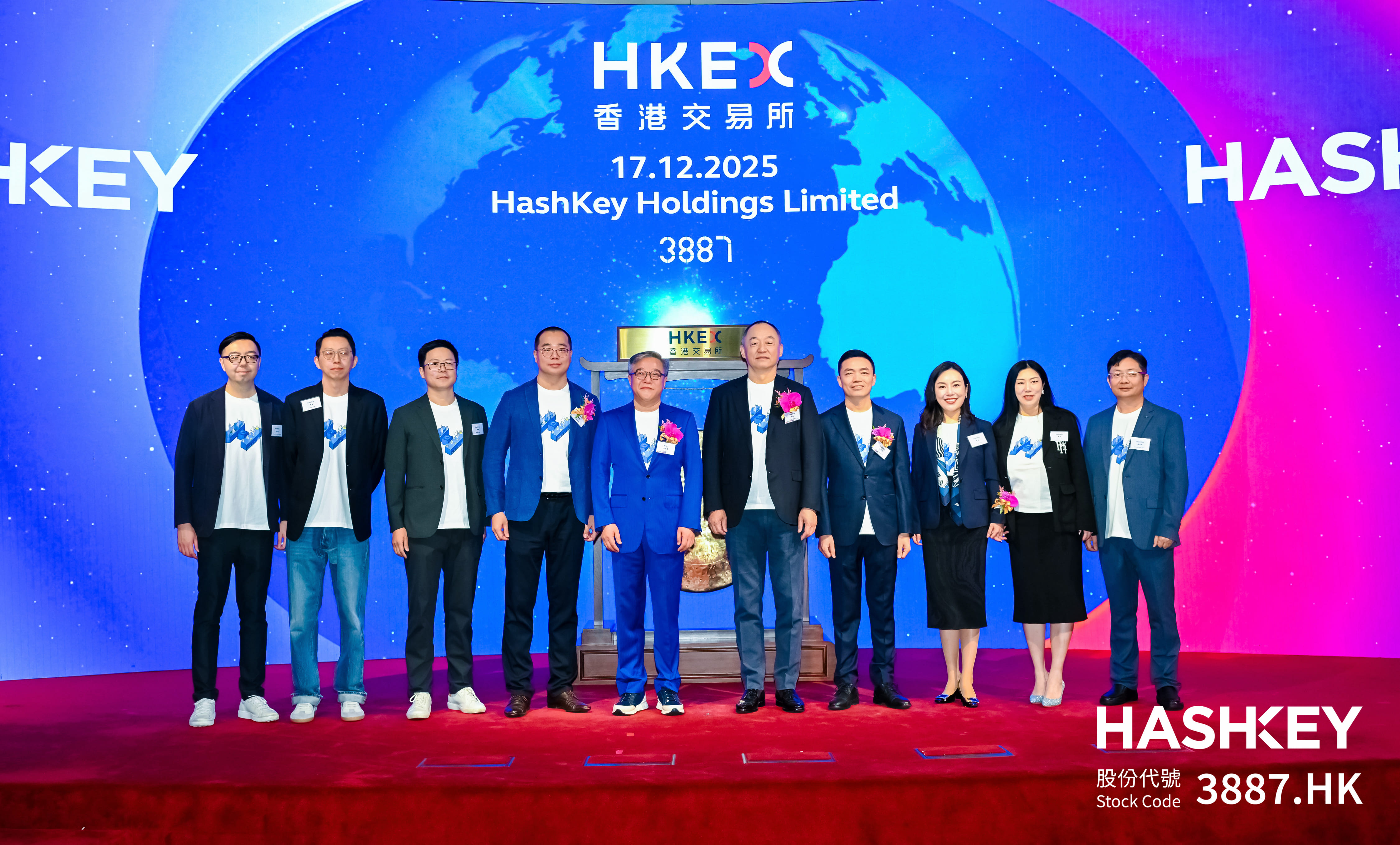
HashKey’s listing bell-ringing ceremony, Xiao Feng is fifth from the right
HashKey Group, the Hong Kong-based digital asset financial firm, is preparing for its initial public offering (IPO), marking a significant milestone in the evolution of crypto finance under a framework of regulatory compliance.
Led by Dr. Xiao Feng, widely recognized as the “Godfather of Blockchain in China,” the company is positioning itself as a bridge between traditional capital markets and the emerging tokenized financial ecosystem.
At 37, Xiao left his post as Deputy Director of the Shenzhen Securities Regulatory Office—now part of the China Securities Regulatory Commission—to join Bosera Funds, holding one of China’s first ten public fund licenses. Nearly three decades later, Xiao is drawing on that regulatory and market experience as he steers HashKey through Hong Kong’s crypto-licensing landscape, including Type 1 (securities trading), Type 7 (automated trading services), and VATP (Virtual Asset Trading Platform) licenses.
“The era of wild, unchecked growth has come to an end,” Xiao told NextFin. He emphasized that global regulators are swiftly establishing frameworks, and compliance is now the essential requirement to operate sustainably.
HashKey adopted a compliance-first strategy as early as 2018, even before Hong Kong had clarified its crypto rules. This approach required the firm to forego rapid offshore growth and absorb substantial costs. According to the prospectus, HashKey expects its compliance expenses in the first half of 2025 to reach roughly HK$130 million, with average monthly expenditures exceeding HK$20 million.
But compliance is only the baseline of Xiao’s vision. He aims to reimagine crypto-financial infrastructure, leveraging distributed ledger technology to create systems for trading, clearing, and settlement. Unlike conventional trading platforms that focus on volume-based profits, HashKey is building a foundation intended to underpin the broader tokenized financial market.
Xiao’s research into major global exchanges revealed that trading revenues typically account for less than half of total revenue. Guided by this insight, HashKey’s business spans three divisions: trading facilitation, on-chain services, and asset management. Trading remains the core, controlling roughly 75% of market share among Hong Kong’s 11 licensed exchanges. Its on-chain services manage HK$29 billion in staked assets, while asset management oversees HK$7.8 billion since inception.
Despite growing revenues, HashKey has yet to escape the cyclical volatility inherent in crypto markets. The firm continues to operate at a loss, a reflection not of inefficiency but of deliberate investment in R&D. In 2024, HashKey spent HK$556 million on R&D—77.1% of its revenue—well above typical internet platforms and even exceeding many hard technology companies. These investments support blockchain infrastructure, including HashKey Chain, a Layer 2 network, and other foundational systems.
Xiao dismissed suggestions that the IPO was driven by cash needs. The prospectus shows that as of October 31, 2025, HashKey held HK$1.48 billion in cash and HK$567 million in digital assets. Even without considering digital assets or IPO proceeds, the company’s cash reserves are sufficient to cover operations for over three years at the current burn rate of HK$40 million per month.
Looking ahead, Xiao sees the second half of 2026 as a pivotal moment for crypto-financial markets. Both Coinbase and Nasdaq plan to launch tokenized stock trading services during that period, a development Xiao views as the “singularity” when traditional and on-chain financial orders converge. In this vision, tokenization of funding instruments such as stablecoins and CBDCs merges with tokenized assets like stocks, bonds, and funds to create a fully integrated on-chain financial market system, with HashKey poised as a key infrastructure provider.
Xiao described this evolution as both a challenge and an opportunity. “Coinbase is attempting to disrupt Wall Street’s back office, and Nasdaq is responding to survive,” he said. Despite the rapid pace of the crypto world, Xiao remains focused on long-term infrastructure development rather than short-term market fluctuations. He categorizes the market as comprising revolutionaries and reformers, but emphasizes that the creation of new financial market infrastructure is an irreversible trend.
HashKey’s IPO signals a new chapter for crypto finance, demonstrating that rigorous regulatory compliance and ambitious technological investment can coexist. Under Xiao’s leadership, the company aims not merely to match existing trading platforms but to lay the foundation for a regulated, tokenized financial ecosystem that bridges traditional finance with the blockchain era.
With licensing in hand, a clear compliance strategy, and deep investment in blockchain infrastructure, HashKey positions itself as a global player ready to shape the future of digital finance. The IPO will not only provide capital for continued development but also serve as a benchmark for how digital asset companies can operate within regulated markets while advancing innovative financial infrastructure.
As markets anticipate the IPO, investors and regulators alike will watch closely to see whether HashKey can turn its compliance-first philosophy and infrastructure investments into sustainable long-term growth, potentially setting a new standard for regulated crypto finance worldwide.
The following is a conversation between NextFin and Xiao Feng, Chairman and CEO of HashKey Group, edited for brevity and clarity:
Stablecoins: Overcoming Common Misconceptions
NextFin: Recently, there’s been a lot of discussion about the mainland cracking down on "illegal stablecoins." Will this affect Hong Kong’s pace?
Xiao: These are two completely different matters. It’s crucial to distinguish between the two: the mainland crackdown is targeting pyramid schemes and scams that misuse the “stablecoin” concept; what Hong Kong is doing involves compliant stablecoins under a legal framework.
Even I’ve had friends come to me and ask, “Xiao, I also want to invest in stablecoins.” I asked why, and he replied, “Don’t stablecoins offer fixed returns?” This is a fundamental cognitive misunderstanding. Real stablecoins (such as USDT) themselves are non-interest-bearing, but in the rhetoric of pyramid schemes, they are turned into financial products guaranteeing stable returns.
In fact, since the Hong Kong Monetary Authority began drafting its stablecoin regulations two years ago, the entire landscape of the tokenization market has undergone significant changes. We can no longer view the situation with the perspective we had two years ago.
NextFin: What changes have occurred in the tokenization market landscape?
Xiao: Looking at the global scene now, “monetary tokenization” has already developed three clear approaches, or we could say, three main models:
The first: regulatory-approved commercial stablecoins. This is what is defined by Hong Kong’s stablecoin legislation, and what is being discussed in the US stablecoin bill, whereby commercial institutions (such as Circle and Tether) tokenize fiat currencies. This is currently the most mainstream model. The second: central bank digital currencies (CBDCs). In this model, central banks themselves directly lead the tokenization of money. China’s central bank is already implementing the digital yuan, and the European Central Bank is also working on it. Although the Federal Reserve’s attitude is still unclear, this is undoubtedly an important branch. The third: bank deposit tokenization. This is a new force that has emerged rapidly in recent months. For instance, the sandbox initiative launched by the Hong Kong Monetary Authority already has seven participating banks, including HSBC, Standard Chartered, and Bank of China (Hong Kong). The core of this sandbox is exploring how to directly tokenize bank deposits.
NextFin: Why are banks so active and positive about deposit tokenization?
Xiao: Banks have been backed into a corner— they have no choice but to fight back.
The stablecoins issued by commercial entities (such as USDT) have taken business away from banks. When banks realized this, they thought: If the market needs tokenized currencies, I have larger capital reserves, more customers, and a wider range of application scenarios than you do. Plus, if I tokenize deposits, I can even pay users interest—something you can’t. So why shouldn’t I do it myself?
That’s why these three models—commercial stablecoins, CBDCs, and tokenized bank deposits—will likely coexist for a long time to come. As for which model will prove stronger and more resilient, it remains to be seen. It’s not a given that stablecoins will win, and it’s not certain that banks will come out on top either.
Banks have obvious advantages: they control large funds, have a vast customer base, and offer abundant application scenarios. Moreover, bank deposit tokenization allows users to earn interest, which is something USDT cannot offer. However, banks also have their disadvantages: they typically operate within closed systems and can only serve their own customer networks. Unlike USDT, which does not depend on bank accounts and can flow freely and borderlessly on public blockchains.
So I believe that each will find its own use cases, and each will advance currency tokenization within its respective ecosystem.
If you look at the broader financial market, you’ll find that asset-side tokenization is also accelerating. Funds, bonds, and stocks are all being experimented with in terms of tokenization, and I believe insurance will join in as well. This way, both the capital side and the asset side will undergo tokenization. With time, we’ll see a closed loop formed by on-chain capital-side tokens and asset-side tokens.
NextFin: Regarding RWA, the U.S. saw its first case of default in November. What are your thoughts on the authenticity and future of RWA?
Xiao: Actually, people are overcomplicating RWA. At its core, it’s simply asset tokenization. The so-called “everything can be tokenized” is an unstoppable trend. I believe its development can be clearly divided into three stages:
The first stage is currency tokenization. This dates back to the launch of USDT in 2014, which essentially tokenized the US dollar. Later, in 2016, USDC came out. This is RWA version 1.0.
The second stage is the tokenization of financial assets, which really began to take off last year. The most notable examples are BlackRock and Franklin Templeton, who have started rolling out the tokenization of money market funds and government bonds in the U.S. This stage is progressing rapidly, with the technical and legal frameworks now relatively mature.
Phase 3: Tokenization of Physical Assets. This refers to RWA in the narrower sense, such as putting real estate or artworks on the blockchain. Frankly, up to now, there haven’t been any successful cases in this area. Why is that? Because one core technical challenge remains unsolved: the oracle problem. How can you ensure that an on-chain token always stays perfectly tied to its corresponding physical asset in the real world, never becoming unpegged? The trust mechanism for this process still needs exploration.
In my view, the key to solving the tokenization of physical assets may lie in DePIN (Decentralized Physical Infrastructure Networks). DePIN connects physical devices directly to blockchain networks. Only when IoT devices can transmit real-world data to the blockchain in a real-time and trustworthy way, thus solving the trust issue of on-chain assetization, will we have a complete solution for the tokenization of physical assets.
IPO, Compliance, and Profitability
NextFin: Why did you choose to go public at this particular moment? Is it a case of “riding the momentum,” or are you preparing for lean times due to financial pressure?
Xiao: To be precise, it’s “stockpiling resources” in order to “ride the momentum.”
Why now? Because, as I mentioned earlier, the on-chain financial market system is already within reach. A few months ago, Nasdaq submitted a framework for tokenizing stock transactions to the SEC. When the world’s largest capital markets start launching tokenized stock trading in the United States, it means that a true “on-chain financial market” is being built.
This is why I am optimistic about the future. On one side, we have the tokenization of the funding end (currencies, deposits); on the other, the tokenization of the asset side (funds, bonds, stocks) is accelerating. Once both funding and assets are fully tokenized on-chain, and as the process reaches a certain point, the two will converge, forming a closed-loop “on-chain financial market system”—that is, using on-chain money to buy on-chain assets, with transactions happening directly between both sides.
If we turn the clock back to this July, things weren’t so clear then. But now, the situation is gradually taking shape. On the asset side, stocks, bonds, and funds are moving; on the money side, liquidity is also shifting. I believe that by the second half of next year, this closed loop will come together. The market system for on-chain finance will truly start running smoothly.
Since this is a financial market, it can’t exist without trading intermediaries and foundational infrastructure. That’s exactly what HashKey is working on.
This year, we deployed a compliance layer CaaS (Crypto as a Service) product on HashKey Chain, covering aspects such as KYC, AML, privacy protection, and information disclosure. HashKey Chain is an Ethereum-based Layer 2, but unlike typical public chains, we specifically added a “compliance layer.” Our banking partners gave us feedback: “Account information on public chains is fully transparent, and that’s unacceptable to us.” So, we had to introduce privacy protection features.
Another important point is that we’ve implemented a “trade rollback” mechanism on-chain. In financial markets, mistakes like hitting the wrong decimal point or entering an extra zero—so-called “fat finger” errors—are inevitable, so there must be a remedy to roll back transactions. Traditional public blockchains don’t have this, but it is essential for financial markets.
In addition to preparing the capital, going public is even more of a “self-revolution.” Although HashKey is now a licensed institution regulated by the securities commission, that is not enough. Becoming a publicly listed company means HashKey must accept scrutiny from society at large. When J.P. Morgan or other major financial institutions choose partners, their standards are extremely high. Due diligence from these institutions typically takes three to six months. If we’re a listed company, it’s an entirely different story.
Our prospectus is over 690 pages long. After listing, we’re required to publish quarterly financial reports and have strict information disclosure obligations. This level of extreme transparency is our “passport” for collaborating with world-class financial institutions. For an emerging sector like Web3, transparency is the greatest foundation for trust.
NextFin: The market is very concerned about HashKey’s profitability. According to your prospectus, the company currently maintains healthy cash flows but remains in a loss-making position. When do you expect HashKey to achieve full break-even?
Xiao: Yes, our balance sheet is indeed strong—we have approximately 2.05 billion HKD in reserves (about 1.48 billion HKD in cash and nearly 567 million HKD in digital assets). But this isn’t just to keep the lights on; it’s also to seize strategic opportunities next year.
As for profitability, I don’t agree with the saying that “regulatory compliance means you can’t make money.” Compliance certainly prevents you from making quick profits at the expense of others, but as long as you reach a certain scale and can spread out the compliance costs, it’s still a great business. Regarding the precise breakeven point, of course we have internal projections, but as a company preparing for an IPO, it’s not appropriate for us to disclose any forecasts right now.
Running an offshore business can be exhilarating—one boss makes the decision and you just get things done. But at HashKey, it’s not just up to me. If I want to push something forward, I have to consult with the compliance officer and the legal officer first. If they tell me, “Mr. Xiao, this is clearly prohibited by regulations,” then it’s absolutely off-limits.
Even for reasonable requests like “shared liquidity,” we spent over half a year communicating with regulators. There are countless details involved: for example, if liquidity is shared between Hong Kong and Dubai, how do we settle in between? If it’s the weekend and the banks are closed, how are funds transferred? Each issue must be tackled one by one. Compliance is a meticulous and time-consuming process.
NextFin: In HashKey’s early days, when Hong Kong’s crypto industry was still the Wild West, why were you so determined from the beginning to choose the most expensive and slowest path—regulatory compliance? After all, self-imposed constraints might have caused HashKey to miss out on some of the bull market’s upside.
Xiao: I’ve never had any doubts about this. I worked in the traditional financial system for more than 20 years and have been a regulator myself. I understand better than anyone why this world needs financial regulation. Financial activities naturally have huge negative externalities. You can’t rely on practitioners’ moral self-discipline to eliminate these risks—it’s impossible. Without laws and regulation, the world would just be a “law of the jungle,” where only the strong survive.
Why was “cutting leeks” (scamming newcomers) so prevalent in the early Crypto community? Because there was no regulation. But if you want to grow this market to a scale of $10 trillion, no government in the world will allow you to scam people at will. If the market is small, it can be like a casino—people gamble and accept the risks; but if you want to become a mainstream financial market and serve the general public, there must be rules in place.
Where do laws come from? They are established after countless investors have been cheated and defrauded. Laws must be backed by law enforcement, courts, and prisons as a deterrent. So let’s not use technology as a cover. “Decentralization” is simply a technology, not a justification for defrauding others. Even in a decentralized world, fraud remains a crime, and fraudsters still go to jail.
NextFin: While compliance may be the right path, the cost can be extremely high, to the extent that it can even drag down a business.
Xiao: Timing is indeed critical. If you talked about compliance back in 2009 when Bitcoin just emerged, it would have been too early—the whole thing wouldn’t have been feasible. But by 2018, we decided to apply for a license in Hong Kong because I could see a major trend emerging. This is also a matter of perception and conviction: Do you believe cryptocurrencies are merely cyclical speculative tools, or do you believe they can truly transform the global financial infrastructure? From the very beginning, I have firmly believed that distributed ledger technology will reshape financial infrastructure. That’s why I came to Hong Kong at the end of 2018, even though there were no concrete licensing rules in Hong Kong at that time. I still wanted to find a compliant place to do this.
It was quite interesting when I first arrived in Hong Kong—the Hong Kong Securities and Futures Commission told me, “Hong Kong doesn’t require licenses for this right now, nor is there any legal framework to issue you a license.”
Under Hong Kong’s common law, for companies it’s “what the law does not prohibit is allowed,” while for regulators it’s “what the law does not authorize is prohibited.” At the time, the regulators even joked, “You can just turn left out the door and start your business—no one will stop you.” I joked back, “Does that mean literally no one is in charge?” They replied, “No, someone is in charge—the police.”
The logic was clear: if you defraud consumers or investors, or misappropriate customer assets, that’s a criminal offense and falls under the jurisdiction of the police—it's no longer within the financial regulatory scope of the Securities and Futures Commission.
NextFin: Where do the main compliance costs go?
Xiao: Compliance costs are reflected in every aspect. First, there’s the customer acquisition cost. Offshore exchanges are like internet companies—register with just an email address; we can’t do that. Our strict KYC process inevitably slows down customer growth, and naturally, revenue growth as well.
Next, being licensed means that, as the saying goes, “though small, a sparrow has all its vital organs”—you have to set up every department and system required by the regulators.
There’s also the cost of security. Our custody system uses HSMs (Hardware Security Modules), with a single server costing upwards of a million US dollars. To start a server, six people must be present—three to open the secure room, and three to power up the server.
Then there’s insurance. To meet regulatory demands, we purchased $2 billion in client asset insurance, which is a top-tier setup globally.
On the bright side, regulators are also helping us cut costs. For example, this year the Hong Kong Securities and Futures Commission allowed different global exchanges within the same group to share liquidity pools, so we don’t have to build a separate pool for every exchange. Also, we’re now allowed to offer our custody system externally—not only to exchange clients but also to family offices and other institutions. As our scale grows, the per-unit compliance cost will certainly go down.
More Than Just An Exchange
NextFin: HashKey has many business lines. With the new IPO strategy, will there be any shift in focus? At the same time, the crypto industry itself is highly cyclical, while listed companies need stable quarterly financials. How will HashKey reconcile this contradiction between the highly cyclical nature of crypto and the stock market’s demand for steadiness?
Xiao: Our business lines are actually very clear—just three: 1) Transaction facilitation (exchange + OTC); 2) On-chain services (node validation + technical services); 3) Asset management.
Our business model is actually closer to Coinbase, rather than those exchanges that are only engaged in basic matching. If you’ve studied the largest exchange groups in the world—such as Nasdaq, NYSE, and the London Stock Exchange—you’ll notice a pattern: none of them are “just” exchanges.
In their revenue structure, transaction commissions are only one part. The second and third largest sources of revenue usually come from data services and technology services, and their proportions are not much less than that of commissions. For instance, the London Stock Exchange Group owns FTSE Russell, whose indices serve funds worth $40 trillion globally; Nasdaq sells its matching systems to over 80 exchanges around the world.
HashKey is also a client of Nasdaq—we’ve purchased its market surveillance system. This system is extremely expensive and carries annual service fees, but it’s essential. The reason is that the Hong Kong SFC itself uses this system to monitor the market in real time for irregularities or manipulative behavior. This was a major revelation for us: in the future, HashKey also aims to become a technology service provider of this caliber. We won’t just focus on trading, but will also provide compliance technology and data services. This is a business model that can endure across market cycles.
True long-term investors, when evaluating an exchange group, care greatly about the diversity of its revenue streams. If you tell me your only income comes from trading commissions, your valuation is definitely going to be discounted. Markets inevitably go through bull and bear cycles. When a bear market hits and trading volume is halved, so is your income. That’s why you must have non-trading related revenues to smooth out such volatility.
When I was researching the history of exchanges, I found out that Nasdaq sells its matching engine to more than 80 exchanges globally and charges an annual service fee. This income is rock-solid, unaffected by market conditions. HashKey is building a similar model: not only running a trading platform, but also selling technology and data. This is a path we are determined to take.
NextFin: The prospectus shows that HashKey’s institutional clients contribute the vast majority of trading volume. How do you view the relatively weak presence on the retail side?
Xiao: The local retail market in Hong Kong is indeed not very large, but among licensed exchanges, HashKey holds the largest retail market share. More importantly, our user quality is extremely high.
For a retail user to complete such a complicated and strict KYC process, if it weren’t for a true passion for the platform, they would have left long ago. Although the number of retail clients we retain is only in the tens of thousands, their value is very high. The value contributed by a single retail user here is about ten times higher than that of offshore exchanges.
Beyond retail and institutional clients, we also have a third unique type of customer: licensed broker-dealers.
This is a phenomenon unique to Hong Kong. In the United States, you won't see Coinbase offering such services to brokerages, and it's very difficult for brokerages to access Coinbase as intermediaries. Why can't Coinbase do this? Because Coinbase doesn’t hold a securities license—instead, it holds a series of state-by-state Money Transmission Licenses (MTLs).
In Hong Kong, however, HashKey holds two sets of licenses: one is Type 1 and Type 7 licenses under the Securities and Futures Ordinance, which establish our legal status as a licensed trading system. With a securities license, we're able to connect with all Hong Kong brokerages (as long as they upgrade their Type 1 license).
At the same time, we also hold a VATP (Virtual Asset Trading Platform) license under the Anti-Money Laundering Ordinance. Having both licenses allows us to operate like a securities exchange while also legally trading non-securities virtual assets (tokens). This is our competitive moat. It’s a unique Hong Kong phenomenon: currently, there are over 40 licensed brokerages that have upgraded their licenses to facilitate virtual asset trading on behalf of clients. Of these, 90% rely on HashKey’s trading system on the backend. Of course, under this model, I can’t see who the end-clients actually are.
So, when you add in these “invisible clients” behind the dozens of brokerages, institutional clients (including omnibus accounts) account for around 80% of our client base, while retail investors make up 20%. This aligns with the data we disclosed in our prospectus.
NextFin: Strategically, which segment will you be focusing on more in the future?
Xiao: We plan to develop both. We’ll keep expanding our retail user base, as well as greatly grow our institutional brokerage business with omnibus accounts. As for the ultimate balance, we’re not aiming for any specific numbers. We’ll just serve whichever market structure develops naturally.
NextFin: What about your international strategy? The prospectus shows your company is already operating in places like Bermuda.
Xiao: For our global operations, we’re licensed in Bermuda. Although Bermuda is considered offshore, it actually has a comprehensive regulatory framework—Coinbase has also obtained a license there.
Of course, the Bermuda model is fundamentally different from Hong Kong’s “onshore model.” Hong Kong has its own local market, but Bermuda’s population is only a few tens of thousands—there’s basically no local market to speak of. So, it’s inherently 100% focused on the international market. We began operating in Bermuda last April. During the process, we faced a major challenge: no banks were willing to provide deposit and withdrawal services. But this year, we resolved that issue, and have confirmed two banks willing to support us.
With the banking services resolved, we now have three major advantages in Bermuda that other offshore exchanges don't possess: 1. A compliant fiat on-and-off-ramp; 2. The ability to serve omnibus brokerage business (compliant brokers can only partner with compliant exchanges); 3. The capability to trade RWA tokenized assets (requiring regulatory approval).
So next year, we plan to leverage these three core advantages to build up our compliant offshore business in Bermuda.
NextFin: With banks and other traditional financial institutions entering the tokenization space, how do you maintain your competitive edge in the institutional (B-side) market?
Xiao: Collaboration will certainly outweigh competition.
It’s just like our core business—we are transaction intermediaries. No matter which institution issues a tokenized product, as long as it’s compliant, we welcome it and are happy to help with distribution and trading.
At present, the Hong Kong Securities and Futures Commission has approved us to act in the role of a distributor. That’s why, over the past year, when Hong Kong asset management companies launched tokenized funds, we participated as the distributor. Right now, we’re actively preparing for the next step: on top of distribution, we’re working to offer secondary market trading services for these products. Of course, the prerequisite is that these products must be approved by the regulators—otherwise, we absolutely cannot get involved.
In this context, we’re not looking to issue products ourselves, but rather to provide fundamental infrastructure services for the entire market. So, our relationship with traditional financial institutions is definitely a collaborative one.
NextFin: Why don’t you issue your own stablecoin?
Xiao: That’s right. Last year and even the year before, nobody in the market had started working on tokenization, and no one really knew how to approach it. At that time, we did need to develop a few “model projects” or set up some templates to show everyone: “Look, this can actually be done.” But that doesn’t mean we intend to keep doing it ourselves in the long run.
The most typical example is stablecoins. You'll notice that HashKey itself didn't apply for a stablecoin issuance license. Instead, we invested in another company and had them apply for it. Even though we are the largest shareholder, it is a completely independent legal entity.
If I tightly held a stablecoin license myself, running both an exchange and issuing stablecoins, what would other stablecoin issuers think? They would doubt us: "You’re acting as both the referee and the player. Will you give your own coin special treatment? Will you treat me fairly?" This inevitably creates a conflict of interest.
So, we carefully considered our options internally: First, should we avoid participating in the stablecoin sector altogether? That wasn’t appropriate—stablecoins are foundational infrastructure, and we can’t be absent. Second, should we get directly involved ourselves? That wouldn’t work either, as it would compromise the neutrality of the exchange.
NextFin: How do you hope the market will define HashKey as a company?
Xiao: This is something I really want to emphasize. People often misunderstand HashKey as just an exchange. But in reality, we are a comprehensive financial services group based on digital assets. As I’ve mentioned before, we have three main pillars: trading facilitation (exchange business), on-chain services (infrastructure), and asset management.
The Old Order and Great Revolution of the Crypto World
NextFin: For HashKey to be able to establish itself in Hong Kong and go public, it must rely on sound judgment regarding industry cycles. Looking back over the past few years, the crypto industry has gone through a period of savage growth, as well as increased regulatory tightening. At this point in time, what are your predictions for industry trends?
Xiao: We have three major trend predictions for the industry's future:
The first trend: a shift from "offshore" to "onshore." What we mean by "offshore" is operating outside of regulation, or even evading regulation. "Onshore" means obtaining a license and being regulated within a specific jurisdiction. In the future, the space for compliant "onshore" businesses will grow rapidly, while the space for "offshore" operations will shrink dramatically.
Why is this trend happening? Because in the past year or so, more and more countries have started passing legislation and issuing licenses. Once a country legislates, the logic is straightforward: if you want to continue serving local citizens with an offshore approach, sorry, you can’t anymore. You either get a license and stay legally, or if you don’t, you have to leave.
The new Hong Kong regulation, the “Guidelines for Virtual Asset Trading Platform Operators”, which came into effect on June 1, 2023, is a prime example. Prior to this, HashKey voluntarily chose to be regulated, while other offshore exchanges, even without licenses, could freely operate in Hong Kong and their apps were easily downloadable. However, after June 1, this voluntary status became mandatory.
Previously, you could find the apps of all offshore exchanges in Hong Kong’s app stores. But after the new rules took effect on June 1, these apps were all removed. The signal from the Securities and Futures Commission was crystal clear: Want to keep serving Hong Kong customers? Get a license. If you express interest in applying, you’re given a 12-month transition period. If you decide not to apply, then sorry—you have a grace period (until late May or late August to offboard your clients), after which you must completely exit the Hong Kong market.
This isn’t just the case in Hong Kong; countries around the world are moving in the same direction. As more nations enact relevant regulations, the room for offshore businesses will inevitably shrink. I won’t go so far as to say the offshore model will disappear entirely in the future, but its scope will definitely not be as vast as it used to be. The era of unfettered growth is coming to an end.
Why can’t the offshore model work anymore? Because governments around the world are taking action. There are two key reasons for this: First, taxation. No government will sit by and watch huge flows of capital without collecting tax revenue. Second, investor protection. As a responsible government, how can you allow your own citizens to be exploited on unregulated platforms? That’s why passing laws and issuing licenses is inevitable for all countries.
The second trend: Evolving from “digital native” to “digital twin.” The transition from offshore to onshore is about exchanges’ business models, while this trend concerns the financial assets themselves—specifically, the tokenization of assets. Bitcoin and Ethereum are considered “digital native” assets. But now, global traditional financial markets hold over $270 trillion in assets, and these large pools of assets are set to be gradually tokenized. This is what’s known as the “digital twin.”
In reality, tokenizing assets is essentially a process of securitization. Since we’re talking about securities, 99.99% of them require regulatory approval. Do you really think assets approved for issuance by the Securities and Futures Commission would be allowed to be traded on unregulated offshore exchanges? Absolutely not. This is exactly why compliant exchanges have a tremendous opportunity.
The third trend is the shift from Off-chain to On-chain. In the future, all financial institutions and markets will ultimately converge into a unified on-chain financial market system. Once tokenization reaches a certain scale on both the funding side (capital) and the asset side (assets), it will generate a network effect and form a closed business loop. The point at which this loop is established is expected to be in the second half of next year, as mentioned earlier.
Of course, this doesn't mean the market will be fully formed by then. The key is that if Nasdaq and Coinbase actually start tokenizing stocks in the U.S., capital and assets will be connected on-chain, and the closed loop will begin to function. This also means that the prototype for an on-chain financial market will formally take shape in the second half of next year.
Once the U.S. establishes this model, what follows is quite straightforward: countries around the world will start to learn from, imitate, and follow this approach. This is an inevitable process, led by the U.S. and echoed globally.
NextFin: The global regulatory environment has changed significantly over the past two years. You also mentioned that tighter regulation is an inevitable trend in global markets. Looking ahead to the next two to five years, how do you predict the short- to medium-term trend of global regulation?
Xiao: From a global perspective, there is no doubt that the U.S. is leading the way in legislative and institutional developments.
The pace of U.S. legislation has been very rapid. It is expected that by the end of this year or early next year, key bills will be put into effect. Of particular note is the Crypto Market Structure Bill, which has already passed the House and is now under review by the Senate. Even if it isn’t passed this December, it is very likely to go through in January next year.
Why am I so confident? Because when it was voted on in the House, we saw strong bipartisan support across the board. The same is true of the Stablecoin Bill. This means that regulating the crypto industry and establishing market structure is no longer a partisan issue between Republicans and Democrats, but a consensus among America’s elite classes. Everyone believes that the U.S. must take the lead in Web3 and is determined to do so. Once these bills pass, I am optimistic that the industry will see explosive growth over the next two years.
First of all, concerns about the legality and compliance for all traditional financial institutions entering the crypto space will be completely resolved. The biggest fear for traditional institutions is that the narrative might sound appealing, but there are regulatory flaws. If the legal framework is unclear, they will not enter the market in a big way. However, once legislation is in place and the obstacles are removed, they will enter the space en masse.
Recently, there has been a clear signal: the U.S. Commodity Futures Trading Commission (CFTC) has approved a federal-level spot trading license for cryptocurrencies.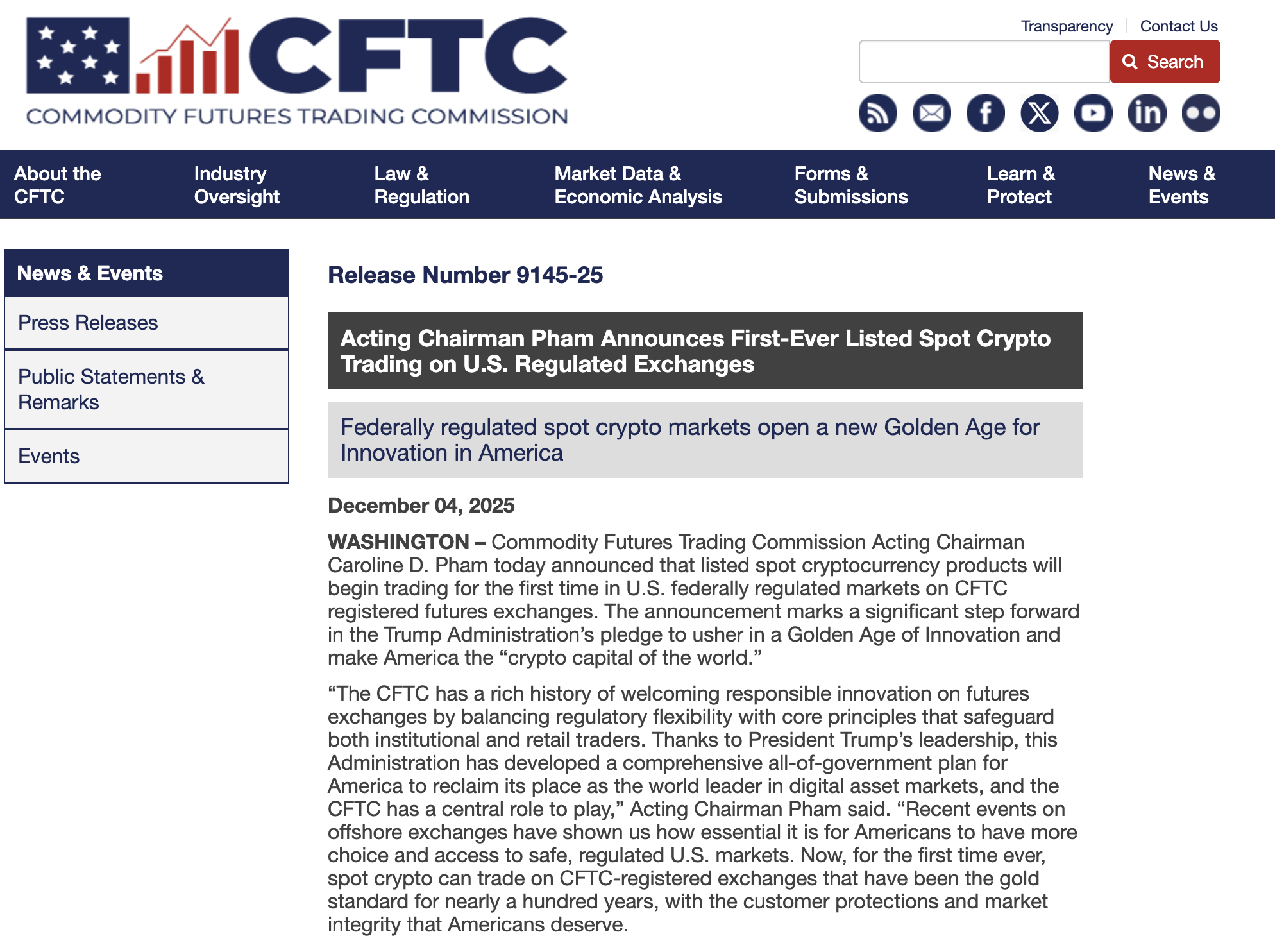
The CFTC has approved a federal-level spot trading license for cryptocurrencies; Source: CFTC official website
This is extremely significant. According to the new legislation, regulatory authority over most crypto assets will be handed over to the CFTC. The fact that the CFTC is now issuing this license indicates that the legislation is virtually set in stone—regulation of crypto assets (excluding securities) will definitely fall under the CFTC’s purview.
Up until now, there has been no federal-level spot trading license in the U.S. In order to stay compliant, Coinbase has had to apply for a money transmission license in all 50 states, dealing with them one by one. Coinbase maintains a compliance team of several hundred people just to navigate the differing regulatory requirements across these states. This not only incurs huge financial costs, but also substantial manpower expenses. Now, with the CFTC’s federal license, institutions only need this single license to conduct spot trading nationwide.
NextFin: What impact will this series of moves by the U.S. have globally, and in particular, on China?
Xiao: Whenever America makes a move, the rest of the world responds. Europe is following suit, and so is Hong Kong. More importantly, it will definitely have an effect on Mainland China.
This is competition at the level of foundational financial market infrastructure—between old and new systems for trading, clearing, and settlement. When the world’s major economies are embracing distributed ledgers, new financial infrastructure, and tokenized financial assets, no one can remain unaffected. In fact, even Mainland China’s push for digital RMB is essentially about the tokenization of legal tender, based on blockchain and distributed ledger technology.
I believe this is a trend that will become increasingly evident over the next two years.
NextFin: While traditional finance indeed operates with its own inherent logic and faces many issues, crypto finance (including stablecoins and RWAs) undoubtedly offers many advantages. But does this necessarily mean a ‘disruptive impact’ is inevitable? After all, when you spoke of ‘distributed business’ over a decade ago, the transformation didn’t happen overnight.
Xiao: You can view the past decade or so, from the birth of Bitcoin in 2009 to today, as a massive social engineering experiment. Restructuring the entire financial market system and shifting operations from off-chain to on-chain—that’s certainly not something that can be accomplished in three to five years.
However, this experiment has provided the biggest revelation for traditional finance: blockchain, as a brand-new transaction, clearing, and settlement system, is indeed feasible—and it’s highly efficient. With the traditional system, remitting money from New York to Hong Kong takes three days. With blockchain, it takes just two minutes. From a business perspective, when a new infrastructure is so much more efficient and cost-effective, it is inevitable that it will replace the old system.
NextFin: Who will launch this revolution to replace the old order?
Xiao: It will definitely be disruptors. Coinbase is a prime example of such a disruptor. At one point, Coinbase’s market capitalization even surpassed that of the New York Stock Exchange (NYSE). It’s like a newcomer, a disruptor, telling an established institution that’s been around for a hundred years: “I may be young, but my market value is higher than yours, and I’m eating away at your market share.” If traditional giants fail to wake up to this or are unwilling to give up their vested interests, they will simply have to watch themselves be pushed out. But there’s no way they’ll go down without a fight.
Two months ago, Nasdaq submitted a proposal for tokenized stock trading. That move was one hundred percent triggered by the pressure from Coinbase.
Earlier this year, when Coinbase submitted its plan to the SEC to launch tokenized stock trading in the U.S., Wall Street’s immediate reaction was essentially “This is the end.” Why? Because when comparing the two proposals, Coinbase’s system is entirely based on a new transaction, clearing, and settlement mechanism.
Wall Street’s existing system relies on DTCC (Depository Trust & Clearing Corporation), operating through centralized registration, custody, counterparty trading, and settlement. In contrast, Coinbase’s proposal is: “We don’t need DTCC or a central counterparty—everything is done on-chain.” It’s peer-to-peer trading, where “trade equals settlement,” and every transaction is settled individually. It’s like me giving you $100, and you giving me two packs of cigarettes—instant settlement, no third-party bookkeeping required. This is a “digital cash” transaction, clearing, and settlement model.
If Coinbase’s proposal were adopted, all the middle and back-office departments that keep Wall Street running would become obsolete. This could mean that half of Wall Street’s workforce would lose their jobs. The front-office traders might be safe, but those handling settlements and clearance in the back office would inevitably be out of work. At the time, the whole of Wall Street was gripped by panic.
I actually called a friend working in the middle and back office at a major financial institution on Wall Street. I asked him, “I saw that Coinbase has proposed a solution for tokenized stock trading. Does this have a big impact on your business?” He told me, “Xiao, everyone on Wall Street has been talking about that proposal these past couple of days. We all feel like it’s over, our jobs are really at risk this time.”
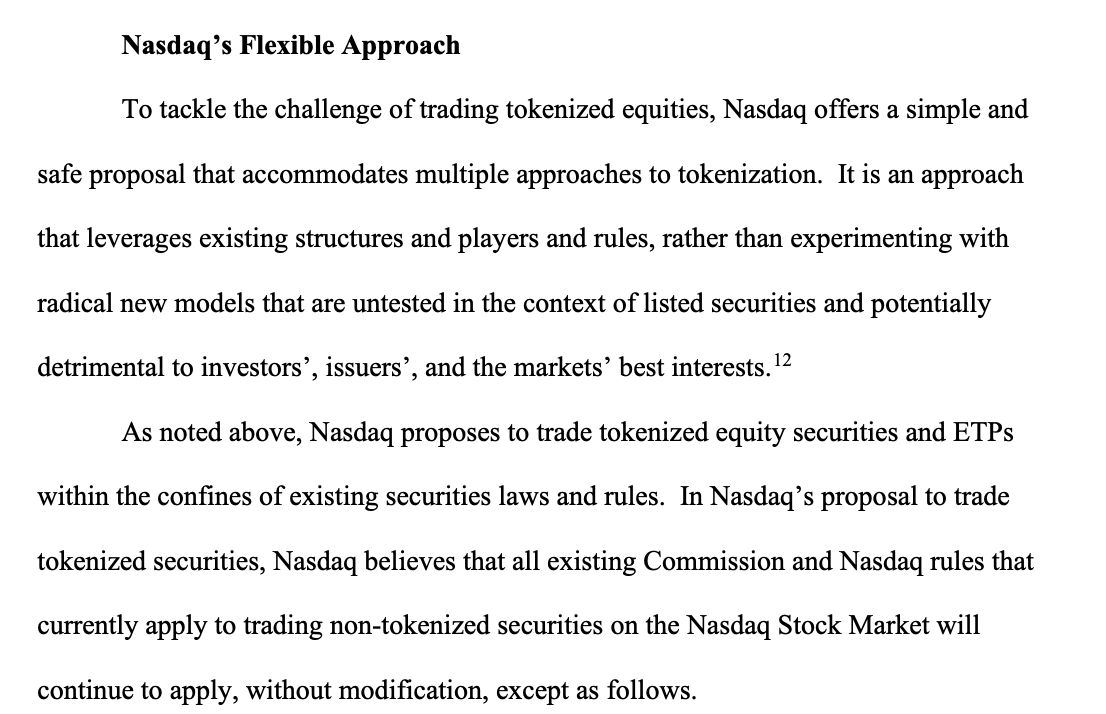
Nasdaq said that, in response to the challenges of tokenized stock trading, it has provided a simple and secure solution that is compatible with multiple types of tokenization. Source: SEC official website
Facing this existential threat, Wall Street began to fight back. Everyone thought, “We can’t just sit around and wait for disaster.” That’s how Nasdaq’s alternative proposal came to be. The more than forty-page proposal can still be found on the SEC’s website today. Nasdaq put forward a completely different path from Coinbase: reform rather than revolution.
At its core, the plan is to retain the DTCC (Depository Trust & Clearing Corporation), which will continue to centrally clear tokens. The DTC will be responsible for the custody and settlement of tokenized assets. This means Wall Street’s original structure would largely be preserved. While it wouldn’t save absolutely everyone’s job, it would at least protect a substantial portion of positions.
Now there are two options on the table: the revolutionary path proposed by Coinbase, and the reformist approach from Nasdaq.
However, even though Nasdaq’s plan retains the DTCC, tokenization is still a must. Why? Because only through tokenization can you achieve 24/7 trading and settlement. If you can’t do 24/7, you’ll certainly lose out in future competition.
Real-time settlement is only possible with tokenization, because only new financial infrastructure based on tokens can support around-the-clock trading.
This is a classic case study: on one side, you have the revolutionaries (Coinbase); on the other, the reformists (Nasdaq). But regardless of which side you’re on, you have to admit: new financial market infrastructure (blockchain/tokenization) is an irreversible trend.