

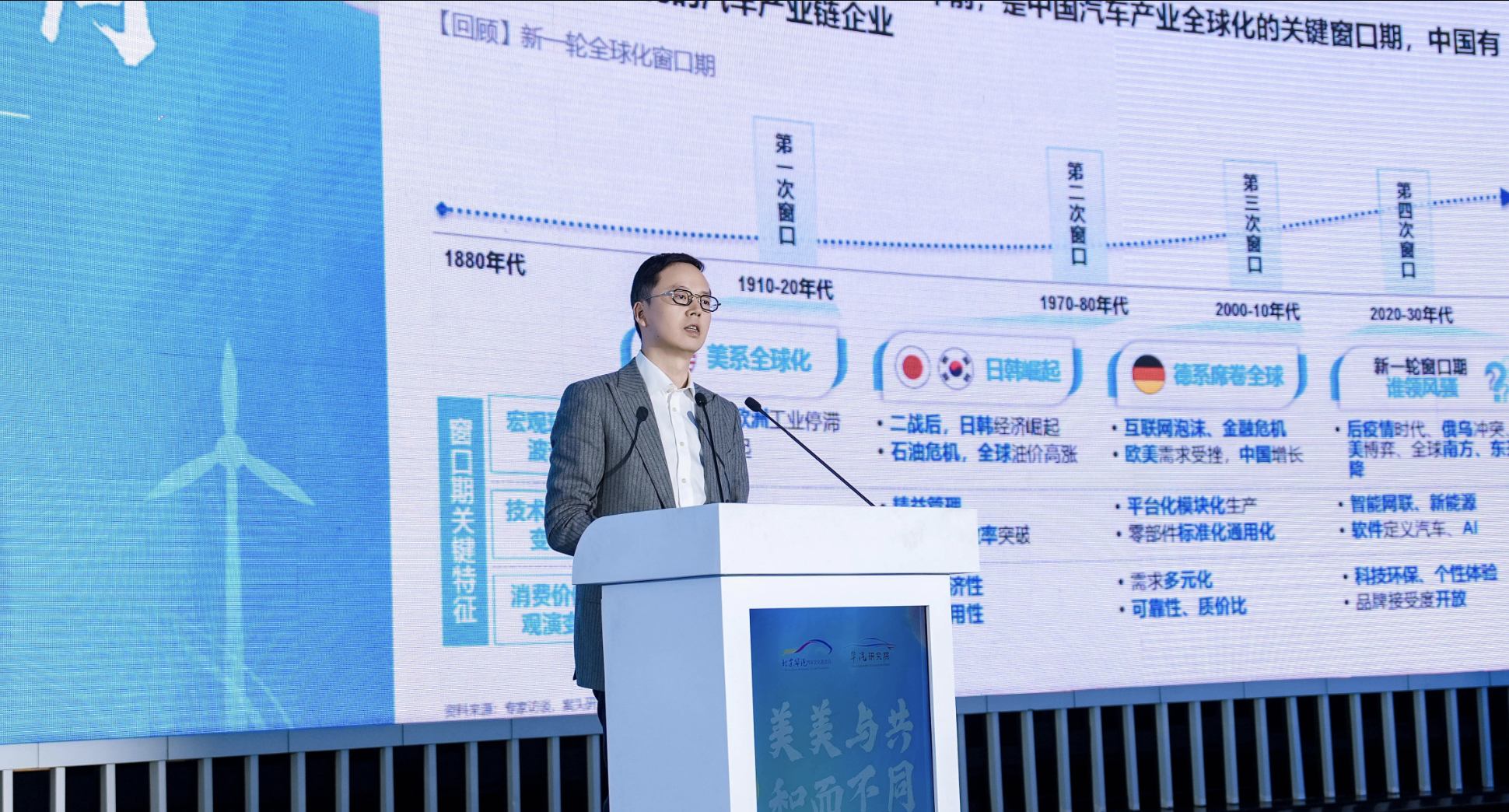
Zheng Yun, Global Senior Partner and Head of Automotive, Asia-Pacific, Roland Berger
Chinese automakers could capture up to one-fifth of the global auto market by 2030, but structural limits and rising operational challenges are likely to slow their overseas expansion in the coming years, according to a report released on Wednesday by consultancy Roland Berger and the China Automotive Research Institute.
The report, titled China Automotive Globalization Development Report 2025, argues that there is a theoretical ceiling of about 25% on the overseas market share that any single country's automotive brands can achieve, based on more than a century of global industry history.
Within that limit, Chinese brands could reach overseas sales of between 7.5 million and 10 million vehicles by 2030, equivalent to a 15%–20% share of the international market, the report said. However, it warned that growth will not be linear and that the next one to two years may see a temporary plateau as companies grapple with inventory pressures, the cost and complexity of localizing research and development, and long construction cycles for overseas factories.
"We are entering a more difficult phase of globalization," said Zheng Yun, Roland Berger's global senior partner and head of automotive for Asia Pacific. "The easy growth driven by exports alone is fading, and what comes next requires much deeper capabilities."
The report places the current wave of Chinese expansion within the context of four historical phases of automotive globalization: the U.S.-led mass production boom of the late 19th century, Japan and Korea's lean manufacturing rise in the early 20th century, Germany's engineering-driven expansion in the 1970s and 1980s, and today's shift driven by electrification, digitalization and new mobility technologies.
Chinese automakers, however, remain heavily concentrated in the earlier stages of that cycle. Most are still transitioning from export-led trade and assembly operations toward localized production, while global incumbents have long moved into fully integrated global operations encompassing R&D, manufacturing, procurement and marketing.
This gap is most visible in localization rates. Japanese and European automakers localize more than 80% of their overseas sales through local production, the report said, while Chinese brands currently localize only about 27%.
"That is clearly inconsistent with China's position in global vehicle sales," Zheng said.
Low localization undermines cost competitiveness, weakens supply chain resilience, slows responses to market shifts and limits brand-building, the report said. These constraints are expected to become more binding in the next two years as export growth slows and companies face rising regulatory and logistical hurdles.
To break through the 25% ceiling and sustain long-term growth, Chinese automakers must shift from a "Made in China" export model to full-scale global operations, the report said.
Europe has emerged as the pivotal market for that transition.
"If Chinese companies want to move into the world's top tier, they must establish a firm presence in Europe," Zheng said. "Not just selling there, but embedding themselves across the value chain."
Europe's strict regulatory standards, safety requirements and environmental rules make it a demanding but strategically important testing ground. Success there would signal that Chinese brands have developed the organizational, technological and compliance capabilities needed to compete globally, the report said.
Behind vehicle exports, China's auto parts sector has also expanded rapidly overseas. By 2024, exports of auto components exceeded 670 billion yuan, with localized overseas delivery accounting for more than 250 billion yuan and more than 300 overseas factories in operation, the report said.
However, profitability remains elusive. A survey of suppliers found that 55% were at or below breakeven in overseas operations, and only 9% reported healthy profits. Just 28% expected profitability to improve over the next two years.
The report attributes this to structural weaknesses rather than cyclical factors. Key problems include unclear strategic positioning, fragmented operational processes and weak coordination between headquarters and overseas units.
Many firms pursue overseas projects opportunistically, investing heavily for single clients without a long-term plan, the report said. Operationally, internal processes and decision-making systems often lag behind the geographic expansion of business, leading to constant crisis management. At the organizational level, firms struggle to balance autonomy and control, resulting either in disorder or excessive rigidity.
To address these issues, the report recommends a three-layered approach: clear long-term strategy, robust and agile global systems, and precise execution aligned with customer and market needs.
"All three are essential," Zheng said. "Globalization is not just about presence, but about building system-wide capabilities."
The report concludes that while the numerical targets of 15%–20% global share appear achievable, reaching them will require sustained investment in factories, R&D, talent and organizational reform.
"This is a marathon," Zheng said. "And it will be won not by speed alone, but by endurance and system strength."