

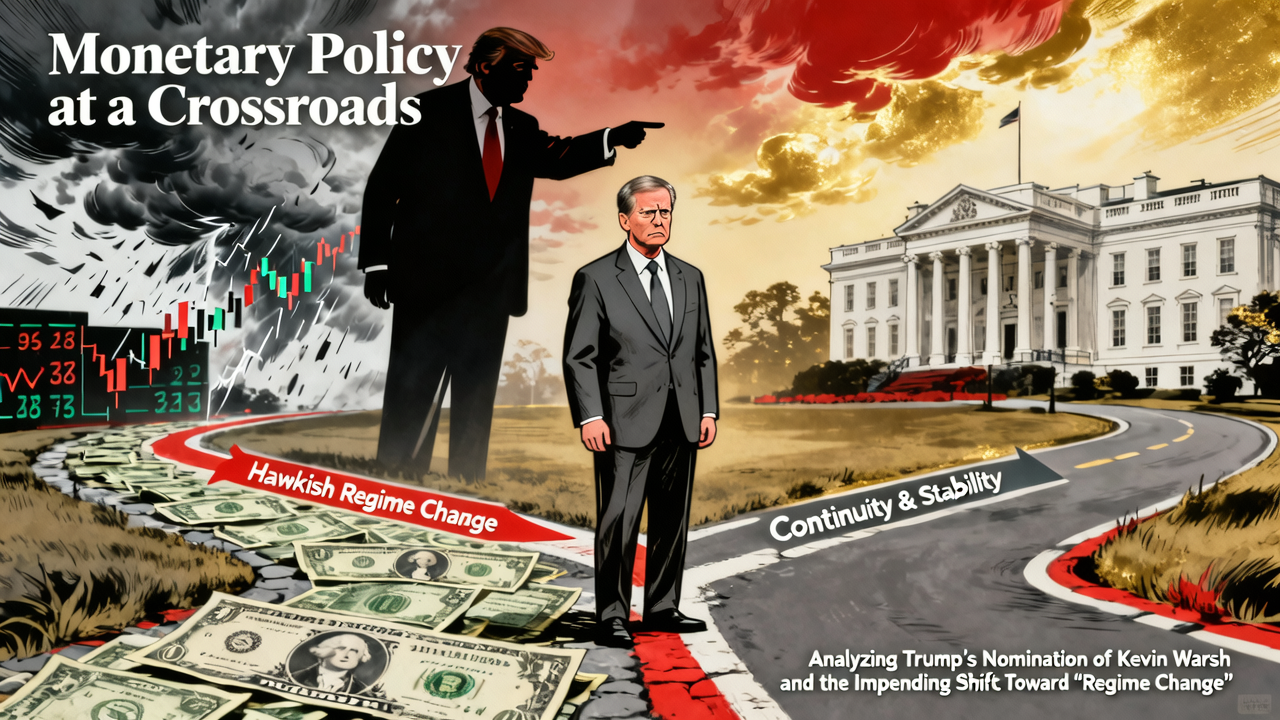
NextFin News - In a move that signals a definitive break from the monetary orthodoxy of the past decade, U.S. President Trump announced on Friday, January 30, 2026, the nomination of Kevin M. Warsh to serve as the next Chairman of the Federal Reserve. The announcement, made via Truth Social and later confirmed in an Oval Office briefing, positions the 55-year-old former central bank governor to succeed Jerome H. Powell, whose term expires in May. U.S. President Trump praised Warsh as a "central casting" figure who would become one of the "greatest Fed Chairmen" in history, explicitly noting his expectation that Warsh will be more amenable to the administration’s demands for lower interest rates.
The nomination comes at a period of unprecedented friction between the White House and the central bank. According to The New York Times, the selection follows months of public attacks by U.S. President Trump against Powell, who is currently the subject of a Department of Justice investigation regarding headquarters renovations—an inquiry Powell has characterized as a political pretext. Warsh emerged as the victor in a high-stakes search that included finalists such as White House economic adviser Kevin Hassett and current Fed Governor Christopher Waller. If confirmed by the Senate, Warsh will take the helm of an institution currently grappling with a 3.5% to 3.75% interest rate range and a mandate that is increasingly being challenged by the executive branch’s desire for "regime change" in monetary policy.
Warsh’s resume reflects a unique blend of Wall Street pragmatism and Washington insider experience. A graduate of Stanford University and Harvard Law School, he began his career in the Mergers and Acquisitions department at Morgan Stanley before joining the George W. Bush administration in 2002 as a special assistant to the president at the National Economic Council. In 2006, at the age of 35, he became the youngest person ever appointed to the Federal Reserve Board of Governors. During his tenure, which lasted until 2011, Warsh was a key architect of the Fed’s response to the 2008 financial crisis, playing a pivotal role in the rescue of AIG and the sale of Bear Stearns. Since leaving the Fed, he has served as a senior fellow at the Hoover Institution and worked closely with billionaire investor Stanley Druckenmiller.
Analytically, Warsh’s policy evolution presents a complex puzzle for investors. During his first stint at the Fed, he was widely regarded as an "inflation hawk," frequently expressing skepticism toward quantitative easing and warning about the long-term risks of an expanded balance sheet. However, in recent years, Warsh has repositioned himself as a critic of the Fed’s "credibility deficit," arguing that the institution has been too slow to react to changing economic conditions. According to CNBC, Warsh has recently advocated for closer coordination between the Fed and the Treasury Department, suggesting a revamp of the 1951 Accord that established the Fed’s independence. This shift suggests that a Warsh-led Fed might prioritize short-term growth and debt management over the rigid 2% inflation target that has defined the Powell era.
The market reaction to the nomination has been characterized by a "wait-and-see" volatility. On the day of the announcement, the S&P 500 nudged 0.3% lower, while gold and silver prices saw significant pullbacks as the U.S. dollar strengthened. Bond markets showed a slight steepening of the yield curve; shorter-dated yields dipped on the prospect of imminent rate cuts, while longer-dated yields rose, reflecting investor anxiety over potential long-term inflationary pressures. Analysts at Barclays noted that while Warsh is a known quantity with deep financial market expertise, the primary concern for the private sector is the erosion of the Fed’s institutional autonomy. If the Fed is perceived as a tool of the executive branch, the "inflation risk premium" on long-term U.S. debt could rise, potentially offsetting the benefits of lower short-term rates.
Looking forward, Warsh faces a contentious confirmation battle in the Senate. Republican Senator Thom Tillis has already vowed to block any Fed nominee until the Justice Department’s investigation into Powell is resolved, while Democrats like Elizabeth Warren have labeled Warsh a "loyalty test" appointee. Beyond the political theater, the structural impact of a Warsh chairmanship could be profound. He is likely to push for a smaller Fed balance sheet while simultaneously advocating for lower policy rates—a combination he believes will reduce the Fed’s footprint in financial markets. However, the risk remains that such a "regime change" could unanchor inflation expectations. As Warsh prepares for his Senate testimony, the global financial community will be watching for one thing: whether he will act as a bridge between the White House and the markets, or as a catalyst for a new era of politicized monetary policy.