

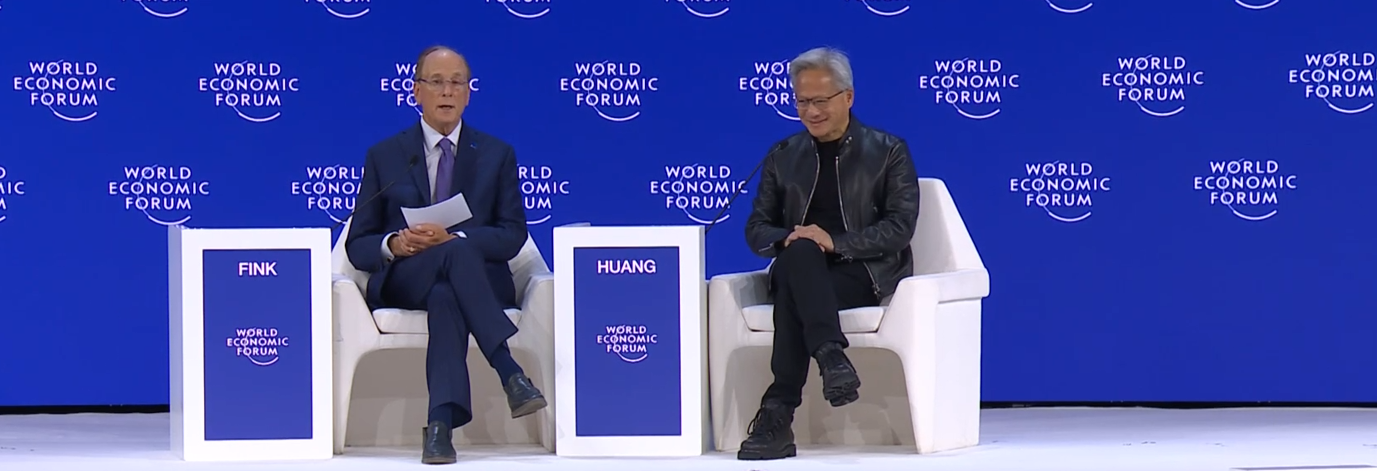
Screenshot from the World Economic Forum official livestream
Artificial intelligence (AI) is not merely another wave of technological innovation but the foundation of what could become “the largest infrastructure buildout in human history,” Nvidia founder and chief executive Jensen Huang said this week, arguing that the rapid expansion of AI is already reshaping global labor markets, capital flows and national economic strategies.
Speaking on a packed mainstage at the World Economic Forum’s annual meeting in Davos, Huang described AI as the beginning of a new computing platform era — one that will generate jobs across the economy, from skilled trades and heavy industry to software development and venture-backed startups. He was joined in conversation by Larry Fink, chairman and CEO of BlackRock, the world’s largest asset manager.
Rather than viewing AI as a single technology, Huang urged policymakers, investors and business leaders to understand it as a multi-layered system that must be built, operated and continuously refined. He likened AI to “a five-layer cake,” with each layer representing a distinct but interdependent part of the emerging platform.
Those layers, he said, start with energy and power generation, extend through chips and computing infrastructure, cloud data centers and AI models, and culminate in the application layer — where AI is embedded into real-world industries and delivers economic value.
“Every one of these layers has to be built,” Huang said. “And because they all have to be built and operated, this platform shift is creating jobs everywhere.”
From electricity generation and transmission to semiconductor manufacturing, data center construction and cloud operations, Huang said the AI buildout is already driving demand for skilled labor at scale. That includes not only engineers and software developers, but also plumbers, electricians, steelworkers, construction crews, network technicians and teams responsible for installing and maintaining advanced equipment.
“The infrastructure itself creates jobs,” he said, emphasizing that AI’s economic footprint extends far beyond the technology sector.
But Huang stressed that the largest and most durable economic gains will emerge at the top of the stack — the application layer — where AI is being integrated into industries such as healthcare, manufacturing and financial services.
“This layer on top,” he said, “is ultimately where economic benefit will happen.”
As AI models become more capable, Huang said they are reaching a threshold where businesses can reliably build applications on top of them. That shift, he argued, is one reason venture capital investment has surged.
He described 2025 as one of the largest years on record for global VC funding, with the majority of capital flowing into what he called “AI-native companies.”
“These companies span healthcare, robotics, manufacturing and financial services,” Huang said. “For the first time, the models are good enough to build on top of.”
That capital, he added, is translating directly into job creation across both digital and physical sectors.
Addressing concerns that AI could displace workers, Huang pushed back on the idea that automation necessarily destroys jobs. Instead, he said AI changes the nature of work by taking over tasks, allowing people to focus on the core purpose of their roles.
“AI likely won’t destroy jobs,” Huang said. “It actually increases demand in many professions.”
He pointed to radiology as a clear example. AI has become a critical tool for analyzing medical images, yet the number of radiologists has continued to rise.
“If you reason from first principles, not surprisingly, the number of radiologists has gone up,” Huang said.
The reason, he explained, is that reading scans is only one task within a radiologist’s job. The true purpose of the profession is diagnosing disease and helping patients. By analyzing images more quickly and accurately, AI allows radiologists to spend more time with patients and collaborate more closely with other clinicians. Because they can also see more patients, overall demand for radiologists increases.
A similar dynamic is unfolding in nursing, Huang said. The United States faces a shortage of roughly 5 million nurses, in part because nurses spend nearly half their working hours on administrative tasks such as charting and documentation.
“Now they can use AI to do the charting and the transcription of patient visits,” Huang said, pointing to work being done by companies such as Abridge and its partners.
As productivity improves, he argued, outcomes improve as well. Hospitals operate more efficiently, patient care improves — and healthcare systems hire more staff, not fewer.
“Hospitals do better, and they hire more nurses,” Huang said. “AI is increasing productivity, and as a result, hospitals want to hire more people.”
To underscore his broader point, Huang joked that if an observer simply watched him and Fink during their day-to-day work, “you would probably think the two of us are typists.”
Automating typing, he said, would not eliminate their jobs because typing is not their purpose. AI, by handling tasks, makes workers more productive and ultimately more valuable.
“So the question is,” Huang said, “what is the purpose of your job?”
Huang also framed AI as a matter of national strategy, arguing that governments should treat it as critical infrastructure — on par with electricity, roads or telecommunications.
“AI is infrastructure,” he said. “You should have AI as part of your infrastructure.”
He urged countries to develop their own AI capabilities rooted in local language, culture and data. Rather than relying entirely on external systems, nations should continuously refine their own models and integrate them into their economic ecosystems.
“Develop your AI, continue to refine it and have your national intelligence be part of your ecosystem,” Huang said.
Fink pressed Huang on whether AI primarily benefits the most educated segments of society. Huang rejected that notion, arguing that AI’s explosive adoption is driven by its ease of use.
“AI is super easy to use — it’s the easiest software to use in history,” Huang said, noting that in just two to three years, AI tools have reached nearly one billion people worldwide.
As a result, he said, AI literacy is rapidly becoming an essential skill — not unlike leadership or people management.
“It is very clear that it is essential to learn how to use AI — how to direct it, manage it, guardrail it, evaluate it,” Huang said.
For developing countries, Huang argued that AI offers a rare opportunity to close long-standing technology divides. Because AI is abundant and accessible, he said, it can help nations leapfrog traditional stages of industrial development.
“AI is likely to close the technology divide,” he said.
Turning to Europe, Huang highlighted the continent’s deep manufacturing and industrial expertise as a major competitive advantage. Rather than viewing AI as purely a software challenge, he encouraged countries to combine industrial capability with artificial intelligence to unlock what he described as “physical AI” — including robotics.
“You don’t write AI — you teach AI,” Huang said, calling robotics a “once-in-a-generation opportunity,” particularly for economies with strong industrial foundations.
Fink concluded the discussion by observing that Huang’s remarks suggested the global economy is far from being in an AI bubble. Instead, he posed a different question: whether the world is investing enough.
Huang agreed, saying the scale of the opportunity demands massive investment across all layers of the AI stack.
“We have to build the infrastructure necessary for all of the layers of AI above it,” he said.
The opportunity, Huang added, “is really quite extraordinary, and everybody ought to get involved.”
He reiterated that 2025 marked the largest year for global venture capital investment, with more than $100 billion deployed worldwide — most of it into AI-native startups focused on building the application layer.
“These companies are building the layer above,” Huang said. “And they’re going to need infrastructure — and investment — to build this future.”
Fink emphasized that participation in that growth must be broad-based, extending beyond technology firms and venture capitalists to long-term savers and pension funds.
“I actually believe it’s going to be a great investment for pension funds around the world to be a part of that, to grow with this AI world,” Fink said. “We need to make sure the average pensioner and the average saver is part of that growth. If they’re just watching it from the sidelines, they’re going to feel left out.”
As the Davos audience listened, Huang’s message was clear: AI is no longer a distant promise or a niche technology. It is fast becoming the backbone of a new economic era — one that will require unprecedented investment, reshape how people work, and redefine what infrastructure means in the 21st century.