

Image source: AMD livestream screenshot
Advanced Micro Devices (AMD.O) CEO Lisa Su on Monday showcased a slate of new artificial intelligence chips at the CES trade show in Las Vegas, including the MI455 processors designed for data-center servers sold to customers such as ChatGPT-maker OpenAI.
Su also introduced the MI440X, an enterprise-focused version of its MI400 series intended for on-premise use by businesses whose infrastructure is not built specifically for large AI clusters. The MI440X is based on an earlier chip design that the United States plans to deploy in a supercomputer.
AMD is Nvidia’s closest challenger in AI chips but has so far struggled to match the market leader’s commercial success. In October, AMD signed a strategic deal with OpenAI that analysts said represented a major endorsement of its hardware and software, though it is unlikely to significantly erode Nvidia’s dominance in the near term.
Nvidia continues to sell every AI chip it can manufacture, generating tens of billions of dollars in quarterly revenue — a scale AMD has yet to achieve.
Su invited executives from nine partner companies — including OpenAI, Luma AI, Liquid AI, World Labs, Blue Origin, Generative Bionics, AstraZeneca, Absci and Illumina — on stage for presentations and discussions on how AI is being applied across sectors from healthcare and life sciences to robotics and space.
OpenAI President and co-founder Greg Brockman said AI was already delivering tangible benefits to people’s lives, adding that healthcare was his favorite application area and that ChatGPT was helping save lives.
Earlier on Monday, OpenAI told digital media outlet Axios that more than40million people worldwide rely on ChatGPT each day for health-related information.
In a discussion with Su, Brockman said AI systems would continue to require more computing power, and that one of humanity’s biggest challenges would be how to use limited resources to generate the greatest benefit for society.
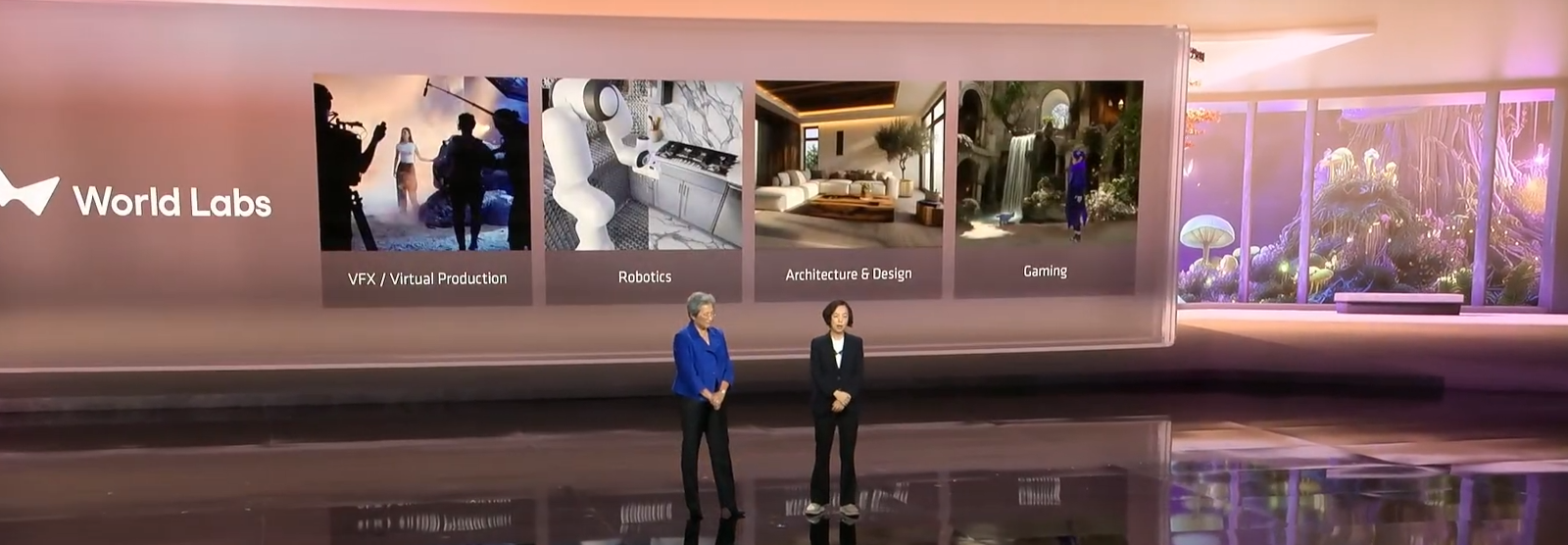
“Godmother of AI” Fei-Fei Li, founder and CEO of World Labs, also appeared on stage with Su and shared her views on so-called “world models” — systems that allow AI to understand and interact with the physical world.
Li said AI should not remain confined to large language models but should use its spatial intelligence to connect perception with action. She said she was particularly excited about the current wave of AI development, which she believes could bring machines closer to human-level spatial understanding.
“That is why I founded World Labs — I want to bring spatial intelligence to life and create real value for people,” Li said, adding that she expects spatial intelligence to reach application-level scale within two years.
Li also demonstrated Marvel, World Labs’ generative3D model, which can create digital replicas of real-world environments using just a few smartphone photos, enabling new applications in gaming, design and simulation.
She said World Labs had recently begun working with AMD, and that within less than a week Marvel was running on AMD’s MI325X chip, with performance boosted more than four-fold using AMD’s Instinct platform and ROCm software.
“After today’s announcements, I cannot wait to see how our products evolve on platforms like the MI450,” Li said.
Looking ahead, Su previewed AMD’s next-generation MI500 processor, which she said would deliver up to1,000times the performance of older versions. AMD said the MI500 series is expected to launch in2027.
At the same event, Su hosted Daniele Pucci, CEO of Italian AI developer Generative Bionics, who unveiled GENE.01, a humanoid robot. Pucci said the company’s first commercial humanoid robot would be manufactured in the second half of2026.
Earlier on Monday, Nvidia (NVDA.O) unveiled its next-generation Vera Rubin platform, a six-chip system that CEO Jensen Huang said is now in full production and is expected to debut later this year.
AMD executives said the OpenAI deal is expected to drive significant additional sales, with the first deployment of servers using MI400-series chips scheduled for rollout this year.
AMD also announced the launch of its Ryzen AI400 Series processors for AI-enabled personal computers, alongside Ryzen AI Max+ chips designed for advanced local inference and gaming workloads. Rival Intel held a separate launch event for its Panther Lake processors, which it said would become available for order on Tuesday.