

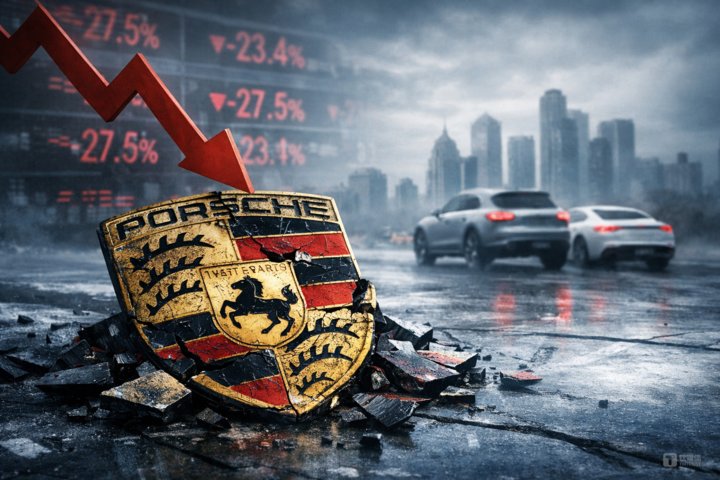
At a briefing a few days ago, Porsche China President and CEO Alexander Pollich laid out the backdrop bluntly: while China’s overall auto market has still been growing over the past three years, the luxury and premium segments have declined by about 28%, and models priced above 1 million yuan have fallen by about 23%.
The significance of these figures is that they draw a clear dividing line—China’s car market hasn’t slowed across the board; instead, it has cooled in layers. The higher up you go, the faster the temperature drops; and the more a brand depends on high price points and high premiums, the more acute it feels.
And Porsche happens to be sitting at the steepest part of that curve.
As a niche luxury brand with high per-vehicle value, it doesn’t have the option of diluting risk by chasing volume. When the overall price band above RMB 1 million contracts, Porsche isn’t simply facing the issue of selling a bit less—it’s dealing with a narrowing market in which it can still maneuver. That means even if it keeps its pricing structure unchanged, sales will naturally slide; once it resorts to price moves, its profit model comes under direct pressure.
Pollich’s stance on this was notably restrained. He said, “We can’t change the broader economic environment, nor can we reverse the overall market trend. What we can do is take a hard look at ourselves and place greater emphasis on our core development.”
Porsche can, of course, explain everything away with “the macro environment.” The problem is that the cooling of China’s high-end car market isn’t simply a macro-level story of more cautious spending; it is being squeezed by a three-way overlay of price, product, and competition.
Pollich described the situation as a “perfect storm”—young affluent consumers are highly sensitive to the economic climate, real estate can no longer underpin expectations for asset values, and domestic brands are advancing at breakneck speed on both cost and technology.
If the decline in the first phase could still be explained away as “a tough environment,” then Porsche’s truly thorny problem in China actually lay one layer deeper—high-end users’ understanding of “luxury” has already shifted to an entirely new coordinate system.
Michael Kirsch’s ranking of the reasons behind the sales slump offered a very clear line of reasoning. He didn’t put the “macro economy” first; instead, he pointed straight at demand itself: “Such structural shifts usually always begin with changes in customer needs.”
This means he rejected the simplistic narrative that “a price war defeated Porsche.” A more accurate way to put it is: it wasn’t that users no longer认可 Porsche; rather, the evaluation framework had moved.
For more than a decade, Chinese high-end consumers’ view of luxury cars was relatively stable—brand heritage, mechanical performance, and an engineering-driven aesthetic formed the core sources of premium pricing. Today, however, that logic is being overridden by a new main thread: whether the tech experience is complete, whether the system is smooth, and whether the scenarios truly fit real-world use.
Kirsch didn’t dodge this at all: “Chinese customers are at the forefront of changing needs. They want a perfect technology experience in their cars, and they expect the same seamless experience in the vehicle as they have within the smartphone ecosystem.”
For any traditional luxury brand, those words translate into real pressure. Because they imply that even if a product still delivers on driving, handling, and craftsmanship, any gap in the system experience will lead people to repeatedly question the premium.
This shift was especially evident in the core SUV segment. Kirsch said, “Take the C-segment SUV submarket where the Cayenne sits, for example: over three years, manufacturers’ suggested retail prices fell by more than one-third.” The price anchor for the entire subsegment was dragged sharply downward. When consumers got used to using what used to be a B-segment SUV budget to compare the specs, smart features, and space of C-segment SUVs, the price structure that once rested on brand stature was forced into direct, side-by-side comparison.
For Porsche, the squeeze had twofold consequences: on the one hand, bargaining room on new cars was compressed; on the other, residual values and channel expectations began to come under pressure. Falling sales were only the surface symptom—the real risk was the continued erosion of profit.
More complicated still, what is driving this shift isn’t price alone, but a change in the very rules of competition. When talking about domestic brands, Michael Kirsch highlighted a key difference: they already have ready-made ecosystems, and they don’t carry the baggage of legacy platforms or massive sunk investments. That allows them to start software development and system integration from a “blank sheet.” Add to that economies of scale and vertical integration, and their cost structures are inherently lighter.
That’s also why simply debating “whether to cut prices” or “whether to localize” doesn’t really solve anything. The real issue is this: once the criteria for what counts as “luxury” are rewritten, the premium foundation Porsche once relied on is being asked—again and again—to prove itself.
A Defensive Survival Strategy
Against this backdrop, Porsche’s repeated emphasis that “quality matters more than volume” is, at its core, a survival choice forced by reality.
Kirsch said candidly: “In a market environment like this, we won’t do everything possible to chase sales or market share. Compared with long-term success, pursuing short-term sales would be disastrous.”
If you read it purely as brand storytelling, it sounds restrained; but from an industry perspective, it looks more like a clearly defined stop-loss line. Because with the premium market overall moving downmarket, once you trade price for volume, what gets truly pierced isn’t sales—it’s three assets that are far harder to repair: residual-value expectations, channel confidence, and long-term pricing power.
Precisely for that reason, Porsche’s adjustments in China have not moved toward aggressive expansion, but instead have chosen contraction and restructuring in parallel.
Its dealer network has been explicitly identified as needing optimization——to be adjusted from more than 100 stores to a more controllable scale. 4S centers are positioned as “motherships,” taking on integrated functions across new cars, pre-owned vehicles, and after-sales service and repairs, rather than serving as single-purpose sales windows.
The logic behind this direction isn’t complicated: as incremental demand slows, the value of point-by-point reach declines, and the comprehensive efficiency of each outlet becomes more important than sheer coverage density. Kirsch’s attitude toward new retail formats and city showrooms is also quite cautious——prime commercial-district rents are soaring, and after-sales chains are complex; once functions are split up, costs can balloon quickly. By comparison, limited-time pop-ups look more like a controllable experiment.
The same defensive logic is also reflected in R&D and the cadence of technology rollout. Porsche has not denied the impact of “China speed”; on the contrary, it has clearly stated that it intends to learn——shortening cycles and improving efficiency. But in intelligence and driver-assistance, it has repeatedly stressed one red line: safety and reliability are non-negotiable, and it will not turn customers into “guinea pigs for iterative testing.”
This makes Porsche’s position in China particularly paradoxical: on the one hand, it has to accelerate localized R&D to close the gaps in system-level user experience; on the other hand, it can’t, like some of the new EV upstarts, trade high-frequency iteration for a speed advantage.
The result is that it has chosen to sacrifice tempo in exchange for brand consistency.
From a business standpoint, this is hardly the most crowd-pleasing path. The market rewards speed and punishes hesitation; yet under pressure, Porsche has opted to prioritize defending its pricing and brand boundaries. That reflects a clear-eyed assessment of its own limits: without a scale advantage, getting overly drawn into price wars would only accelerate model distortion.
So rather than saying Porsche in China is “choosing to slow down,” it’s more accurate to say it is being pushed into a defensive posture. It is no longer chasing every volume opportunity; instead, it is filtering risk first, reserving limited room for a more sustainable mix of customers and products.
Whether this strategy will be enough to cope with shifts in the Chinese market still needs to be tested by time. But one thing is certain: at this stage, “quality over quantity” has gone from a value slogan to a reality it has no choice but to execute.
Can Porsche Still Win China Back?
When people keep asking, “Can Porsche still win China back?”, Oliver Blume’s answer deliberately avoided the easiest metric to quantify——sales.
He said, “Sales volume is not our yardstick for success.”
That line hints at a less-than-optimistic judgment: at least for the foreseeable future, Porsche does not have the conditions to re-enter a high-growth lane. Whether it’s the product cycle, the pace of electrification, or how quickly it can close the gap in smart capabilities, all of it means it can’t, like some Chinese brands, quickly repair the curve through back-to-back launches and dense iteration.
Blume himself didn’t try to sugarcoat this. He framed 2026 as “a phase of recalibration and adjustment,” stressing that this is an “endurance race,” not a sprint.
Judging from the current product cadence: before new models in the B and D segments truly generate incremental volume, and before its BEV products are fully on solid footing, Porsche in China can only accept a slower, more cautious operating mode.
Zooming out to the global picture, this choice isn’t unique to China. A pullback in global sales and a pronounced drop in margins have already left Porsche with less room than before to “use strength elsewhere to offset local volatility.” China is no longer just a source of swings, because any misstep in pacing will be quickly magnified on the profit and loss statement.
The problem is that shifts in the Chinese market won’t slow down just because a brand chooses to ease off. Consumers’ expectations for intelligent features, a cohesive system experience, and overall value have already become the new baseline. For Porsche, that means a far-from-easy reality: without compromising the brand’s core, it has to prove its legitimacy all over again.
As a result, Porsche’s situation in China may be closer to a “structural stress test” than a temporary trough. It hasn’t lost its brand appeal, and it’s nowhere near being pushed out of the market; but it is being forced to accept one fact—in China, the luxury label alone is no longer a shield, and past glory doesn’t automatically translate into today’s sales and profits.
The outcome of this endurance race has yet to be decided. But one thing is certain: in a highly efficiency-driven market that keeps accelerating, Porsche is trying to push back against an era that no longer waits for anyone by “holding the line.” (Reporting by Li Yupeng, Editing by Li Chengcheng)