

Against the backdrop of gold’s relentless surge through 2025, a red-hot overseas gold rush by China’s domestically listed mining companies has been unfolding.
Over the past year or so, five industry leaders—including Zijin Mining and CMOC Group—have spent more than RMB 66 billion (about $9.4 billion) in total “shopping” for gold mines worldwide. To secure their preferred targets, they have not hesitated to pay hefty premiums to acquire loss-making companies.
Behind the shopping spree are two forces: a hunger for resources and the windfall from higher gold prices. Earlier, riding the wave of rising gold prices, domestic miners posted eye-catching earnings growth, validating the “buy, buy, buy” strategy as a short-term success. However, as gold prices have dipped recently, this large-scale global “shopping” binge also carries hidden risks—tighter funding conditions and exposure to gold-price volatility.
Gold mine “shopping spree”
Over the past year or so, China’s listed gold companies have been snapping up assets overseas. According to Jiemian News statistics, the combined amount spent on overseas gold-mine purchases by five companies—Zijin Mining, CMOC Group, Jiangxi Copper, Lingbao Gold, and Shengtun Mining—has already exceeded RMB 66 billion.
Among them, Zijin Mining—now ranked among the world’s top five listed gold producers—has been the most aggressive in its overseas push, spending more than RMB 45 billion in total over the past year or so.
In December 2024, Zijin Mining acquired Peru’s La Arena gold mine for up to US$300 million; in April 2025, it bought Ghana’s Akyem gold mine for US$1 billion; and in October that year, it acquired Kazakhstan’s Raygorodok gold mine for US$1.2 billion.
Just a few days ago, Zijin Mining made another move, announcing that Zijin Gold International, which it controls, planned to acquire all issued and outstanding common shares of Canada’s Allied Gold Corporation (Allied Gold) at a cash price of CAD 44 per share. The total consideration is about RMB 28 billion, in order to secure three gold mine projects in Africa.
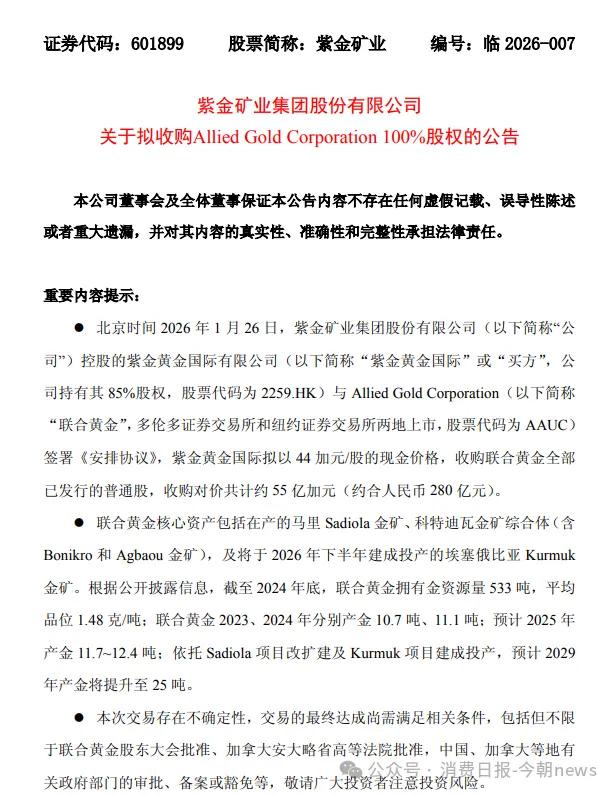
Image source: Zijin Mining
The other four companies also spent heavily.
Since June 2025, CMOC Group has invested a total of over RMB 10 billion in acquiring gold mines. It first bought Ecuador’s Odin gold mine in June last year, and then in January this year spent about RMB 7.162 billion to acquire three Brazilian gold mine projects owned by Equinox Gold, a Canadian-listed mining company.
After Jiangxi Copper increased its stake in early 2025 to become the largest single shareholder of London-listed SolGold Plc, it made a third bid in December that year of about RMB 8.2 billion to buy the remaining shares, securing the company’s core asset—the Cascabel gold mine in Ecuador.
Shengtun Mining announced in October 2025 that it would acquire 100% of Canada-listed Loncor for about RMB 1.35 billion, thereby obtaining the Adumbi gold mine in the Democratic Republic of the Congo. Two months later, peer Lingbao Gold announced that it planned to subscribe for a 50% plus one share equity stake in Australia’s St Barbara Mining for RMB 1.735 billion, gaining the Simberi gold mine in Papua New Guinea.
To expand their gold resources, listed mining companies have even lowered their requirements for the performance of acquisition targets.
According to a report by Jiemian News, to secure Ecuador’s Cascabel gold mine—widely seen as having the potential to rank among the world’s top 20 copper-gold mines—Jiangxi Copper did not hesitate to raise its offer for SolGold from 26 pence per share to 28 pence per share. The offer represented a premium of about 42.9% over SolGold’s closing price of 19.6 pence on November 19, 2025 (the last trading day before initial contact), and a 58.5% premium over the prior three-month volume-weighted average share price.
It is also worth noting that SolGold was still loss-making, posting losses of US$60.30 million and US$36.2491 million in fiscal 2024 and fiscal 2025, respectively; as of June 30, 2025, it had total assets of US$493 million and total liabilities of US$254 million.
To obtain Ecuador’s Cangrejos gold mine, CMOC acquired Toronto Stock Exchange-listed Lumina Gold at a purchase price of C$1.27 per share, a 41% premium to the closing price on April 17 (the day before the announcement).
Lumina Gold’s performance was likewise weak. Based on its pre-feasibility study, heavy upfront spending during the early exploration phase left Lumina Gold in sustained losses in recent years. In the first three quarters of 2024, it reported a loss of US$33.1464 million, with cash and cash equivalents of just US$5.3122 million.
The operator of Papua New Guinea’s producing Simberi gold mine was also in the red, recording losses of US$12.737 million and US$21.292 million in fiscal 2024 and fiscal 2025, respectively, on revenue of US$130 million and US$136 million; as of September 30, 2025, it had total assets of US$233 million and negative net assets of US$27.794 million.
Even so, Lingbao Gold subscribed last December for 50% plus one share of St Barbara Mining’s equity, adding 153 tonnes of gold resources to the company.
Several key projects acquired by Zijin Mining were profitable, but according to Jiemian News, as gold grades declined and mining costs rose, cash costs at the La Arena gold mine in Peru—acquired by Zijin Mining—kept climbing, coming in at US$1,038/oz, US$1,237/oz, and US$1,362/oz in 2022, 2023, and 2024, respectively.
At the same time, the heap-leaching process involved in La Arena’s operations also carries environmental risks, which could lead to substantial remediation costs.
At Akyem, one of Ghana’s largest gold mines, which Zijin Mining bought for over RMB 7 billion, all-in sustaining costs in Q2 2024 reached US$1,952/oz—far higher than those at the Wassa gold mine, also in Ghana (all-in sustaining costs were US$1,177.8/oz in the first half of 2024).
Gold prices are soaring
Even if it means paying top dollar to acquire a money-losing company, the goal is still to secure gold-mine resources. Behind this, the rapid surge in gold prices is the direct catalyst.
In 2025, the international spot gold price rose from US$2,585/oz to US$4,314/oz—an increase of nearly 70%. After entering 2026, the international spot gold price had already broken US$5,080 by January 27, up 18% in less than a month. In its latest research note, Goldman Sachs raised its forecast for gold to US$5,400/oz by the end of 2026.
Runaway gold prices have given major domestic listed companies the impetus to pursue acquisitions—catapulting overseas miners into the spotlight.
At home, high-quality, high-grade gold deposits are scarce; most are low-grade ores that are difficult to process and smelt, with high mining costs and limited room for capacity expansion. Overseas, by contrast, core metallogenic belts (West Africa and South America) are resource-rich.
The cost of acquiring overseas projects is also lower.
China Galaxy Securities, commenting on Zijin Mining’s purchase of the Akyem project—one of Ghana’s largest gold mines—said: “The P/E for this acquisition is 7.8x, significantly below the 20x-plus P/E currently seen among A-share listed gold companies.” Including underground resource reserves, the implied price Zijin Mining paid this time was RMB 41 million per tonne of gold resources. In the same year, the implied prices per tonne of gold resources involved in Shanjin International’s acquisition of the Twin Hills gold mine and Shandong Gold’s acquisition of the Taolegai gold mine project were RMB 15 million and RMB 42 million, respectively.
This has driven domestic listed miners into a frenzy of overseas M&A. And in an upcycle, listed miners have indeed tasted the “sweetness” of a buy-buy-buy strategy.
Previously, Zijin Mining stated publicly that in the very year it acquired Allied Gold, Allied Gold could already contribute output and profit. In 2025, Allied Gold was expected to produce 11.7–12.4 tonnes of gold. With the expansion and upgrade of the Sadiola project and the completion and commissioning of the Kurmuk project, gold output was expected to rise to 25 tonnes by 2029.
Zijin Mining also said in its earnings pre-announcement that it expected net profit attributable to shareholders in 2025 to reach RMB 51.0–52.0 billion, up 59% to 62% year on year; within that, Zijin Gold International was expected to deliver net profit attributable to shareholders of about US$1.5–1.6 billion, more than tripling year on year.
China Molybdenum expects its 2025 net profit attributable to shareholders to come in at about RMB 20.0–20.8 billion, up 47.8%–53.71% year on year. Lingbao Gold expects its 2025 net profit attributable to shareholders to be about RMB 1.503–1.573 billion, up 115%–125% year on year.
That said, the gold market is cyclical. Especially right now, not only are the swings large, but the cycle is also short.
Multiple risks lurk beneath the gold rush
After a previous round of strong gains, international precious metals markets were hit by a “major plunge.”
According to a report by Red Star News, on January 30 international gold prices fell through multiple psychological round-number levels, dropping more than 11% in a single day. Silver prices plunged even more dramatically—down 31.37%—marking their worst single-day performance since March 1980. On a weekly basis, last Friday’s steep sell-off wiped out all gains from the prior few sessions earlier in the week: international gold prices fell 4.71% in total, while international silver prices declined 22.50% in total.
Domestic retail gold jewelry prices per gram also tumbled, with some gold shops seeing drops of more than RMB 200 over two days.
Several domestic banks moved quickly over the past two days—raising the threshold for investors to purchase accumulation gold products while also sounding the alarm. Industrial and Commercial Bank of China Limited noted in its February 1 “Notice on Further Strengthening Risk Prevention in the Precious Metals Market” that precious metals prices at home and abroad have been highly volatile lately, and market uncertainty has risen markedly.
Although some mining companies have said publicly that they don’t place much weight on short-term windfalls, in reality their big-spending “buy, buy, buy” strategy has already put some pressure on their cash flow.
As of September 30, 2025, Zijin Mining held about RMB 69.1 billion in cash and cash equivalents and RMB 9.8 billion in trading financial assets. Its latest acquisition payment of RMB 28.0 billion accounted for more than 40% of its cash holdings; meanwhile, it also carried substantial liabilities over the same period.
To ease the funding pressure from spending vast sums to acquire overseas gold mines, Zijin Mining bundled overseas assets such as Ghana’s Akyem gold mine into its subsidiary Zijin Gold International. After spinning it off, the company listed it on the Hong Kong Stock Exchange’s Main Board in September 2025, raising HKD 25.0 billion in its IPO.
Although Shengtun Mining and Lingbao Gold pursued smaller acquisitions, their funding positions were also tightening, requiring them to borrow to go on a buying spree.
Since 2025, Lingbao Gold raised HKD 234 million and HKD 1.166 billion through share placements and the issuance of convertible bonds, among other means, to fund overseas gold-mine acquisitions. As of June 30, 2025, the company had cash and cash equivalents of about RMB 436 million at period-end, current liabilities of about RMB 4.1 billion, including RMB 2.929 billion in short-term bank borrowings.
As of September 30, 2025, Shengtun Mining had about RMB 7.922 billion in cash and cash equivalents and RMB 331 million in trading financial assets, with total liabilities exceeding RMB 23.0 billion. This included RMB 16.6 billion in current liabilities, among which short-term borrowings exceeded RMB 7.6 billion and notes payable plus accounts payable totaled RMB 4.4 billion. Company representatives also told the media that its funding situation was sound, cash flow was normal, and it still had quite a lot of unused bank credit lines.
Gold-price movements directly affect the returns and risks of these companies’ investments. Once the industry enters a downcycle, it can easily trigger risks such as operational difficulties, debt crises, and breaks in the funding chain.
In some overseas M&A deals pursued by certain miners recently, there have also been some visible risks.
For example, some mining companies, due to inadequate early-stage assessments and the difficulty of negotiating the deal, saw their quoted prices repeatedly rejected. In the end, the agreed transaction value carried a premium of more than 40%. Although the acquisition targets’ resources show strong potential, some gold mines are still undeveloped, such as the Adumbi and Cascabel gold mines. And with development cycles stretching over several years, the payback period is long.
Previously, the surging gold price enabled Chinese gold companies to reap short-term dividends in the global M&A arena. Their eye-catching performance growth figures validated the phase-by-phase success of the “buy, buy, buy” strategy.
However, long mine-development timelines and heavy capital requirements—coupled with sharp swings in gold prices and the strained cash flows of some companies—have planted hidden risks beneath this gold rush. Looking ahead, as a cyclical adjustment in the gold market arrives, mining companies that have made big-ticket overseas bets will ultimately face a major test of judgment and risk resilience.
(Note: 1 US$ equals 7 Chinese yuan.)