

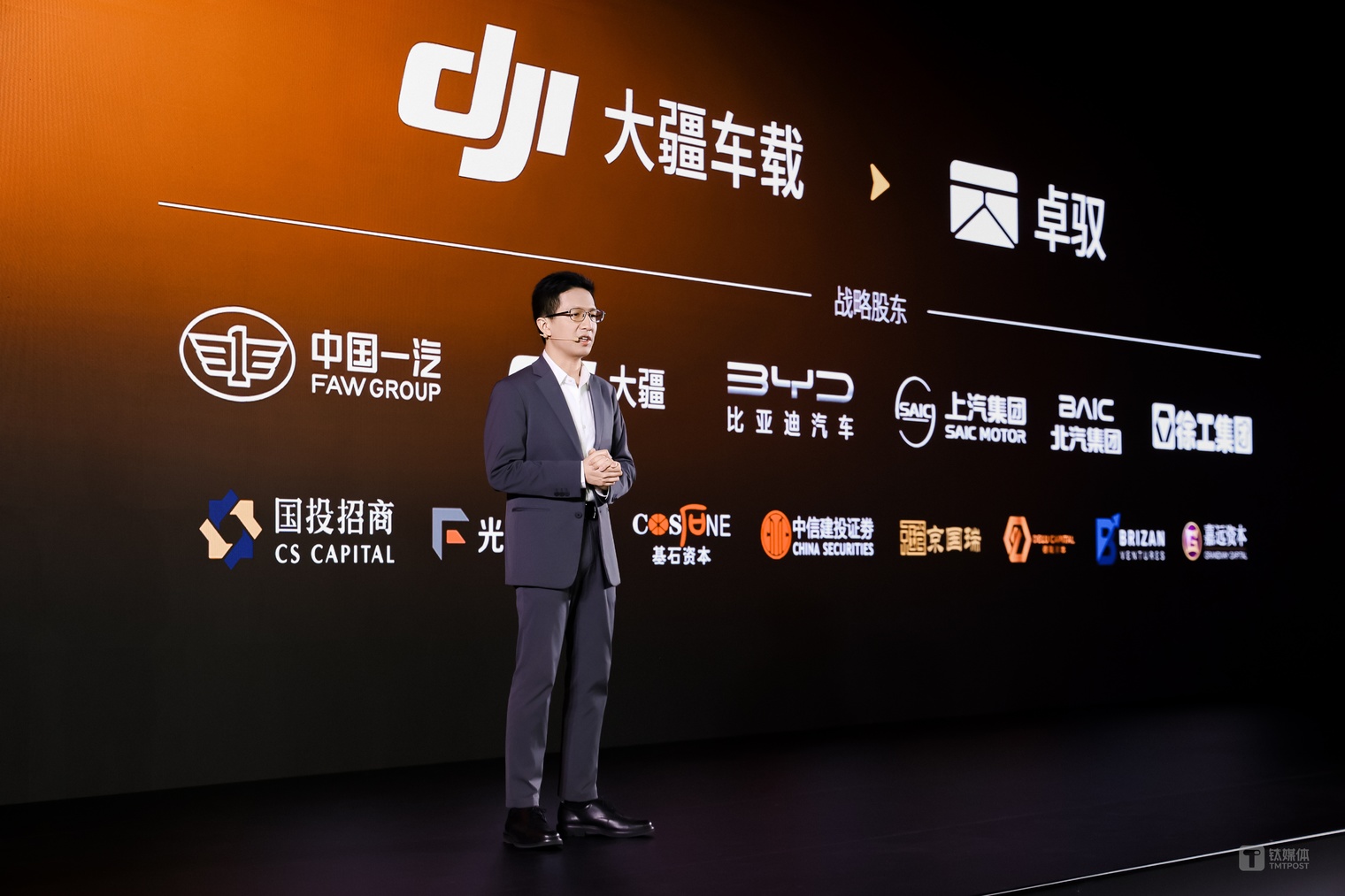
Shen Shaojie, the founder of Zhuoyu
China’s autonomous driving industry is entering a rapid shakeout as startups shut down, merge or seek shelter inside automakers, while survivors race to rebuild their technology around data-driven artificial intelligence systems.
The collapse of Haomo Zhixing at the end of 2025, despite backing from a major conglomerate, and the dissolution of Dazhuo Intelligent months earlier have underscored how quickly the sector is consolidating. At the same time, companies that manage to reposition themselves are attracting capital and industrial partners, such as Zhuoyu Technology, which recently secured more than 3.6 billion yuan ($500 million) in strategic investment from China FAW Group.
The diverging fortunes reflect a structural shift in the industry, away from rule-based driver assistance software toward end-to-end, data-driven models that can be retrained and improved continuously.
In May, Dazhuo Intelligent said it would dissolve and fold its operations into Chery Automobile’s intelligentisation unit. Zhongzhixing was later declared bankrupt and liquidated by a court after failing to pay a labour arbitration award.
“These are not isolated cases,” said Shen Shaojie, founder of Zhuoyu Technology. “They are symptoms of the same transformation.”
Access to funding and early market entry, once decisive, no longer guarantee survival, industry executives say. Instead, the key differentiator has become the ability to build a fast, reliable system for data collection, model training, testing and deployment.
“For leading companies, model iteration now happens on a monthly basis, sometimes faster, and the rankings keep changing,” Shen said. “The competition is no longer about who started first, but whose iteration system is faster and more efficient.”
Zhuoyu has shortened its internal model iteration cycle to about one week, and reduced customer delivery timelines from around six months to just over one month, according to Shen.
“In many cases, the gap between leaders and followers is just the time window of a successful update,” he said.
Like many peers, Zhuoyu initially relied on rule-based engineering. The company was founded by a robotics team that believed driving behaviour could be explicitly modelled and controlled.
That approach became increasingly uncompetitive as end-to-end systems improved. On Oct. 14, 2024, Zhuoyu deleted its entire rule-based codebase and committed fully to a data-driven approach.
“We wiped out about 3,000 lines of code and all the path dependence behind them,” Shen said.
The transition was painful. Early models were unstable, customers demanded predictable delivery, and system behaviour was harder to explain.
But over time, Zhuoyu found that layered fallback rules intended to improve safety often made systems perform worse.
“Most ‘dumb mistakes’ happen when fallback logics clash,” Shen said. “When they conflict, the vehicle makes unreasonable decisions.”
Zhuoyu replaced fallback rules with a unified evaluation framework, in which models are accepted or rejected based on performance across comprehensive test suites.
The shift has also changed how companies invest.
Several of Zhuoyu’s biggest performance gains in 2025 came not from changing model architectures, but from improving the quality and structure of its data, Shen said.
“This year, better data mattered more than better models,” he said.
As a result, data pipelines, labelling accuracy and feedback loops have become core operational metrics. Zhuoyu now provides automakers not just with software features, but with tools for data feedback, retraining and optimisation.
The aim, Shen said, is to combine the adaptability of AI with the reliability required for mass production.
Shen acknowledged that Zhuoyu lagged some rivals by about six months in adopting end-to-end methods.
“That gap can be critical,” he said. “But starting later doesn’t mean you’ll always be behind.”
He said Zhuoyu’s internal restructuring has enabled it to catch up and in some areas lead on user experience.
The discipline of the data-driven approach, however, requires engineers to resist quick fixes.
“When a problem appears, the instinct is to patch it,” Shen said. “But any logic you add is hard to remove later and creates conflicts.”
Looking ahead, Shen expects competition to intensify further.
After the third quarter of 2025, the industry entered what he described as a “breakthrough period,” with major advances emerging every few months.
“That intensity will be even higher in 2026,” he said.
Zhuoyu plans to extend its end-to-end approach across more scenarios and vehicle models, and to scale its so-called VLA architecture — integrating perception, scene understanding and short-term action inference.
The company is also promoting a “foundation model” strategy that allows automakers to build their own functions on top of its system.
“Once that foundation exists, the traditional boundary between in-house development and supplier solutions becomes less rigid,” Shen said.
Despite the technological progress, the commercial environment remains tight.
Shen said most of Zhuoyu’s revenue — and nearly all of its data — will continue to come from passenger vehicles, making partnerships with automakers essential.
For smaller firms without such ties, survival is increasingly difficult.
“If a new area requires hundreds of people, we won’t do it,” Shen said. “If a small team can do it, we will.”
As consolidation continues, analysts and executives expect the number of independent intelligent driving startups to shrink further, leaving a smaller group of companies deeply embedded within automakers’ supply chains.
The industry’s next phase, they say, will be defined less by bold claims and more by engineering discipline — and by how quickly companies can turn data into deployable, reliable systems.