

NextFin -- The sudden appearance of the famous painting Spring in Jiangnan on the auction market has triggered a wave of public outrage, official investigations and legal battles, exposing unresolved questions about how cultural relics once entrusted to public institutions were dismissed as fake and ultimately monetized.
On Dec. 17, Shanghai-based The Paper reported that Spring in Jiangnan, a Ming-dynasty handscroll attributed to painter Qiu Ying and once part of the Nanjing Museum’s collection, had surfaced at a Beijing auction preview with a reserve price of 88 million yuan (about US$12.6 million). The work was donated by the descendants of early-20th-century collector Pang Laichen in 1959.
The report ignited a storm of public reaction. On Dec. 23, China’s National Cultural Heritage Administration said it had formed a working group and dispatched officials to Nanjing to investigate. The Jiangsu provincial government announced the creation of a joint task force involving disciplinary inspectors, judicial authorities, police, publicity officials and cultural heritage regulators to conduct a comprehensive inquiry into the handling of donated artifacts at the Nanjing Museum.
Authorities pledged that violations would be penalized and that findings would be made public.
At the center of the controversy lies a simple but troubling question: How did a painting sold for just 6,800 yuan in 2001 reappear more than two decades later with a price tag exceeding 88 million yuan?
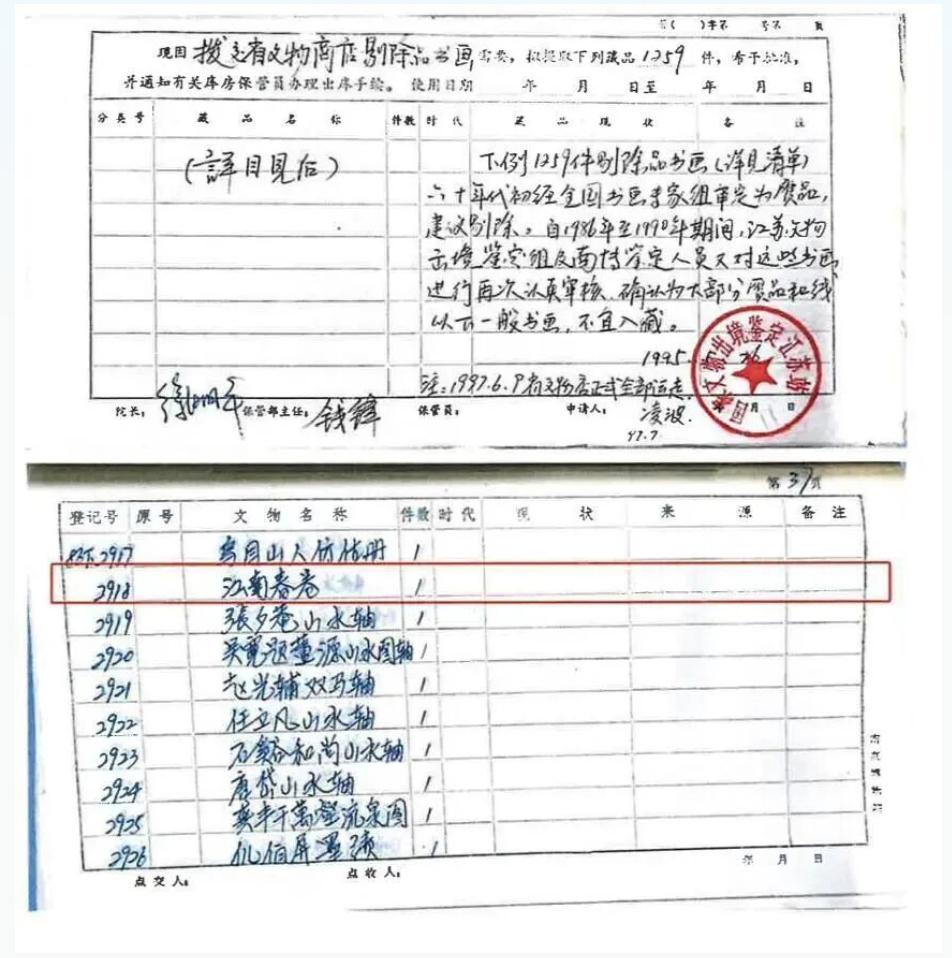
Evidence published by the Nanjing Museum on December 19 indicates that in May 1997, the Ming-dynasty painting Spring in Jiangnan attributed to Qiu Ying — later identified as a forgery — was handed over to the former Jiangsu Provincial Cultural Relics General Store, where it was registered as Spring in Jiangnan Scroll.
On Dec. 19, the Nanjing Museum released a document chain showing that in 1997 the painting, then classified as a forgery, was transferred from the museum to the Jiangsu Provincial Cultural Relics Store. On April 16, 2001, it was sold for 6,800 yuan under the name Imitation of Qiu Ying Landscape Scroll.
But the invoice did not list a buyer’s name. It simply said “customer.”
Why was the buyer anonymous? Is it normal to for the buyer to stay anonymous?
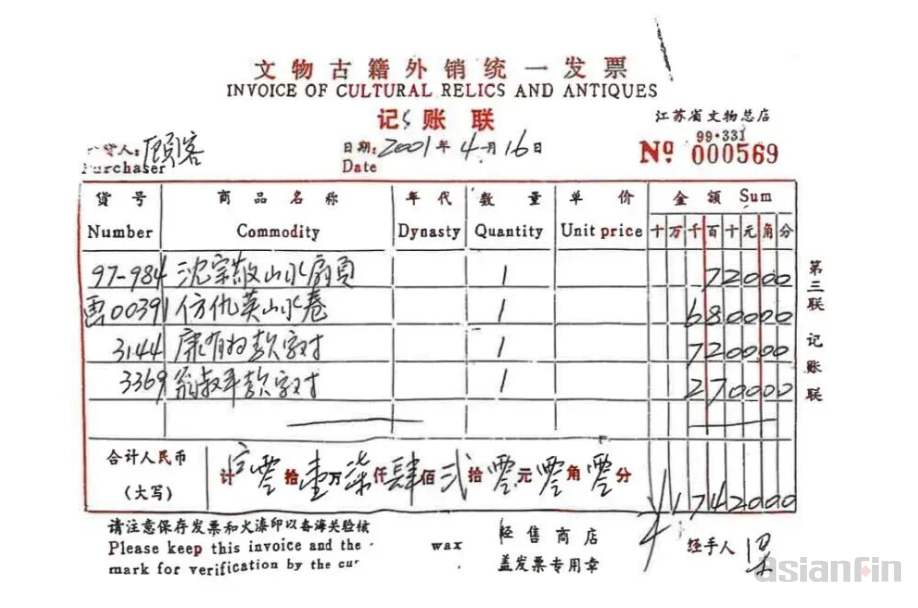
Materials released by the Nanjing Museum on December 19 show that on April 16,2001, the painting Spring in Jiangnan was sold to a “customer” for 6,800 yuan, with the sales list describing it as Qiu Ying Landscape Scroll.
A well-known art broker told the Paper that “customer” was sometimes used as a deliberate concealment. “Ordinary buyers were normally named,” he said. “If it only says ‘customer,’ it often means the buyer could not be named — either because they were politically sensitive, socially influential, or connected to the institution itself. Inside the industry, this was sometimes called an ‘internal counter’ transaction.”
The original 1997 transfer document bore three signatures — Xu Huping, Qian Feng and Ling Bo — with Xu Huping being the most significant.
At the time of the transfer, Xu was vice president of the Nanjing Museum and simultaneously the legal representative of the Jiangsu Cultural Relics Store, which later sold the painting. In 2001, Xu became president of the museum — just three months before the sale.
His dual role has become a central focus of scrutiny.
Pang Shuling, a great-granddaughter of Pang Laichen and one of the donors’ descendants, argues that Xu had no legal authority as vice president to approve the removal of over 1,200 artifacts from the museum’s collection.
“This created conditions for secret stealth dealings and targeted transfers,” Pang told the Paper. “The vague word ‘customer’ on the invoice may be a trace of such abnormal operations.”
Xu declined to comment, telling reporters that he was retired and unwell. When journalists visited his home on Dec. 22, he refused to answer questions, saying only: “There will be a day when everything becomes clear.”
The painting was long believed to have been owned by Lu Ting, a prominent Nanjing collector and founder of the private Yilan Zhai Museum. Lu, who died in May 2025, publicly described Spring in Jiangnan as the centerpiece of his collection.
Lu and Xu were closely connected. Xu was the founding chairman of the Jiangsu Collectors Association, while Lu served as a consultant. Xu once publicly praised Lu’s museum project as “an extraordinary achievement” larger than the provincial museum itself. Xu has taken away by police for investigation on Friday.
But contradictions soon emerged.
While museum records suggest the painting was sold in 2001, several people say Lu already owned it in the late 1990s.
Shanghai collector Yan Ming said he personally saw the painting at Lu’s home in 1999. “Lu proudly unfolded it and called it ‘the world’s finest Qiu Ying," Yan recalled. “He clearly already had it.”
Yan later learned that Lu had acquired the painting from the Jiangsu Cultural Relics Store for about 160,000 yuan — far higher than the 6,800-yuan invoice shows — possibly through a pre-arranged transaction.
This has fueled suspicions that the transfer and sale may have been orchestrated specifically for Lu.
After Lu’s death, many assumed his family consigned the painting for auction. That assumption proved wrong.
Pang Shuling learned during court proceedings in November that the consignor was not Lu’s family, but a man named Zhu Guang from Ningbo.
According to art market insiders, Lu had pledged eight artworks — including Spring in Jiangnan — as collateral to Nanjing Ten Bamboo Studio in exchange for loans totaling tens of millions of yuan. After Lu defaulted, the works were transferred to Zhu Guang for at least 50 million yuan.
Zhu later sold one of the eight works, a calligraphy scroll by Chen Chun, for 35 million yuan at a 2023 auction. He then consigned Spring in Jiangnan.
Zhu has declined to comment and hung up on reporters who called him.
The painting appeared at a Beijing auction preview in May with a reserve price reported to be 88 million yuan. But following Pang’s complaints and official intervention, it was withdrawn just hours before the sale.
The fate of the painting now remains uncertain.
The legal battle now centers on whether Pang’s descendants can reclaim the painting.
Museum lawyers argue that ownership transferred to the state in 1959 and that donors retain no right of return.
Pang’s lawyers counter that the museum violated a fundamental condition of the donation — permanent preservation — and that under China’s Civil Code, donors can revoke gifts if recipients fail to fulfill agreed obligations.
A 1959 letter from the Nanjing Museum thanked the Pang family and promised: “We will carefully preserve this batch of paintings.” Pang’s lawyers argue this constituted a binding commitment.
Legal scholars and cultural experts largely support the view that museums should not sell donated works, regardless of authenticity.
“If a museum rejects a donated work as unsuitable, it should return it — not sell it,” said Jiang Yin, a professor of South China Normal University. “Selling a donated artifact is a violation of basic ethical and contractual norms.”
Beyond the painting, the case has debunked the boom in China’s cultural heritage system — particularly during the loosely regulated 1990s.
Experts say the scandal highlights the need for transparency, accountability and clear legal frameworks for managing donated and de-accessioned artifacts.
As investigations continue, Spring in Jiangnan remains suspended between public and private worlds — a single artwork that has come to embody decades of unresolved institutional practices, blurred boundaries and unanswered questions.
Whether it ultimately returns to public custody or remains in private hands, the painting has already reshaped the national conversation about trust, heritage and responsibility.
And that may be its most enduring legacy.
(Note: 1 dollar equals 7.03 yuan)