

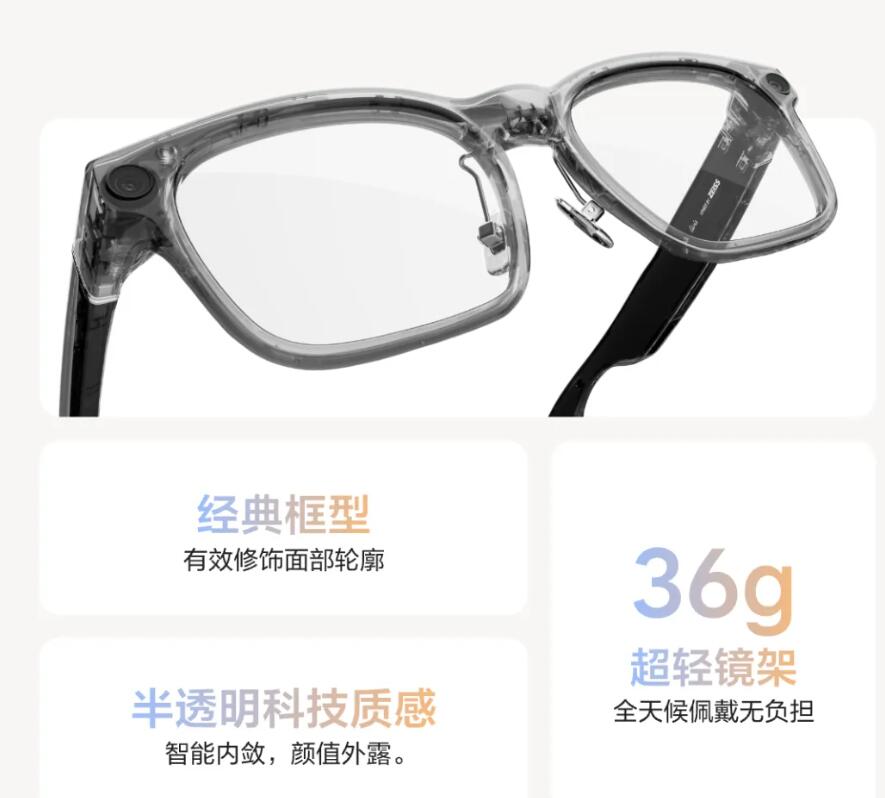
AsianFin -- Li Auto Inc. on Wednesday officially launched Livis, its first artificial intelligence (AI) smart glasses, priced at RMB1,999 ($238) with a post-subsidy price of RMB1,699, becoming the first automaker to enter the AI glasses field. The move marks a significant shift as automakers seek to expand beyond high-value, low-frequency vehicle sales into smart wearable devices to secure new user touchpoints and traffic entry points. Weighing just 36 grams with an 18.8-hour battery life and standard Zeiss lenses, the product positions Li Auto at the intersection of automotive intelligence and wearable technology.
Credit:Li Auto
The December 3rd launch comes as China's consumer AI/augmented reality(AR) market surges, with third-quarter 2025 sales jumping 186% year-on-year, according to CINNO Research. Screenless AI glasses have performed particularly well in this expanding market. Li Auto CEO Li Xiang stated that the team began researching smart glasses two years ago, officially launching product development in 2024 after finding existing products from brands like Meta unsatisfactory. The product name "Livis" pays homage to Jarvis, the AI assistant in Iron Man.
Fan Haoyu, Senior Vice President of Li Auto, described the AI glasses as a natural extension of Li Auto's intelligent experience from in-car use to all-day user companionship. The product is equipped with Li Auto's self-developed MindGPT-4o multimodal large model and the upgraded "Li Auto Assistant," which has already served nearly 1.5 million car owners and executed hundreds of millions of commands.
The cross-industry move reflects urgent challenges facing automakers: long repurchase cycles and low repurchase rates necessitate finding new ways to strengthen brand exposure and continuously engage users. Li Auto positions Livis as a "wearable robot," part of its embodied intelligence strategy alongside its vehicles, forming a complete ecosystem.
Technical Specifications and Automotive Computing Integration
The Livis glasses adopt a mainstream form factor focused on image recording and voice interaction rather than optical displays. The product features a 12-megapixel lens with 105° ultra-wide-angle shooting and EIS electronic image stabilization. All models come standard with high-quality Zeiss lenses and are available in multiple versions, including refractive, photochromic, and sunglasses styles.
Li Auto leverages its automotive computing advantage to differentiate from competitors. The Li Auto L6 Max includes two Orin X chips delivering 508 TOPS of computing power. For complex functions like map navigation and AR scene interaction, the glasses can offload data processing and calculations to the in-vehicle computing platform, creating a "lightweight glasses interaction plus deep automotive computing" division of labor.
The product runs on Li Auto's self-developed Livis OS embedded operating system and WearLink Realtime Audio communication system. With MindGPT-4o model support, question-and-answer wake-up speed reaches 300ms, and end-to-end execution response time hits 800ms. For vehicle-to-everything integration, users can voice-command the "Li Auto Assistant" to control functions like air conditioning, steering wheel heating, and tailgate operation.
Li Auto addressed the industry's weight-battery-performance dilemma by limiting frame weight to 36 grams while achieving 18.8-hour continuous operation in simulated daily use scenarios and 78-hour standby battery life. The system adopts a never-shutdown strategy with background processes always on standby. The glasses include a wireless charging case and Type-C charging port.
Strategic Partnership and Distribution Strategy
On December 2nd, Li Auto announced a strategic partnership with Zeiss, initiating global technology and market collaboration. The partnership extends beyond the domestic market to jointly develop next-generation smart glasses optical technology. Zeiss lenses cover plano, blue light blocking, photochromic, and refractive lenses for myopia and hyperopia, meeting daily wearing and driving needs.
The companies created an online glasses ordering service allowing users to upload prescriptions, complete orders, and receive glasses the same day. Li Auto stated the collaboration makes premium optical experiences accessible to users.
During the initial sales period through December 31st, Li Auto offers a 15% national subsidy. Users can order through the Li Auto App store and the official Li Auto smart glasses flagship store on JD.com. From mid-to-late December, Livis will also be available at Zeiss's official flagship stores on Tmall and JD.com, as well as officially authorized Zeiss partner stores.
Market Competition and Brand Recognition Challenges
Despite high product completion, Li Auto faces significant market challenges. Competition is fierce, with Xiaomi's AI glasses starting at RMB1,999 and Alibaba's Quark AI glasses priced as low as RMB1,899. The market shows signs of companies vying for dominance before achieving sufficient scale.
Automakers and internet giants share similar strategies in securing market position before the next terminal revolution, but their user bases differ significantly. Internet giants boast tens or hundreds of millions of users, while automakers have relatively smaller customer bases. Li Auto lacks traditional advantages in consumer electronics despite positioning Livis as a "wearable robot" offering independent user experience without in-car systems.
Consumer acceptance of smart glasses from a car brand remains uncertain. As functionality expands, potential conflicts in interaction logic between in-car systems and glasses will pose challenges. Cross-device function calls and redundant computing power handling concurrent tasks represent technical hurdles Li Auto must overcome.
Google has initiated two AI glasses projects entering the POC stage, with industry insiders predicting potential release in fourth-quarter 2026. Domestic players including Baidu, Bolon, and Meizu are expected to launch AI glasses in the fourth quarter, intensifying competition in the rapidly expanding market.