

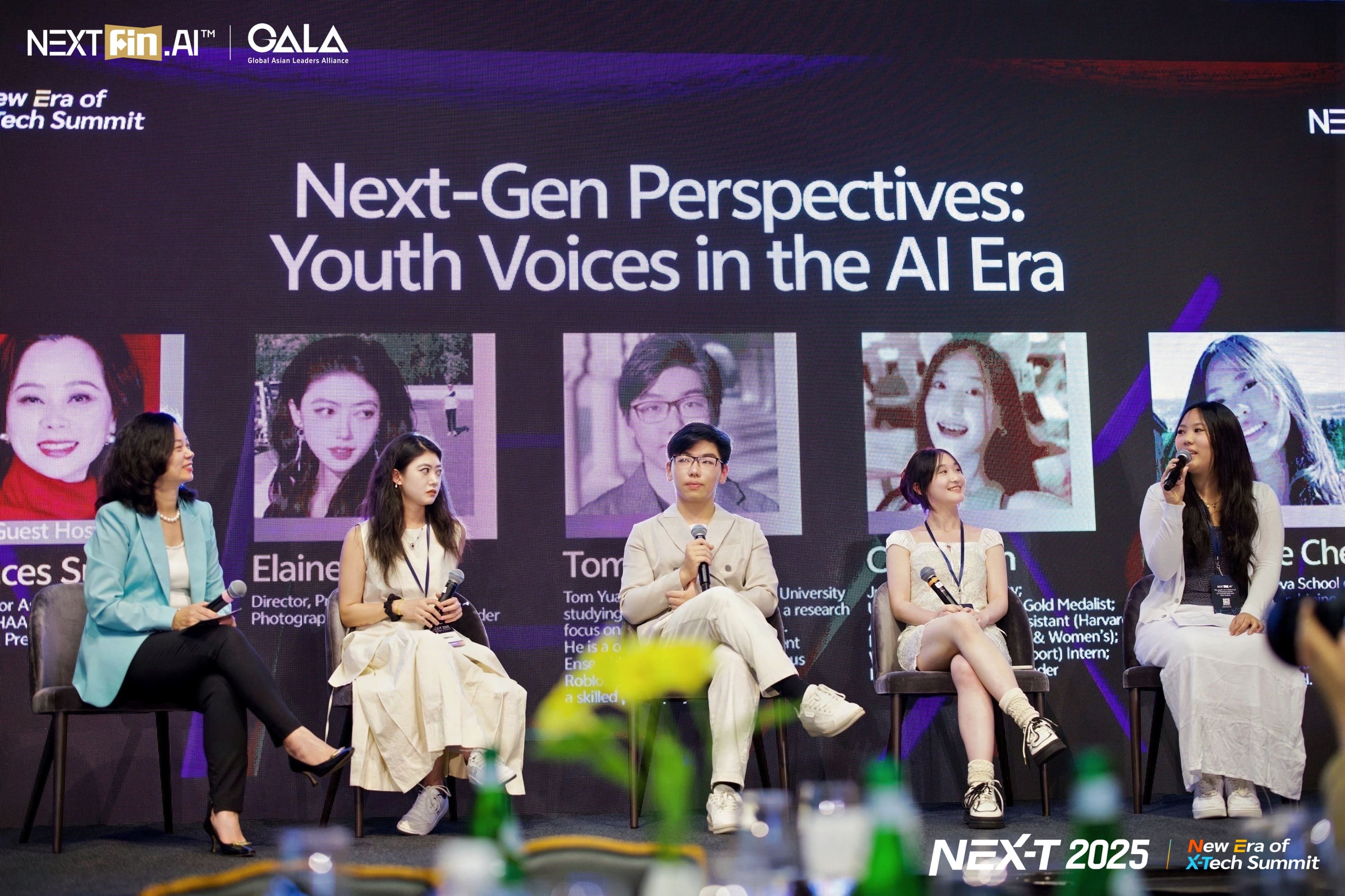
Artificial intelligence (AI) could play a crucial role in reducing wars and conflicts, said Tom Yuan, a Stanford University computer science junior, at the NEX-T Summit 2025 hosted by NextFin.AI and Global Asian Leadership Alliance (GALA) at Stanford University in Silicon Valley.
The NEX-T Summit has established a Youth Board that embodies global vision, courage, and a strong sense of mission to inspire leadership among the new generation of Asians. It attracts young representatives from top universities, secondary schools, and innovation institutions around the world, aiming to spark fresh thinking and action, and to advance innovation and human co-development in the era of AI.
At the panel "Next-Gen Perspectives: Youth Voices in the AI Era" on September 27, he joined discussions with Elaine Du, a director, producer, actor, photographer, athlete and founder; Cindy Ren, a junior at Tabor Academy; and Catherine Chen, a sophomore at the Nueva School.
Yuan, also the builder of the world's first RL agent ensemble for Roblox Playtesting, argued that wars often do not arise when one side is decisively stronger than the other, but take place when one party misjudges its opponent's strength. Yuan noted that if humanity could build an AI world model that remains neutral, accurate, and efficient, it might prevent such miscalculations — and in doing so, help eliminate many wars.
"I think AI could help reduce the number of wars and battles," said Yuan. He paused briefly before elaborating, "Think about it this way — when does war really happen? It doesn't happen when one side is clearly stronger and both know it. War happens when one side underestimates the other. If we could build an AI world model that's neutral, accurate, and efficient, it might eliminate those misjudgments — and with it, many wars."
Yuan's reasoning underscores a deeper optimism — that intelligence, when detached from human ego and bias, could become a stabilizing force in geopolitics. His vision of AI as a neutral arbiter capable of preventing conflict painted a striking picture of a future where machines serve as instruments of peace rather than division.
Yuan’s main concern is the blurring line between AI‑generated and human‑created content, which he warned could undermine fields like journalism and clinical reporting and hamper how future AI models are trained.
He hopes to develop new techniques to identify the sources of text data. If AI could solve one global problem, he chose reducing the risk of war by helping nations simulate conflict outcomes before choosing violence. And on whether AI will surpass human intelligence, he answered “Yes.”
Ren, a U.S. Biology Olympiad Global Gold Medalist and Alzheimer's researcher at Harvard Medical School's Brigham & Women's Hospital, offered her take on humanity's other great battle — aging and disease.
"If AI could solve one big challenge, I feel like it would be longevity," she said. "I work in Alzheimer's, and it's heartbreaking, around 70% of senior deaths in the U.S. are related to cognitive disorders."
Ren, also an intern at Wovenly (Dementia Support) and a leader at Kindness Matters Inc., envisions a world where AI-powered digital twins — virtual replicas of human bodies and brains — could revolutionize medicine. "Imagine building a model of yourself where we can predict diseases before they happen, without invasive procedures," she explained. "That's the direction I believe AI in science should go — not just treating illness, but preserving human life and dignity."
Chen, also a member of the iSing Silicon Valley Choir, echoed that sentiment — but turned it toward the emotional and universal. "If I could solve one problem, it would be cancer or other serious diseases that still don't have a cure," she said. "Everyone knows someone who's suffered from it. Even with all our new resources, we still lose so many lives."
For Chen, who is passionate about combining neuroscience, psychology, and music to understand human behavior, AI's potential lies in humanizing technology — using data and computation to amplify compassion. "I think AI could help us find cures faster, but more importantly, it could help us understand the emotional side of illness — what patients feel and how they cope," she added.
She also pointed out a growing paradox among young people: fearing AI while depending on it. “We need to find a healthier balance,” she said. Her greatest hope is that AI can help cure deadly diseases such as cancer. Her answer to the question of AI surpassing human intelligence was also “Yes.”
Du, who has been experimenting with AI for cultural preservation, expanded the discussion beyond human biology to the preservation of human heritage. "My personal focus is culture and culture preservation," Du said. "We're using motion capture and AI to digitize local art craftsmanship — sewing, pottery, traditional symbols — from ethnic groups across China. Some of these are fading away, and AI helps us capture their beauty and meaning before they disappear."
Her project combines motion capture with AI-driven symbolic modeling, allowing users to recreate ethnic sewing patterns and pottery designs through an interactive interface. "You can type a word, and the system will generate patterns that follow the symbolic logic of that culture," she explained. "It makes art creation accessible while keeping it authentic."
Du highlighted two concerns: AI may widen the digital divide and weaken human memory and creativity. To help address education inequality, she is supporting a project that deploys “AI teachers” in rural areas where qualified instructors are scarce. She also worries ultra‑realistic AI‑generated images could erode our sense of authenticity and our ability to think independently.
Asked what major human challenge she hopes AI could solve, she chose poverty reduction — and expressed confidence that, with responsible use, AI can expand access to opportunities rather than restrict it. On whether AI will surpass human intelligence, she gave a firm “No.”
In a digital age often criticized for erasing nuance, Du's work illustrates how AI can protect diversity instead of flattening it by encoding cultural knowledge into living, creative systems.
But even as these young innovators described AI's transformative potential, they also voiced concerns about its pitfalls.
Ren raised the issue of ethical boundaries, especially in science. "AI could accelerate genetic engineering, but that brings risks," she cautioned, referencing the infamous 2018 gene-editing scandal involving CRISPR-modified babies in China. "Before we integrate AI into genetics or medicine, we need stronger ethical frameworks and regulations."
She also highlighted the growing digital divide, noting that children in rural or underprivileged areas have far less access to AI education. Through her nonprofit Kindness Matters Inc., Ren is developing an AI-powered literacy platform to help children learn to read and write their own stories. "We've collected over 300 children's books to build an adaptive reading system, like a personalized tutor," she said. "AI shouldn't widen inequality — it should close the gap."
She hopes AI can meaningfully extend healthy human lifespans — for example, by building “digital twin” models of the brain to predict disease development without invasive procedures. On whether AI will surpass human intelligence, she also answered “Yes.”
Yuan, meanwhile, touches on another modern dilemma: how to discern truth in an AI-saturated world. "It's getting harder to tell what text or image is generated by AI and what's not," he said. "That's a real problem for trust — in journalism, science, medicine. If we can't tell what's real, even training future AI models becomes risky."
He said the solution lies in better understanding how AI learns language. "When you train large models, you need high-quality data," he explained. "If AI starts training on AI-generated content, you end up in a feedback loop that erodes meaning."
Du added a philosophical layer, reflecting on AI's impact on memory and perception. "As a photographer, I worry about AI-generated images that look as real as photos," she said. "It changes how we form memories. If everything can be simulated, what happens to our sense of what's real?"
Amid these questions, the panel returned to what might be AI's greatest challenge — not just shaping the future, but ensuring that humans remain at its center.
"Philosophy is about finding meaning in life," Yuan said in a reflective tone. "AI might help us live longer, maybe even forever. But what's the point if we forget how to live meaningfully?"
The sentiment resonated across the conference. Whether they were coding neural networks, choreographing dances from brainwave data, or programming cultural preservation tools, these young voices shared a common belief: AI's true power lies not in replacing humanity — but in reminding us what makes us human.
In their hands, the future of AI looks less like a race toward automation and more like a collective effort to amplify creativity, empathy, and wisdom — values as timeless as the human spirit itself.
At the end of the forum, moderator Frances Sun praised the students’ maturity and sense of responsibility.
“You are already using AI with both depth and warmth,” she said. “Hearing your vision, I’m confident your generation will guide AI to serve humanity and advance society. When we one day pass the world to you, we’ll feel at ease knowing it is in good hands.”